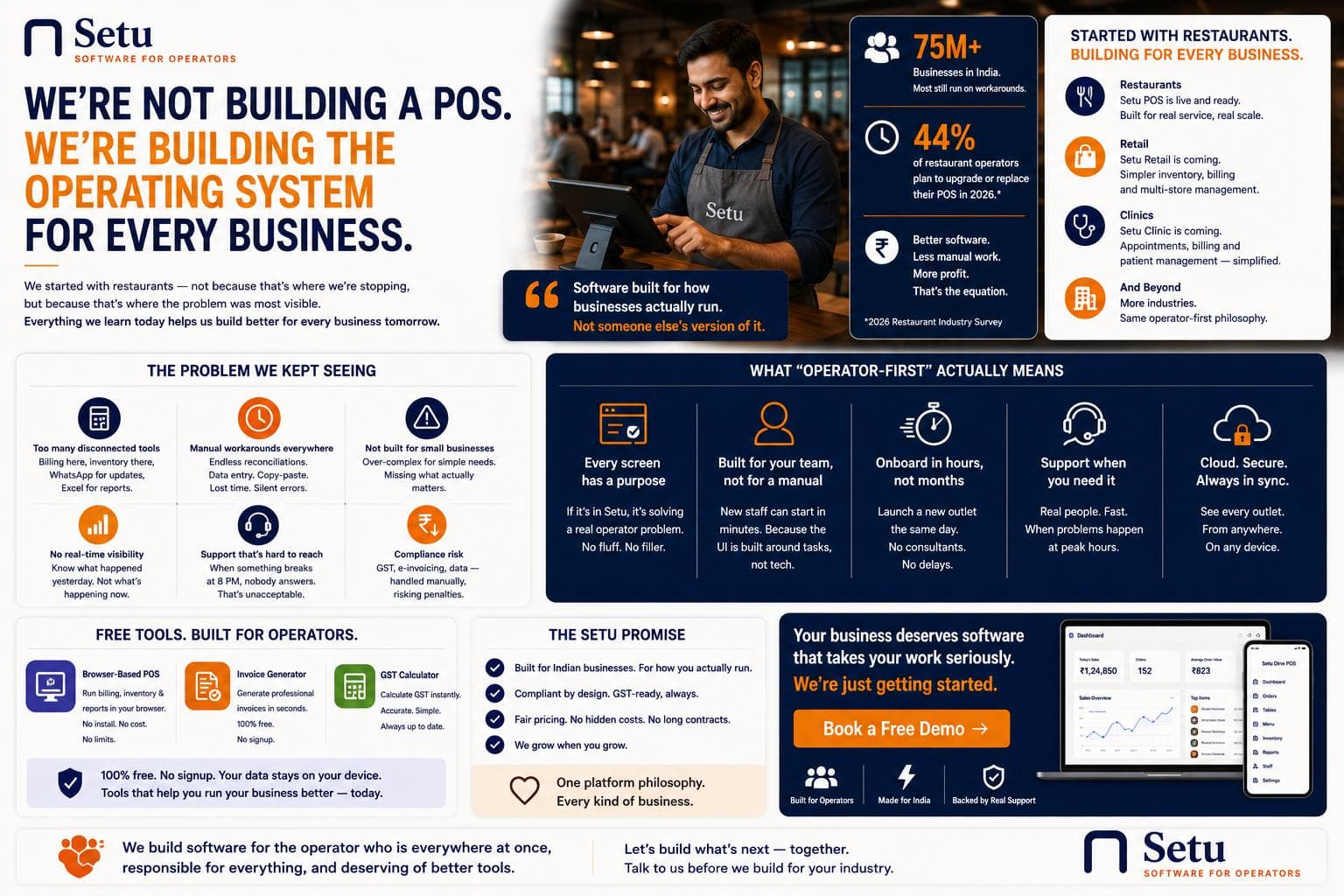
We're Not Building a POS. We're Building the Operating System for Every Business.
There's a joke in Indian business software: every product was built for a company three sizes larger than yours, in a country that doesn't have GST, with a team that actually reads the manual.
We built Setu because we stopped laughing at the joke.
Real businesses — the ones running 5 tables, 2 outlets, 3 staff — deserve software that takes them seriously. We started with restaurants. Not because that's where we're stopping. Because it's where the problem was most visible, most painful, and most solvable. Everything we learn from every restaurant using Setu today makes the next product — for retail, for clinics, for industries we haven't announced yet — better.
This is the story of why we build the way we do.
The Problem We Kept Seeing
Walk into any independent restaurant, retail shop, or clinic in India and ask the owner what software they use to run their business. The answer is almost always a combination: one app for billing, another for inventory, a WhatsApp group for staff coordination, a notebook for daily reconciliation, and an Excel file that only one person understands.
None of these tools were built for them. They were built for someone else's version of their business — usually larger, usually Western, usually more complex in the wrong ways and simpler in the ways that actually matter.
The result is that Indian business owners spend enormous energy working around their software instead of working with it. Every workaround is time. Every manual reconciliation is risk. Every tool that doesn't talk to another is a gap where mistakes quietly grow.
India has 75 million businesses. Most of them are still running on workarounds.
The software industry looked at this and called it a hard problem. We looked at it and called it the work.
Why We Started With Restaurants
We could have started anywhere. We started with restaurants because restaurants are the hardest environment to build for — and if we could get it right there, we could get it right anywhere.
Think about what a restaurant owner is managing at 8pm on a Friday:
Real-time billing across multiple tables. Kitchen orders routing to the right stations without getting lost. GST applied correctly on every bill — different rates for dine-in, takeaway, packaged items. Floor staff who need to know table status without interrupting the kitchen. Customers waiting, watching, comparing their experience to everywhere else they've eaten.
And if you have more than one outlet — which more restaurant owners do every year — multiply all of that by the number of locations, then try to see the full picture from a phone in your pocket while you're at home.
This is the environment Setu POS was built for. Not the calm, controlled demo version. The real thing — peak hour, multiple outlets, real staff, real customers, real GST.
Setu POS wasn't just our first product. It was our proof of concept for what operator-first software actually means in practice.
What "Operator-First" Actually Means
The phrase gets used a lot in software marketing. Here's what we actually mean by it.
It means every screen exists for a reason. If a feature is in Setu POS, it's there because a real restaurant owner was losing time or money without it. Not because it was on a competitor's feature list. Not because it made the product look more impressive in a deck. Every screen has a job, and that job belongs to a real person running a real business.
It means the software fits how your team works — not how we imagined they would. A new billing staff member at a restaurant using Setu POS can be placing orders within minutes. Not hours. Not after a training session. Minutes. Because the interface was designed around the task, not around the database structure behind it. That's a design philosophy, not an accident.
It means onboarding in hours, not months. Enterprise software companies talk about implementation timelines. We talk about getting you live. A new outlet should be up and running the same day, not three weeks after a consultant visit.
It means support that's reachable when it matters. Restaurant problems don't happen at 11am on a Tuesday. They happen at 8pm on a Friday, in the middle of service, with 15 tables occupied. When something goes wrong at that moment, the quality of support isn't a nice-to-have — it determines whether the service recovers or falls apart. Setu's support is built around that reality.
Operator-first is not a feature. It's a decision made at every step of how we build.
Where Setu Is Going
Setu POS is live and ready for restaurants. We're onboarding our first operators now — and everything we build into the product from here is shaped by how real restaurants actually run.
And we're building what comes next.
Setu Retail is coming — for the retail shop owner managing inventory, staff, and billing across locations, who is currently doing all of it across three different apps and a spreadsheet.
Setu Clinic is coming — for the clinic owner managing appointments, billing, and patient records, who has been told that healthcare software has to be complicated to be good.
And after that — more industries. Because the problem we're solving isn't a restaurant problem or a retail problem or a clinic problem. It's the same problem everywhere: software that was built for someone else.
The vision is one platform with a consistent philosophy — operator-first design, India-first compliance, real support — that works for any business that runs operations, manages staff, serves customers, and needs to know what's actually happening across its locations.
One company. One platform philosophy. Every kind of business.
The Invitation
If you're running a restaurant and you're tired of managing your business around your software — Setu POS is built for you.
If you're running a retail store or a clinic and you're thinking "I wish someone would build this properly for India" — we're building it. And we want to talk to you before we ship, not after.
Setu is building for the operator who is everywhere at once, responsible for everything, and deserving of software that takes that seriously.
We're just getting started. And we'd like to build it with you.
Frequently asked questions
Setu is building operational software for how businesses actually run — starting with restaurants and expanding to retail, clinics and beyond — rather than a single-purpose POS.