Table Turnover Time in 2026: Why Slow Dine-In Service Is Quietly Capping Your Restaurant's Revenue
Ask a restaurant owner about their numbers and they'll rattle off covers per day, average ticket size, food cost percentage, maybe even their Zomato commission rate. Ask the same owner how long a table sits between when a guest is seated and when it's reset for the next one, and most go quiet. Table turnover time is one of the least-tracked numbers in Indian dine-in restaurants — and one of the most directly tied to revenue.
You can't add more tables to a full dining room during a Friday night rush. But you can turn the tables you already have faster, safely, without rushing the guest experience. In 2026, with real estate costs up and dine-in margins tighter than delivery-heavy years, turnover speed has become one of the few levers owners can pull without spending on a bigger floor plan.
The table turnover math most owners haven't run
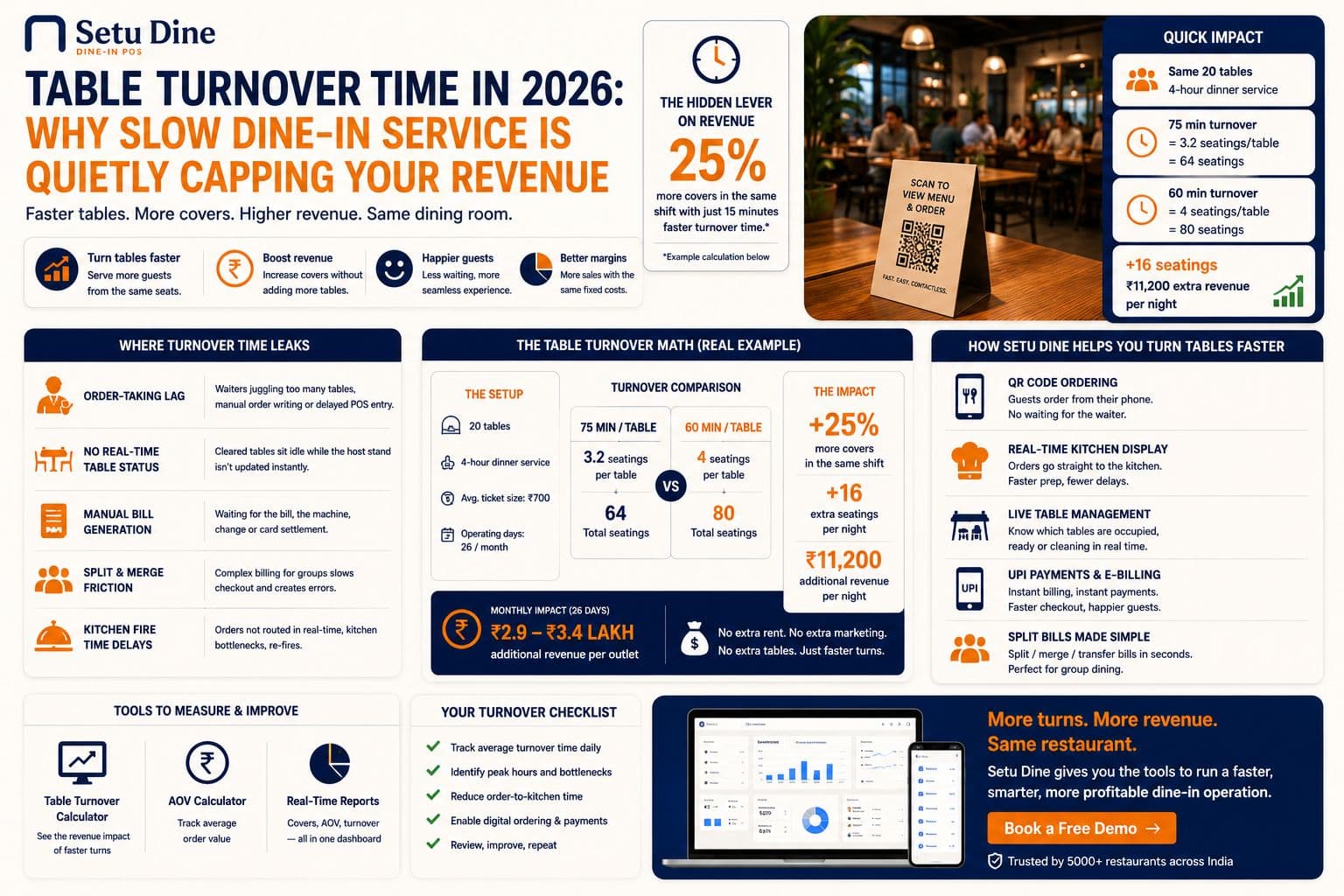
Take a mid-size dine-in restaurant with 20 tables, open for a 4-hour dinner service. If average turnover time is 75 minutes, that's roughly 3.2 seatings per table per service — about 64 seatings total. Shave 15 minutes off turnover time and it becomes 4 seatings per table, or 80 seatings. That's a 25% increase in covers served in the same shift, with the same floor space and largely the same staff.
Most of that 15 minutes isn't sitting in the kitchen. It's sitting in three places: the gap between a guest wanting to order and staff getting to the table, the gap between food being ready and it reaching the table, and — the biggest one in most Indian dine-in restaurants — the gap between a guest asking for the bill and actually paying and leaving.
What that 25% is actually worth
Run the same numbers in rupees and the case gets harder to ignore. At an average ticket size of ₹700 per cover, those extra 16 seatings a night are roughly ₹11,200 in additional revenue — from one dinner service, with zero additional marketing spend, zero additional rent, and no change to your food cost percentage. Multiply that across 26-30 operating days a month and a single outlet is looking at ₹2.9-3.4 lakh a month sitting inside its existing floor plan, unclaimed. For a 3-outlet operator, that's the difference between one location paying for itself and three.
This is also why turnover time deserves the same weekly attention as food cost percentage or covers-per-day. It's not a vanity metric — it's capacity you already own.
Where turnover time actually leaks
- Order-taking lag: A waiter juggling 6-8 tables during peak hours, writing orders on paper or keying them into a POS terminal at a fixed counter, adds 5-10 minutes before an order even reaches the kitchen.
- No real-time table status: If the host stand doesn't know a table is free the moment it's cleared, that table sits empty and unassigned while a queue builds at the door.
- Manual bill generation: Guests asking for the bill, waiting for it to be printed, then waiting again for change or a card machine, is still the single biggest checkout delay in Indian restaurants.
- Split and merge friction: Group tables that want separate bills, or two tables that get pushed together, are still a manual, error-prone process on a lot of legacy POS systems.
What changed in 2026: guests now expect self-serve
Two shifts have made this fixable in ways it wasn't three years ago. First, UPI is now the default payment method at the table, not a backup — India processed over 14 billion UPI transactions in a single month in early 2026, and guests increasingly expect to scan and pay without waiting for a card machine to be walked over. Second, QR-code ordering and digital menus have gone from novelty to baseline expectation, especially with younger diners who'd rather scan a code than flag down a waiter.
Restaurants that have built both into their table workflow — QR-to-order, QR-to-pay, real-time table status on a host screen — are seeing turnover times drop without adding staff. Restaurants still running paper KOTs and a single billing counter are the ones losing the most covers during peak hours, even when their food and service are genuinely good.
How this shows up across POS choices
Most Indian restaurant POS platforms treat table management as a checkbox feature rather than the core workflow it actually is. Petpooja offers table and waitlist tools that work reasonably well for single-outlet and small chains, but table-state visibility across a busy floor is still largely manual. Restroworks (formerly POSist) is built for enterprise chains — strong on central kitchen and multi-brand operations, but heavier than most single-location or small-chain owners need, and table-turnover isn't where it differentiates. Gofrugal's customer-facing layer — QR ordering, waiter handhelds, guest-facing payment — tends to feel dated next to POS systems built specifically for how 2026 dine-in service actually runs.
The gap isn't features on a spec sheet. It's whether table status, order flow and payment are one connected system a host and waiter can see in real time, or three separate steps stitched together with manual updates.
How to measure it before you buy anything
You don't need new hardware to get a first read on this. Pick your busiest 90 minutes over the next two services, and have a manager or shift lead log two timestamps for 10-15 tables: when the guest is seated, and when the table is cleared and reset. Average the gap. Most owners running this exercise for the first time are surprised by how much of that number has nothing to do with the kitchen — it's the order-taking delay and the checkout delay stacking on top of each other.
Once you have a baseline, the fix usually isn't "hire more waiters." It's removing the manual handoffs between seating, ordering, kitchen and billing that a stopwatch can't see but a guest can feel.
A compliance note that's easy to miss
2026's e-invoicing rules add a smaller but real reason to fix a slow, manual billing counter. GSTN has tightened validation on e-invoices and e-way bills this year, and multi-outlet groups above the e-invoicing turnover threshold now need clean, real-time billing data per outlet — not end-of-day reconciliation from handwritten or disconnected bills. A POS that generates GST-compliant invoices at the table, in real time, isn't just faster for the guest — it's one less place for compliance errors to creep in during a busy service.
What to look for in a POS if turnover time is the goal
- Real-time table status visible to the host stand the second a table is cleared, not after someone manually updates it.
- Waiter handhelds or tableside QR ordering so orders hit the kitchen in seconds, not minutes.
- UPI and card payment at the table — guests pay and leave without waiting for a printed bill and a card machine to arrive.
- One-tap split and merge billing that doesn't require voiding and re-entering an order.
- Kitchen display integration so ticket times are visible and bottlenecks get caught before they compound during a rush.
Where Setu Dine fits
Setu Dine was built around this exact loop — table status, order-taking, kitchen routing and billing as one connected workflow, not four separate tools bolted together. Multi-outlet owners get real-time table and turnover visibility across every location from a single dashboard, GST-compliant billing with UPI built in, and split/merge billing that doesn't slow staff down during peak hours. It won't make your kitchen cook faster, but it removes almost every non-kitchen minute currently sitting between a guest wanting to leave and actually leaving.
If you haven't measured your own average table turnover time, it's worth doing before your next Friday night rush — even a rough stopwatch estimate across a handful of tables will usually reveal where the real bottleneck sits.
Frequently asked questions
It's the average time a table is occupied by one party, from seating to the table being cleared and ready for the next. Lower turnover time means more covers served in the same seats over a shift.
More from Dine-In Ops
The Real Cost of Making Diners Wait: Queue Management in 2026
A queue outside looks like proof you're popular. Past a certain wait it is just guests deciding to eat elsewhere — and each one is a table you paid for sitting empty. Here's what making diners wait actually costs in 2026, and how to measure and fix it.
Read more →