Restaurant Inventory Leakage in 2026: Why 8–12% of Your Food Purchases Are Disappearing (And How to Plug It)
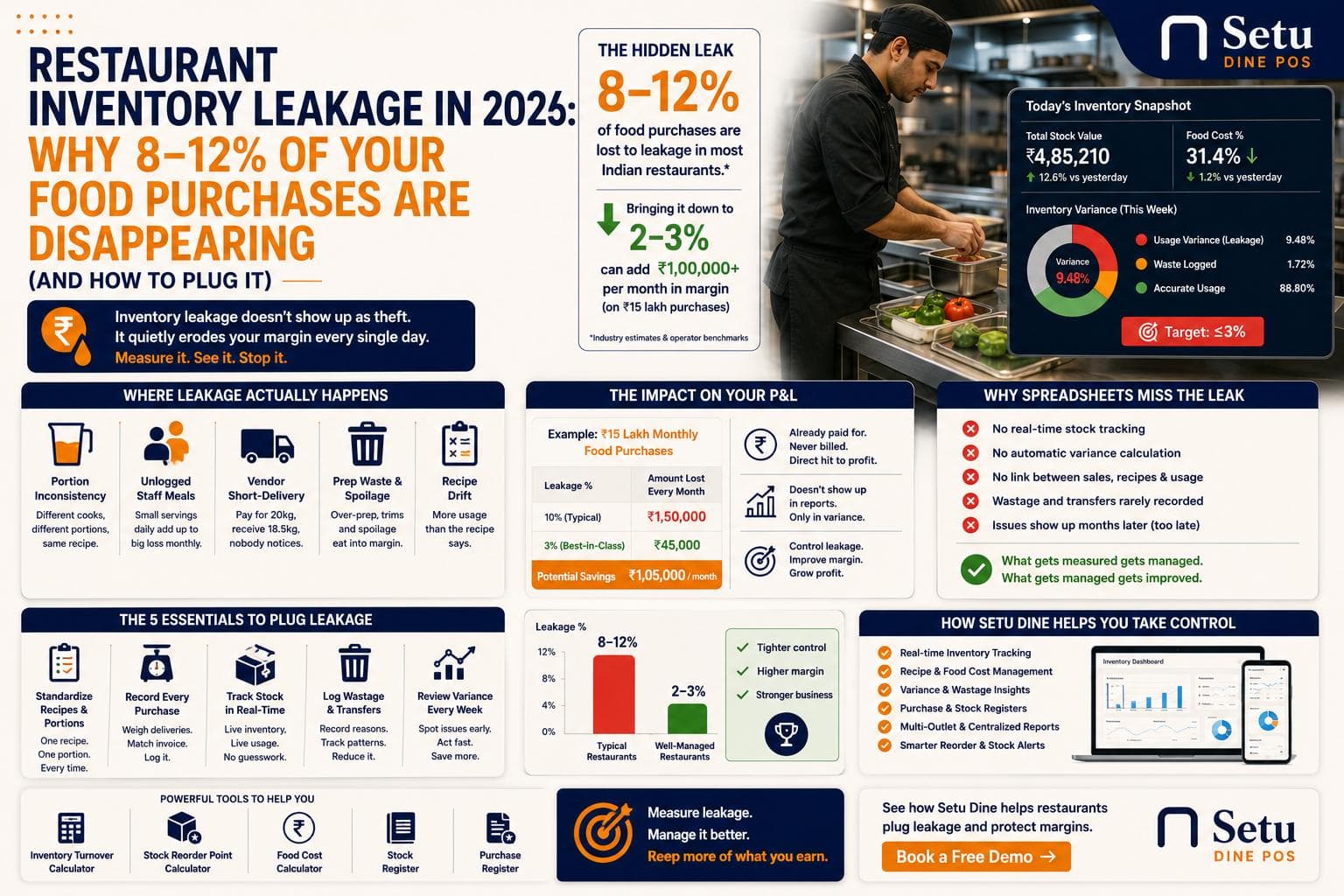
Ask any restaurant owner what their food cost percentage is, and they'll answer without blinking — 28%, 32%, 35%, whatever it is. It's the number they watch most closely. What almost none of them can answer is a different question: how much of that food cost is leakage — ingredients bought, paid for, and never actually turned into a billed dish.
Industry estimates put restaurant food waste at 4–10% of purchases globally, with food waste alone accounting for roughly 14% of total restaurant expenses. In India, where inventory is still tracked on a stock register or a spreadsheet at a meaningful share of outlets, that gap runs wider — inventory shortfalls of 8–12% of total food purchases are common once you actually measure them, and properly tracked kitchens bring that down to 2–3%. On a restaurant doing ₹15 lakh a month in food purchases, the difference between 10% leakage and 3% leakage is over ₹1 lakh a month — money that never shows up as theft, never shows up as a single dramatic loss, and just quietly isn't there at bill-close.
Zoom out and the scale gets harder to ignore. India wastes an estimated 78–80 million tonnes of food a year — roughly ₹1.55 lakh crore — even as a large share of the population remains undernourished. Restaurants aren't the biggest contributor to that number, but they're one of the few links in the chain where the waste is directly tied to a business's own P&L rather than someone else's. Every kilogram that leaks out of a kitchen unbilled was paid for out of that restaurant's own cash flow, at that restaurant's own margin.
Where the leakage actually happens
Leakage rarely comes from one obvious place. It accumulates from several small, boring sources that are each individually easy to wave off:
- Portion inconsistency — different cooks pouring different amounts of the same ingredient into the same dish, especially across shifts or outlets.
- Unlogged staff meals — every restaurant feeds its staff, and most don't record what that actually costs against inventory.
- Vendor short-delivery — paying for 20kg and receiving 18.5kg, unnoticed because nobody weighs deliveries against the invoice every time.
- Prep waste and spoilage — trims, over-prepped batches, and produce that turns before it's used, especially for outlets prepping a full day's stock in advance.
- Recipe drift — the recipe on paper says one thing; the kitchen has quietly been using more of an ingredient for months because nobody re-costed it after a menu tweak.
None of these look like theft. Most of them aren't. They're the accumulated effect of nobody having a system that catches small variances before they become a monthly pattern.
Why a stock register or spreadsheet can't catch this
A manual stock register tells you what was purchased and, if someone remembers to update it, what's physically left at month-end. It cannot tell you what should be left, because it has no idea how much of each ingredient each dish is supposed to consume. Without that link between recipe and stock, a manual system can only ever report the wastage after the fact — as a vague gap between opening stock, purchases, and closing stock — with no way to say whether it came from the kitchen, the counter, the vendor, or the walk-in fridge.
By the time an owner notices margins are off, a full billing cycle or more has already passed, and the specific shift, dish, or vendor responsible is impossible to trace back. The leak isn't closed — it's just noted, and it repeats next month.
The problem multiplies across outlets
Single-outlet owners at least have the option of walking the kitchen floor and eyeballing the problem. Multi-outlet operators don't have that luxury. Without a system that reports variance outlet-by-outlet, leakage at a single underperforming branch simply gets averaged into the group's overall food cost percentage and disappears from view entirely. A chain running five outlets at 4% leakage and one at 14% will show a blended number that looks perfectly normal — until the owner finally isolates that one branch and finds a manager who's been letting portioning slide for months, or a vendor relationship nobody's audited since the outlet opened. This is exactly why a multi-outlet dashboard that breaks food cost and variance down per location, not just company-wide, matters as much for margin protection as it does for sales reporting.
What proper inventory tracking actually looks like
The restaurant POS category has largely converged on the same answer to this problem, even if the depth varies. Petpooja's inventory module ties stock to recipes for item-wise auto-deduction, with low-stock alerts and day-end inventory reports so gaps surface daily instead of monthly. Restroworks takes a similar cloud-based, real-time approach, positioning inventory visibility as a core part of reducing waste rather than a bolt-on report. The pattern across serious systems is consistent:
- Recipe-linked auto-deduction — every billed dish automatically deducts its exact ingredient quantities from stock, so the system always knows what stock should be, not just what was purchased.
- Day-end variance reports — actual closing stock compared against expected closing stock, every single day, not once a month.
- Low-stock and reorder alerts — so purchasing decisions are based on real consumption, not guesswork or a manager's gut feel.
- Vendor reconciliation — matching what was invoiced against what was actually received, at the point of delivery.
This is the same operating principle behind Setu Dine's inventory and reporting layer: every dish that goes out the door is linked back to what it should have consumed, so the day-end variance report tells an owner exactly where a gap opened up — not just that one exists.
A 30-day plan to plug the leak
You don't need to overhaul your entire kitchen to start closing this gap. A focused 30 days gets most of the way there:
- Week 1 — Audit and re-cost. Pull your top 15–20 dishes by volume and re-verify the recipe quantities against what the kitchen is actually using today. Recipe drift is usually worse than owners expect.
- Week 2 — Turn on recipe-linked deduction. If your POS supports it and it isn't switched on, this is the single highest-leverage change you can make — it converts every bill into a live stock update.
- Week 3 — Log staff meals and start weighing deliveries. Two habits, near-zero cost, that close two of the most common leakage sources outright.
- Week 4 — Review the first full day-end variance reports. Look for patterns by shift, by dish, and by vendor — not just the total number.
Owners running a single outlet can usually do this audit themselves over a weekend. Owners running three or more outlets should expect the first variance report to be uncomfortable reading — it's common for one branch to be carrying most of the group's leakage while the others look fine, simply because nobody had visibility down to that level before.
None of this requires new hardware or a kitchen redesign. It requires the recipe-to-stock link to actually exist in your system, and the discipline to look at the variance report daily instead of only when margins feel off.
Food cost is the second-biggest line on most restaurant P&Ls after rent and staff. A 5–7 percentage point improvement in leakage doesn't come from negotiating harder with vendors or raising menu prices — it comes from finally being able to see where the food is actually going.
None of this shows up as a single line item you can point to and fix in one afternoon. That's exactly why it survives so long in restaurants that are otherwise well run — it's not a crisis, it's a slow leak, and slow leaks don't trigger alarms. They just show up, quarter after quarter, as margins that never quite match what the menu pricing says they should.
Frequently asked questions
Around 8–12% of food purchases commonly disappear to over-portioning, spoilage, theft and unrecorded wastage — a leak that lands straight on margin because you've already paid for the stock.
More from Inventory Ops
Catching Supplier Price Creep: A Purchase Variance Walkthrough
Nobody announces a price rise. One line moves a few rupees, the total still looks right, and six months later your margin is two points thinner. A worked eight-line variance example, the three ways it misleads you, and what to do with the answer.
Read more →
Setu Stock Register vs Zoho Inventory: Which Fits a Small Shop in 2026?
Zoho Inventory is a proper order-and-inventory platform that starts free and then prices by how many orders you push through it. Setu's Stock Register is a free browser tool with no order cap. Here's which trade makes sense for your shop in 2026.
Read more →