Restaurant Customer Retention in 2026: Why Chasing New Diners Is Quietly More Expensive Than Keeping the Ones You Have
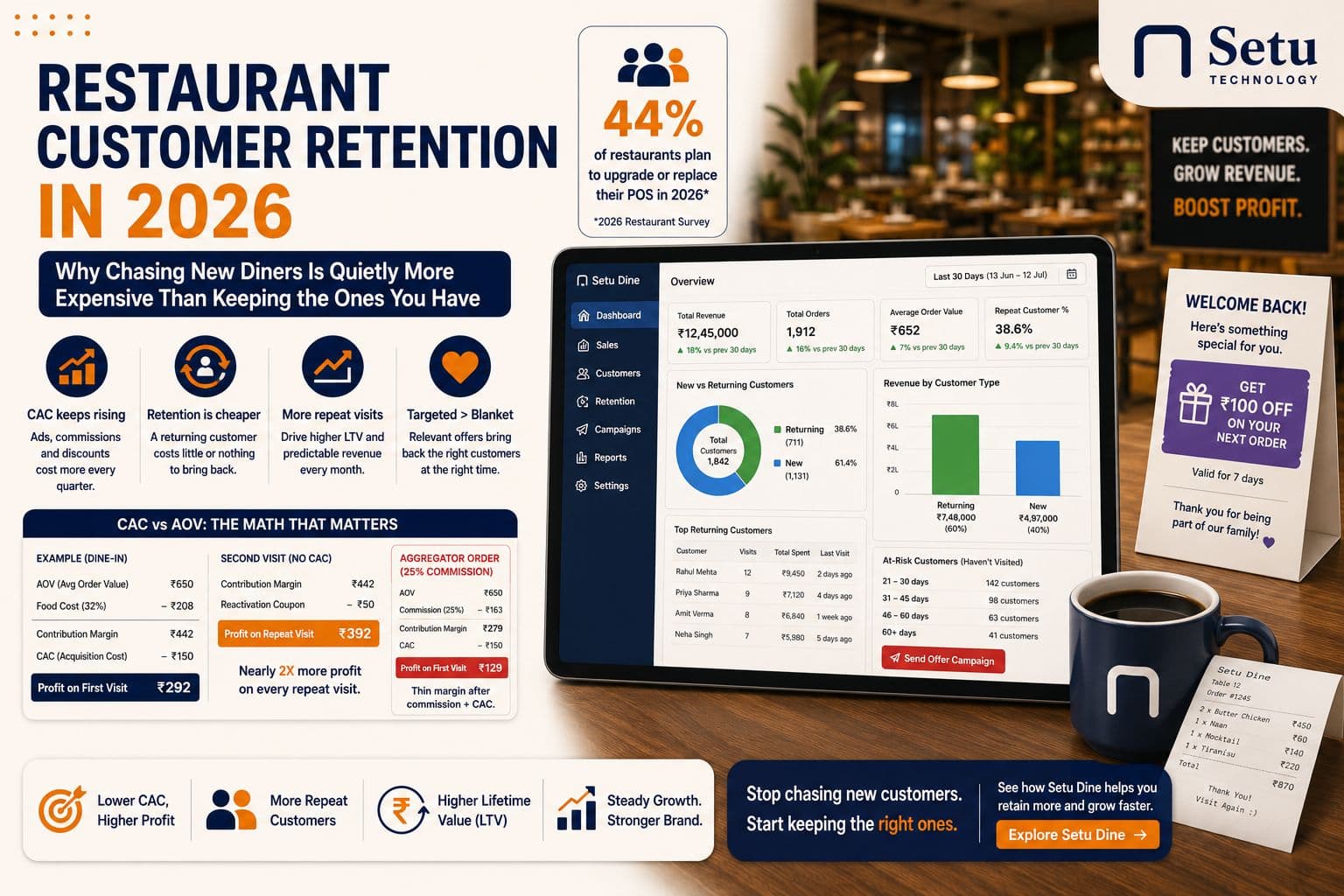
Ask a restaurant owner how much they spent last month trying to bring in new customers — aggregator ads, a boosted Instagram post, a first-order discount code — and most can quote a number without blinking. Ask the same owner what percentage of last month's covers were repeat customers, and the room goes quiet. Not because retention doesn't matter to them. Because almost nobody is actually tracking who came back and who ordered once and disappeared.
In 2026, with aggregator ad costs and platform fees climbing every quarter and dine-in customer acquisition getting more expensive across every channel, that blind spot is no longer a rounding error. It's the difference between a restaurant that's genuinely growing and one that's spending harder every month just to stand still.
The math most restaurants aren't running
Two numbers matter here, and almost no owner tracks both together: customer acquisition cost (CAC) — what it actually costs to bring in one new paying customer — and average order value (AOV) — what that customer spends once they're in. Owners who do check these numbers usually check them separately, in different spreadsheets, months apart. The two only tell you something useful when you look at them side by side, against how often a customer actually comes back.
Setu's free Customer Acquisition Cost Calculator and Average Order Value Calculator are built to answer exactly this — plug in your ad and offer spend against new customers acquired, and your total revenue against total orders, and you get both numbers in under a minute. Most owners running this for the first time are surprised by how thin the margin is on a single first-time order once acquisition cost is netted out.
A worked example
Take a mid-sized casual dining outlet with an average ticket of ₹650 and a food cost around 32% (₹208 per order). Say the restaurant spends ₹45,000 a month across aggregator ads, boosted posts and first-order discount codes, and that spend brings in 300 new customers — a CAC of ₹150 per customer.
On a dine-in order, contribution margin before overhead is roughly ₹442 (₹650 minus ₹208 food cost). Subtract the ₹150 CAC and the restaurant nets about ₹292 profit on that customer's first visit. If the same order came through an aggregator at a 25% commission (₹163), contribution drops to roughly ₹279 before CAC, and to ₹129 after it — a genuinely thin margin for all the work of getting that customer through the door once.
Now the same customer returns a second time. There's no CAC to pay again — at most, a small reactivation nudge, say a ₹50 coupon sent to a customer who hasn't ordered in three weeks. Contribution on that visit works out to roughly ₹229–392 depending on channel, nearly double the first-visit profit, for a fraction of the acquisition spend. A customer who visits six times in a year is worth several times more than the first-order math alone suggests — but only if the restaurant can actually identify them and give them a reason to come back.
Why 2026 makes this math worse for new-customer chasing
Aggregator advertising slots, boosted placement and sponsored listings have all gotten more competitive and more expensive through 2026, on top of standard commission. Commonly cited industry estimates put the cost of acquiring a new customer at several times the cost of retaining an existing one across retail and hospitality — the exact multiple varies by category, but the direction is consistent every year this gets measured. For a restaurant already absorbing 25–30% aggregator commission, spending harder on new-customer ads to compensate for a shrinking repeat base is usually the wrong lever to pull.
What actually brings customers back
Blanket discounting — 20% off for everyone, every Tuesday — is the default move for most restaurants trying to drive repeat visits, and it's usually the most expensive way to do it, because it discounts customers who would have come back anyway. What tends to work better:
- Recognition. A regular being greeted by name or remembered order costs nothing and is consistently cited as a reason customers keep returning to a specific outlet over a nearby alternative.
- Consistency. A dish that tastes different every third visit erodes trust faster than almost anything else — this is part of why keeping recipe costs and portions standardized matters beyond just margin protection.
- Timely, targeted offers — a coupon sent to someone who hasn't ordered in three weeks, not a discount blasted to your entire customer list regardless of when they last visited.
- Speed and reliability at the table or counter, so the experience that earned the first visit doesn't quietly degrade on the second or third.
Where Setu Dine's customer management and coupons fit
Most independent restaurants don't have a separate CRM tool, and most owners don't want to run one — it's one more login, one more export, one more thing that falls out of date. Setu Dine builds a customer profile automatically as people order — visit frequency, average spend, last visit date — without any extra data entry from staff. Coupons and promotions run from the same system, so a targeted ₹50 reactivation offer to someone who hasn't ordered in three weeks is a few taps, not a separate marketing tool bolted on top of the POS.
The point isn't to automate discounting. It's to make it possible to tell the difference between a customer who needs a nudge to come back and one who was going to order again regardless — and stop discounting the second group by default.
How this compares across POS platforms
Petpooja offers customer database and basic loyalty tooling, generally functional for single-outlet operators tracking repeat visits at a high level, though deeper segmentation (by days-since-last-visit, for instance) typically needs a bolt-on CRM. Restroworks (POSist) has stronger customer analytics as part of its enterprise suite, but that depth is built and priced for chains running loyalty programs across dozens of outlets, not a two or three outlet operator trying to run a simple reactivation coupon. Gofrugal, with its retail-first roots, covers basic customer tracking but loyalty and targeted offers are generally a secondary feature relative to inventory and billing. None of this makes any of them a bad choice — it just means retention tracking often ends up manual or skipped entirely, regardless of which POS is running the counter.
A simple weekly retention check
You don't need a full loyalty program to start. Four numbers, checked weekly, catch most of what matters:
- Repeat cover percentage — what share of this week's covers were customers who'd ordered before, versus first-time.
- Days-since-last-visit segments — how many customers are 2–3 weeks dormant and due for a nudge, versus genuinely lapsed.
- Coupon redemption rate — whether reactivation offers are actually being used, not just sent.
- AOV of repeat vs. new customers — repeat customers typically order more confidently and add more to a ticket once they know the menu; if that's not showing up in the data, something in the experience isn't building trust.
Two mistakes that undo retention efforts
The first is discounting everyone the same amount, regardless of visit history. A blanket offer sent to your entire customer list costs the same whether it reaches someone who was already planning to order or someone who genuinely needed the nudge — and only the second case is real incremental revenue.
The second is never closing the loop after the first visit. A first-time customer who has a good experience and hears nothing from the restaurant again has no particular reason to think of it next time they're deciding where to order. A single well-timed message or coupon in the two to three weeks after a first visit is usually enough to meaningfully lift second-visit rates, and it's the step most restaurants skip entirely.
Where this fits with the rest of your operations
Retention doesn't sit in isolation from the rest of the numbers on your P&L. It connects to per-outlet performance tracking, since a location with a low repeat rate is often the same one quietly underperforming on revenue per cover, and to menu profitability, since the dishes worth pushing in a reactivation coupon should be the ones that are actually profitable, not just popular.
You don't need a data science team to start acting on this. You need to know, this week, what share of your covers were repeat customers, and whether the ones who haven't ordered in three weeks got a reason to come back. That's a five-minute check, not a quarterly project — and it's usually worth more than another rupee spent chasing a customer you've never seen before.
Frequently asked questions
Yes. A returning customer costs little or nothing to bring back, so contribution on a repeat visit is often nearly double the first visit — where you've already paid the acquisition cost.
More from Operations
Setu vs Marg ERP: Free Tools or a Licensed Retail ERP in 2026?
Marg ERP editions are publicly listed from about ₹5,550 to ₹26,000 exclusive of tax in October 2026, and the listings disagree on whether that is yearly or one-time. Setu's retail tools are free browser pages. Here is exactly where the line falls.
Read more →
Setu vs Swipe: Free Invoicing Tools or a Billing Account in 2026?
Swipe's paid plans start near ₹2,542 a year excluding GST as publicly listed in October 2026, and it keeps a free app tier. Setu's invoicing tools are free browser tools with no account and no sync. Here is exactly where the line between them falls.
Read more →
Setu vs myBillBook: Counter Billing and Stock for a Small Shop in 2026
myBillBook puts billing, stock and khata in one paid account, listed from ₹3,490 a year with a trial but no permanently free tier. Setu's billing, stock register and ledger tools are free with no cap. Here is how to tell which trade fits your shop.
Read more →
Setu vs Refrens: Quoting and Invoicing for a Service Business in 2026
Refrens is a real quote-to-payment platform for Indian service businesses, free to 15 documents and priced from ₹7,080 a year after that. Setu's quotation and invoice tools are free with no cap. Here is how to tell which trade fits your business.
Read more →