Zomato & Swiggy Menu Pricing in 2026: Why the Same Price as Dine-In Is Quietly Eating Your Margin
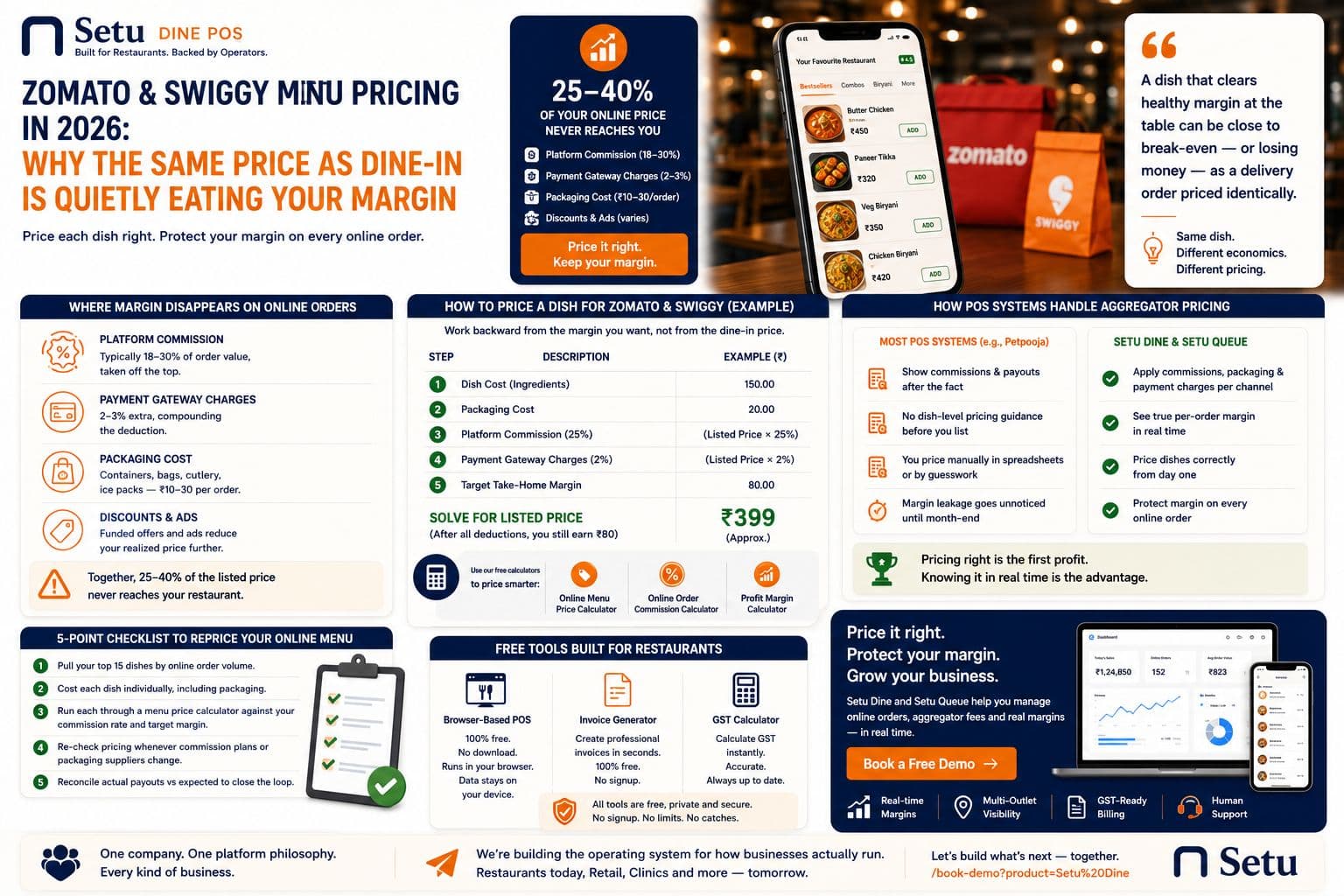
Walk into most restaurants in India and ask how they priced their Zomato or Swiggy menu, and the answer is usually the same: they copied the dine-in menu, maybe added a few rupees, and uploaded it. It feels reasonable — a butter chicken is a butter chicken whether it's eaten at a table or delivered in a box. The problem is that the cost of serving it isn't the same at all, and that gap is exactly where online order margin quietly disappears.
By the time platform commission, payment gateway charges, packaging cost and periodic platform discounts are netted out, a dish that clears a healthy margin at the table can be close to break-even — or losing money — as a delivery order priced identically. Most owners only notice this in the aggregate, as a vague sense that "online orders don't feel as profitable," without ever pricing a single dish to find out by how much.
Dine-in price ≠ online price, and the gap is bigger than owners think
A dine-in bill absorbs its costs cleanly: food cost, staff, rent, utilities, done. An online order absorbs all of that plus a layer of aggregator-specific costs that never touch a dine-in bill:
- Platform commission — typically in the 18–30% range depending on the platform, plan and city, taken off the top of the order value.
- Payment gateway charges — a smaller percentage, but it compounds with commission rather than replacing it.
- Packaging cost — containers, sealing, bags and cutlery that a dine-in table never needs.
- Platform-funded discounts and ads — many restaurants opt into visibility boosts or discount campaigns that shave further off the realized price, even when the listed menu price looks unchanged.
Stack those together and it's common for 25–40% of the listed online price to never reach the restaurant at all. On a ₹450 dish, that can mean ₹110–180 gone before the kitchen sees a rupee of it — and that's before payout mismatches quietly take another 3–5% off what actually lands in the bank, meaning the pricing problem and the reconciliation problem compound each other rather than being two separate issues.
Why "just raise the online price a bit" doesn't fix it
The instinctive fix is to mark up the online menu by a flat percentage — say, 10–15% over dine-in — and call it done. This is better than nothing, but it treats every dish the same when the actual cost structure varies dish by dish.
A ₹150 starter with high commission and cheap packaging behaves completely differently from a ₹450 biryani with the same commission rate but a container cost, ice-pack, and higher spillage risk in transit. A flat markup either overcharges the cheap, easy-to-pack items — hurting conversion — or undercharges the expensive, hard-to-pack ones, quietly bleeding margin on your best-selling dish. Getting this right requires pricing per item, not per menu.
What correct online menu pricing actually looks like
The math isn't complicated once you lay it out per dish:
- Start with true dish cost — ingredient cost plus packaging cost for that specific item, not an average across the menu.
- Add the commission layer — the percentage the platform takes, applied to the price you're solving for, not the cost.
- Add payment gateway cost — small individually, but it should be in the formula, not an afterthought.
- Set your target take-home margin — the amount you actually want to bank per order after every deduction.
- Solve backward for the listed price — the number that, after every deduction, still leaves you the margin from the step above.
Doing this by hand across a 60-item menu is exactly the kind of task that gets done once at launch and never revisited as commission rates or packaging costs shift. This is what the free Online Menu Price Calculator is built for — enter your dish cost, target take-home and platform commission, and it returns the price to actually list on Zomato or Swiggy so you hit your number after every deduction. Pair it with the Online Order Commission Calculator to see your real payout on orders you've already priced, and the GST Calculator to keep the tax layer correct on top of both. All three are free, no signup, and built specifically around how Indian restaurant aggregator pricing actually works.
How this compares across POS systems
Most restaurant POS platforms, Petpooja included, will show you commission percentages and payout summaries after the fact — useful for reconciliation, but it still leaves the pricing decision to the owner's spreadsheet or gut feel. Few systems close the loop between "here's what the platform is taking" and "here's what you should actually charge to protect margin on this specific dish."
That loop is the gap Setu Dine and Setu Queue are built to close. The fee engine in both applies commission, packaging and payment charges automatically per channel, so the dashboard shows true per-order margin rather than just top-line sales — the same principle behind catching food cost leakage before it shows up as a vague margin miss. For counter-service and QSR operators running high online order volume through Setu Queue, that per-channel visibility matters even more, since online orders are often a larger share of total volume than they are for table-service restaurants.
A checklist to reprice your online menu this week
You don't need to redo your entire menu overnight. A focused pass gets most of the value:
- Pull your top 15 dishes by online order volume. These are where a pricing error costs the most, and where a fix pays back fastest.
- Cost each one individually, including packaging — not a blended average across the menu.
- Run each through a menu price calculator against your actual commission rate and target margin, rather than applying a flat markup.
- Re-check pricing whenever commission plans or packaging suppliers change. Aggregator commission structures are not static, and a price that worked six months ago may already be losing money quietly.
- Reconcile actual payouts against what you expected, so a pricing fix isn't undone by a separate payout mismatch.
None of this requires switching platforms or renegotiating commission. It requires pricing each dish against its real cost stack instead of copying the dine-in number — and checking that math again every time the platform terms change.
Frequently asked questions
Usually not. Aggregator commission of 25–30% plus packaging and discounts eats margin that dine-in doesn't carry, so identical pricing often means selling delivery orders at a loss.
More from Aggregator Ops
Setu vs UrbanPiper: Do You Need Aggregator Middleware in 2026?
UrbanPiper does not publish platform pricing, and its Prime POS is listed near ₹8,475 a year on a software marketplace. Setu's browser POS and aggregator calculators are free, and have no Swiggy or Zomato integration at all. Here is which you need.
Read more →