Service Charge Is Now Voluntary in India: How Restaurants Should Run Tip Pooling in 2026
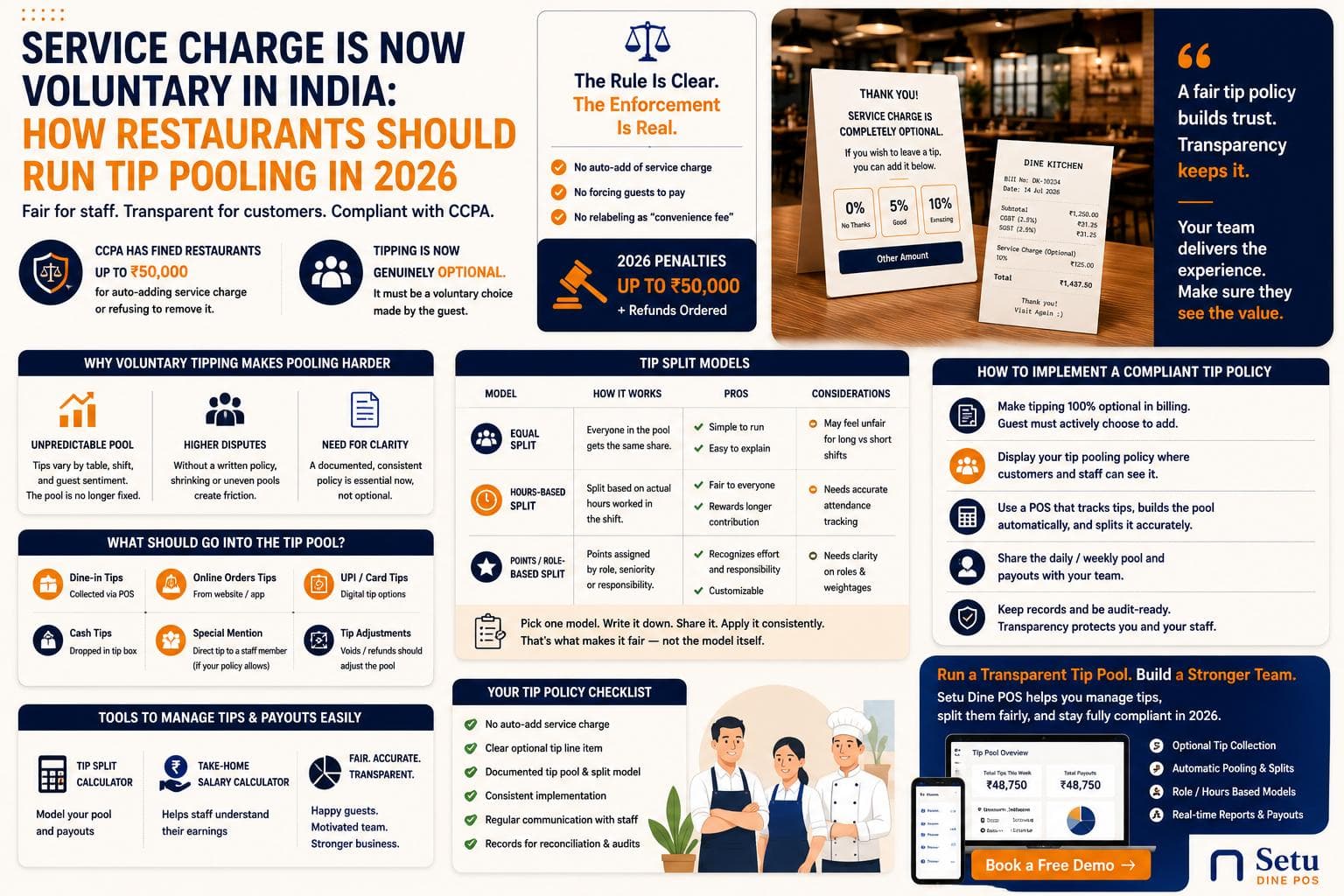
For years, an Indian restaurant bill made the tipping decision for you. A flat 10% service charge landed on the check whether the table loved the meal or sent half of it back, and staff never had to wonder whether a shift would pay out. That era is effectively over. Through 2025 and into 2026, the Central Consumer Protection Authority (CCPA) has moved from advisory letters to actual penalties — fining restaurant chains, including well-known names, for adding service charge automatically or refusing to remove it on request. Tipping in India is now genuinely voluntary, which is good for diners and overdue as consumer protection. It also quietly breaks the tip-pooling system most restaurants have been running unchanged for a decade.
What actually changed, and why 2026 is different
The CCPA's guidelines against default service charge were first issued back in July 2022: no hotel or restaurant may add it automatically, no restricting entry or service based on a guest's refusal to pay it, and no relabeling it as a "convenience fee" or similar to get around the rule. For nearly three years enforcement mostly stopped at warning letters. That changed following a 2025 Delhi High Court ruling that backed the CCPA's authority to act, and in early 2026 the CCPA fined roughly two dozen restaurant chains up to ₹50,000 each, ordering refunds to affected customers and changes to their billing systems.
The practical result for operators: service charge (or tip, or gratuity, whatever it's labeled) must be a genuinely optional line item that a guest actively chooses to pay, not a default that's added and has to be argued down. Restaurants that still auto-add it are now carrying real regulatory and reputational risk, not just a theoretical compliance gap.
Why voluntary tipping makes pooling harder, not easier
When service charge was a guaranteed 10% on every bill, tip pooling was arithmetically simple even if the underlying policy was never written down anywhere. The pool was predictable, and a rough, unspoken split was good enough because nobody was checking closely. Once tipping becomes genuinely optional, the pool stops being predictable. It swings by table, by shift, by how the guest felt about the meal — and a vague, unwritten split that nobody questioned when the pool was fixed starts generating real disputes once staff can see the pool shrinking or moving night to night. This is exactly the moment a restaurant needs a documented, defensible tip-pooling policy, not fewer rules.
Three ways restaurants split a tip pool
Most restaurants land on one of three models. None is universally "correct" — the right one depends on staffing structure and how directly each role touches the guest experience.
- Equal split. Every staff member in the pool gets an identical share, regardless of hours worked or role. Simplest to run and easiest to explain, but can feel unfair to staff who worked a full double against someone who covered a two-hour gap shift.
- Hours-based split. The pool is divided by total hours worked across everyone in the pool, so each person's share scales with time on the floor. Fairer for mixed shift lengths, but needs accurate shift-time data to avoid becoming its own dispute.
- Points or role-based split. Different roles get a weighted share — a server might carry more weight than a busser or host, reflecting more direct guest contact. Most defensible when the weighting is written down and consistent, but the hardest to set up and the easiest to get wrong if the weights look arbitrary.
A worked example
Take a dine-in restaurant on a Saturday night: 8 waitstaff and 3 hosts sharing a tip pool, with ₹18,000 collected across UPI and cash tips through the shift.
Equal split across all 11 staff gives everyone ₹1,636, regardless of whether they worked a 4-hour or 8-hour shift.
Hours-based split: if 5 staff worked 8-hour shifts and 6 worked 4-hour shifts, total hours across the pool come to 64 (40 + 24). At ₹281 per hour, an 8-hour staffer takes home ₹2,250 and a 4-hour staffer takes home ₹1,125 — a meaningfully different, and arguably fairer, outcome for the same ₹18,000 pool.
Points-based split: if waitstaff carry 1.5 points and hosts carry 1 point, the 8 waiters represent 12 points and the 3 hosts represent 3 points, for 15 points total at ₹1,200 per point. Each waiter takes ₹1,800 and each host takes ₹1,200, reflecting more direct guest contact without ignoring hosts entirely.
None of these numbers are right or wrong in isolation — what matters is that the restaurant picked one model, wrote it down, and applies it consistently instead of eyeballing the split differently every week.
Should kitchen staff get a cut?
This is the question that generates the most friction, and there's no single right answer across the industry. The case for including back-of-house staff in a blended pool is straightforward: guest satisfaction, and therefore tip size, is directly tied to kitchen speed and order accuracy, not just table service. A restaurant that has already worked on tightening table turnover time has effectively made every front-of-house tip a joint effort between the floor and the kitchen. Some operators run a fully blended pool across front- and back-of-house on a lower overall weighting for kitchen roles; others keep a small, separate kitchen pool funded by a fixed percentage of total tips, so the two systems don't have to share the same formula. Either can work — what causes disputes is doing neither, and letting kitchen staff simply not know a pool exists.
Staying compliant while running a fair pool
A tip-pooling policy only holds up if the collection side of it is clean. That means:
- Service charge or suggested tip is a clearly optional line item at the time of payment, never pre-checked or pre-added to the bill total.
- Staff never argue a guest into paying it. Refusing to remove a service charge on request is one of the specific violations the CCPA has fined restaurants for.
- The pooling formula is written down and available to every staff member in the pool, not passed along verbally by whoever's on shift that day.
- Pool totals are logged by shift, not just totaled at month-end, so a dispute about a specific Saturday can be checked against real numbers instead of memory.
- UPI tips paid directly to a staff member's personal number are still tracked for payroll and tax purposes, even if they never touch the pool — especially since GST billing discipline and payroll records increasingly get cross-checked together during audits.
Whether pooled tips get paid out as cash at the end of a shift or added to payroll varies by restaurant and by what staff prefer; a quick check against a take-home salary calculator is a useful sanity check if tips are being folded into payroll rather than handed over as cash, since it changes what actually lands in a staff member's account after deductions.
Where the POS fits in
None of this needs a separate system if the POS is already tracking shifts and roles. Setu Dine's role management already distinguishes owners, managers and staff access, which is the same underlying data an hours-based or points-based tip split needs — who worked, which role, how long. Attaching a tip pool total to a shift and letting the split formula run against real shift data removes the spreadsheet reconstruction that normally happens after the fact, and gives an owner a clean record to point to if a staff dispute or a compliance question ever comes up. Counter-service formats running a tip jar through Setu Queue face a simpler version of the same problem — smaller pools, but the same need for a documented, consistent split rather than whoever's closing the register that night deciding on the spot.
The Tip Split Calculator runs all three models above — equal, hours-based and share-based — against a real pool amount, which is a fast way to see how differently the same ₹18,000 lands depending on which formula a restaurant chooses, before locking in a policy.
Service charge going from default to optional isn't a rule restaurants can route around with clever labeling — the CCPA has already shown it's checking. The upside is that a smaller, more genuinely earned tip pool, split by a formula staff can actually see and trust, tends to cause fewer arguments than a bigger pool nobody ever explained.
Frequently asked questions
It can't be added automatically. The CCPA has fined restaurants up to ₹50,000 for auto-adding service charge or refusing to remove it — it must be a genuinely optional line item the guest actively chooses to pay.
More from Compliance
How to Use a GST Calculator in 2026: Inclusive, Exclusive and the New Slabs
Getting GST wrong on a bill is not a rounding error — it is money out of your margin or a mismatch your buyer's accountant bounces. This tutorial walks through the free GST Calculator: inclusive vs exclusive, the state split, and the 2026 slabs.
Read more →
India's New Wage Code Just Rewired Your Payroll Math: What Every SME Needs to Fix in 2026
India's four labour codes came into force on 21 November 2025 and Central Rules followed on 8 May 2026. The new rule that basic pay can't be less than 50% of CTC quietly changes PF, gratuity and overtime math for every SME. Here's what to check before your next payroll run.
Read more →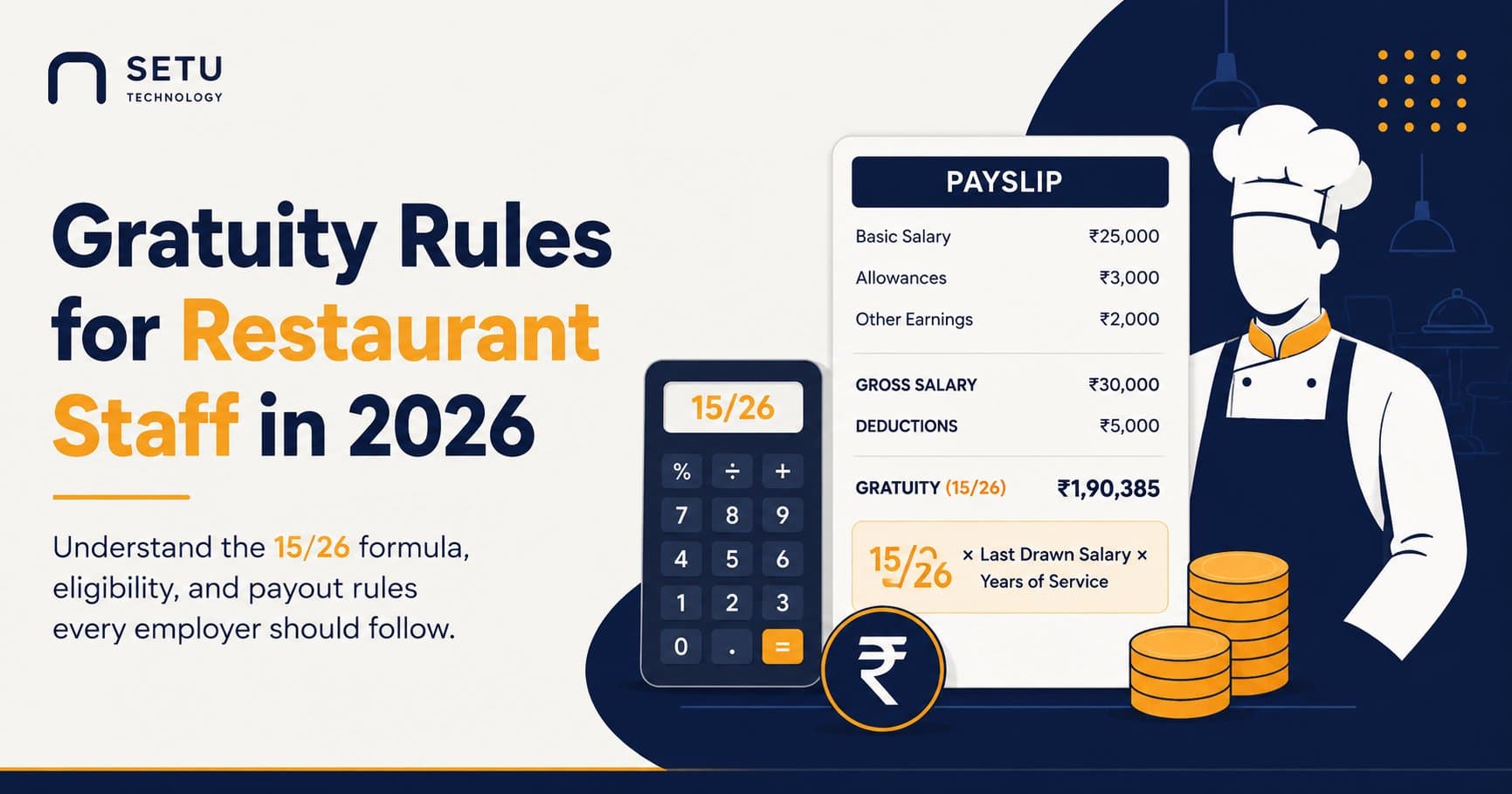
Gratuity Rules for Restaurant Staff in 2026: What Every Owner Must Pay (And How the 15/26 Formula Actually Works)
Restaurants churn staff faster than almost any industry — which is exactly why gratuity math trips owners up. Here's the real formula, the new fixed-term rule, and what a missed payment actually costs.
Read more →
GST Billing Checklist for Restaurants in India (2026)
The most common GST billing mistakes restaurants make, and a complete checklist to fix them before your next audit.
Read more →