94% of Small Business Owners Expect Growth in 2026. Half of Them Can't Predict Their Own Cash Flow.
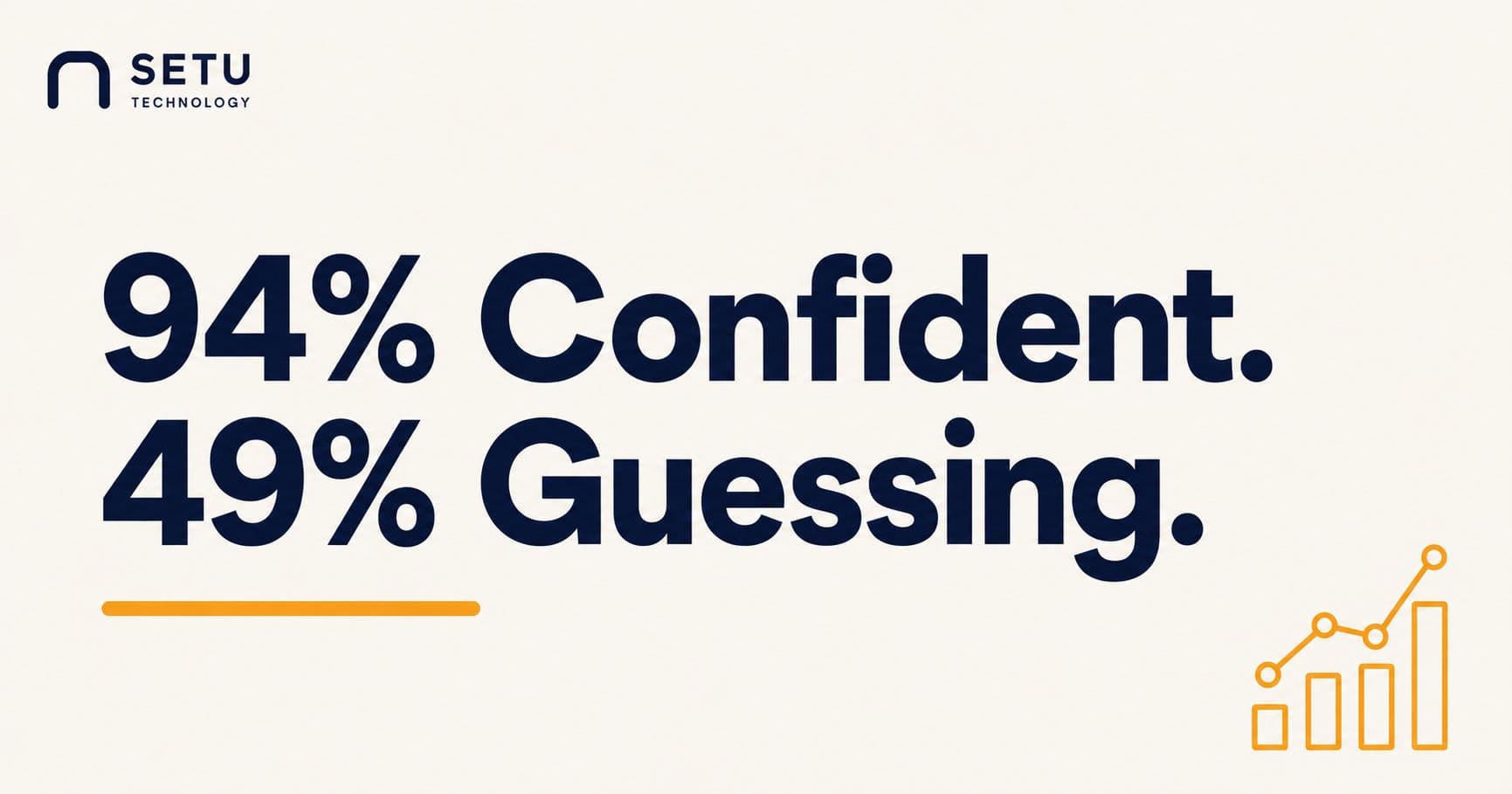
Here's a contradiction sitting inside this year's small business survey data: 94% of owners expect their business to grow in 2026 — matching an all-time high for the measure — while close to half still can't reliably predict their own cash flow from one month to the next. Both numbers are true at the same time, and the gap between them explains more about how small businesses actually fail than either number does on its own.
The optimism is real
Small business confidence heading into 2026 is genuinely strong. Survey after survey shows owners expecting growth, with consumer spending trends and access to credit named as the two biggest factors shaping strategy for the year. Owners are also putting money behind that confidence — roughly 18.7% plan to invest in AI tools this year, and the share of new businesses launching with over $500,000 in startup capital jumped to 31.6%, up from 27.5% in 2025. None of that reads like a market that's worried.
The cash flow number sitting underneath it
At the same time, Federal Reserve Small Business Credit Survey data shows 49% of small businesses struggled with uneven cash flow, and 52% struggled specifically with paying operating expenses — among the most commonly cited financial challenges, year after year, independent of how confident owners feel about growth. Separately, inflation (31%) and cash flow (29%) are named as the top two challenges facing small businesses in 2026 outlook surveys. Put simply: the same population of owners that's more confident than it's ever been is also, in large part, still not sure what its bank balance will look like in three weeks.
Why growth confidence doesn't fix cash flow
These two numbers aren't actually contradictory once you separate what each one measures. Growth confidence comes from demand signals — order books, repeat customers, market conditions — and those are visible to an owner every single day. Cash flow is a timing problem, not a demand problem: it's the gap between when money is owed to you and when it actually lands, against the gap between when you owe suppliers, rent and payroll and when those payments are due. A business can be growing, profitable on paper, and still run short on cash in a specific week, because growth itself often makes the timing gap worse — more inventory bought ahead of sales, more receivables outstanding as the customer base grows, more payroll committed before the corresponding revenue has actually been collected.
Where this shows up first
The businesses most exposed to this gap tend to share a pattern: they review their financial position monthly instead of weekly, they look at profit and loss more often than they look at a cash position, and they don't distinguish between revenue that's booked and cash that's actually in the account. None of that is a bad decision on its own — it's just a blind spot that stays invisible right up until a week where outflows land before inflows do, and a genuinely growing business finds itself unable to make payroll on time.
What actually closes the gap
The fix isn't more optimism or less optimism. It's tracking cash separately from profit, at a shorter interval than most owners currently do. A daily cash position — money in, money out, running balance — catches timing problems weeks before they become emergencies, in a way that a monthly P&L simply can't, because a P&L doesn't care when money actually moved. Setu's free Cash Book gives you that daily in/out view with automatic opening and closing balances, so a cash crunch shows up as a trend line before it shows up as a missed payment.
For businesses financing growth with a loan — and given how many owners are backing 2026 optimism with real capital, that's a lot of businesses — it's worth running the actual repayment math before signing, not after. Setu's Business Loan EMI Calculator shows the monthly repayment burden against your current cash position, so growth financing doesn't quietly become the thing that breaks your cash flow instead of fixing it.
The takeaway
Confidence and cash flow measure two different things, and 2026's numbers show them moving independently of each other. A business can be right to feel optimistic about demand and still be one bad week of timing away from a real problem. The owners who avoid that outcome aren't the most optimistic or the most cautious — they're the ones who track cash on its own terms, separately from how good the year is supposed to be.
Frequently asked questions
Yes. Survey data shows 94% of small business owners project growth in 2026, matching an all-time high for the survey. That's a striking number given that inflation and cash flow remain the two most commonly cited challenges in the same surveys.
More from Business Finance

Discount Maths: What 20% Off Actually Costs You, and How Much Extra You Must Sell
A 20% discount on a 40% margin item does not cost you 20%. It halves your gross profit, and you need to sell twice as many units to stand still. Here is the arithmetic, the one formula worth memorising, and the three free calculators that do it for you.
Read more →
The MSME 45-Day Payment Rule in 2026: New Section, Same Deadline, Same Cash-Flow Squeeze
Section 43B(h) has moved into the Income-tax Act, 2025 as Section 37(2)(g) from 1 April 2026. The section number changed, the 15/45-day deadline did not — and for most SMEs this is a working capital rule wearing a tax rule's clothing.
Read more →
Small Business Loans Are Still Expensive in 2026 (Even as Rates Ease): What SMEs Can Actually Control
Policy rates are falling in 2026, but most small businesses aren't seeing cheaper loans — OECD data shows SME credit stock is still stagnant and borrowing costs remain high. Here's why the gap exists and what's actually in your control.
Read more →
Small Business Late Payments Hit a Record High in 2026: What $17.7K in Unpaid Invoices Is Actually Costing Owners
Nearly 3 in 5 small businesses now have invoices overdue by 30 days or more, up from under half last year. Here's what's driving the record, what it costs downstream, and the fixes the data says actually work.
Read more →