AI in SME Finance in 2026: What It Actually Automates in Your Books (and What Still Needs a Human)
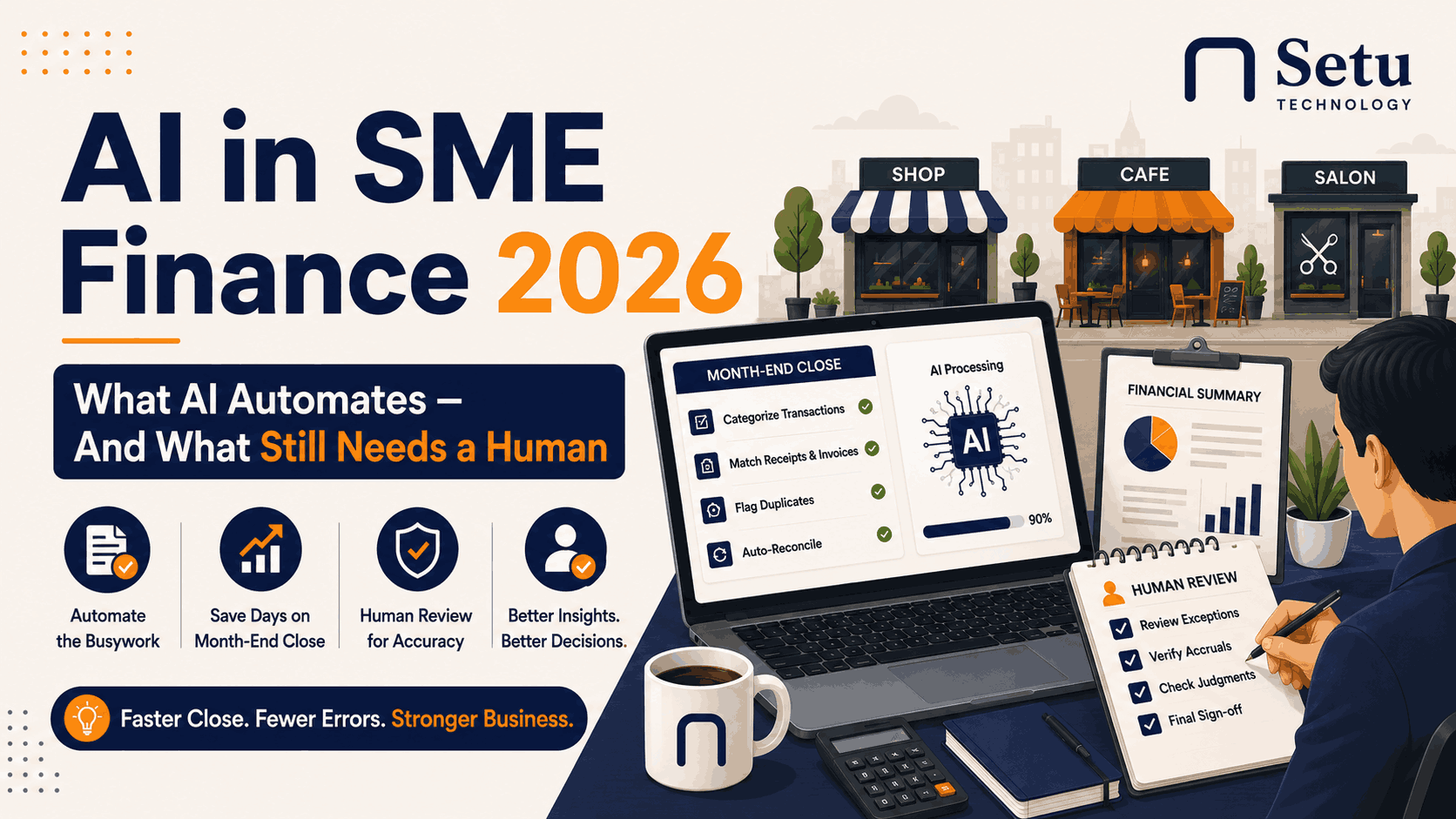
Ask a finance software vendor and artificial intelligence has already transformed small business accounting. Ask a bookkeeper who still has to close the books every month, and the picture is more complicated. Both are describing the same year. The gap between those two answers is exactly what this piece is about — what AI genuinely speeds up in your books right now, what the data actually says about the return on it, and where a human still has to check the work before it goes anywhere near a lender, an investor, or a tax filing.
How fast AI adoption actually moved inside finance teams
KPMG's 2026 global survey of over a thousand senior finance leaders across 20 countries found active AI use inside the finance function jumped to 75%, up from just 30% two years earlier. Among that adoption, the majority reported real gains — roughly seven in ten said AI met or exceeded their ROI expectations, seven in ten reported faster decisions, seven in ten reported improved decision quality, and around two-thirds reported better forecast accuracy.
That figure is skewed toward larger finance teams, though. Among small businesses specifically, adoption is much lower — roughly 22% report using AI for accounting or financial management at all, per Intuit QuickBooks research. That gap between the enterprise headline and the small-business reality is the honest starting point for everything below.
What AI actually speeds up in month-end close
A joint MIT and Stanford study that followed 277 accountants across 79 small and mid-sized businesses found greater AI adoption was associated with a 7.5-day reduction in monthly close time, alongside a roughly nine-percentage-point shift of accountant time away from manual data entry and toward higher-value analysis, an 18% increase in weekly client support, and a 12% increase in how granular and well-categorized the resulting ledger was.
In practice, that maps to a specific set of tasks: categorizing bank transactions, matching receipts and invoices to the right line item, flagging duplicate charges, and producing a rough first-pass reconciliation. This is squarely where the current generation of AI tools earns its keep — the repetitive matching work that used to eat the first several days of every close.
The ROI gap nobody puts in the marketing copy
Despite adoption climbing sharply, measured financial return still lags behind it. A CFO.com survey of 321 finance and accounting decision-makers found only around 28% of teams with active AI investments could point to a measurable financial impact from them. A separate survey of 200 CFOs by RGP put that figure closer to 14%.
The gap makes sense once you separate the two kinds of work inside a close. Tools that speed up categorization and matching don't automatically speed up the part of close that actually takes the longest: the judgment calls. Accrual timing, revenue recognition edge cases, tax treatment of an unusual transaction, and reconciling a discrepancy that doesn't match any known pattern — none of that shortens just because the easy 80% of transactions got auto-categorized.
Why month-end close is still slow, industry-wide
Ledge's 2025 survey of 100 finance professionals found only 18% of teams close their books in three days or less, and half still take longer than a week. Ninety-four percent still rely on Excel somewhere in the close process, and cash reconciliation alone can consume 20 to 50 hours a month on its own. A separate benchmark from APQC, drawn from 2,300 organizations, puts the median close at 6.4 calendar days.
The takeaway isn't that AI hasn't helped — the MIT/Stanford numbers above say otherwise for adopters. It's that AI has shaved real days off close for the businesses using it well. It hasn't eliminated the close, and it isn't close to doing so industry-wide yet.
What still genuinely needs a human
Based on where the ROI gap and the close-time data actually point, the tasks that still need a person reviewing them are consistent:
- Judgment on unusual, one-off, or ambiguous transactions
- Accrual and deferral decisions that depend on context the software doesn't have
- Chart-of-accounts decisions specific to how a particular business actually operates
- Telling a genuine error apart from a flagged-but-fine anomaly
- Final review before a P&L or balance sheet goes to a lender, investor, or tax authority
- Anything carrying real legal or tax exposure if it's wrong
The model that's actually working: human-reviewed, not human-replaced
The businesses landing in that 71% ROI figure — not the 14–28% still waiting for one — tend to be using AI as a fast first pass on the mechanical parts of the close, with a person still accountable for the judgment calls and the final sign-off. Not full automation. Not doing it all by hand either.
It's worth adding one more figure to this, carefully: a widely cited U.S. Bank study is often credited with finding that cash-flow problems play a role in roughly 82% of small business failures. That figure gets oversimplified into a single cause fairly often — it's more accurately read as "cash-flow management is implicated in most failures" than "cash flow alone kills most businesses." Either way, the point of clean, fast, AI-assisted books isn't a tidier spreadsheet. It's an owner who actually knows their cash position before it becomes a crisis.
This is close to how Setu's own bookkeeping team works in practice — software handling the repetitive categorization and matching, with a person reviewing before anything reaches your P&L, your accountant, or your bank. If you're weighing that kind of outsourced setup against hiring in-house, we broke down the real cost math — and a lock-in risk worth checking for — separately.
Read the real cost math on outsourced bookkeeping vs. in-house →
Frequently asked questions
No. AI reliably speeds up the mechanical parts of close — categorizing transactions, matching receipts, flagging duplicates — but judgment calls like accruals, revenue recognition and final review before a filing still need a human.
More from Business Finance

Discount Maths: What 20% Off Actually Costs You, and How Much Extra You Must Sell
A 20% discount on a 40% margin item does not cost you 20%. It halves your gross profit, and you need to sell twice as many units to stand still. Here is the arithmetic, the one formula worth memorising, and the three free calculators that do it for you.
Read more →
The MSME 45-Day Payment Rule in 2026: New Section, Same Deadline, Same Cash-Flow Squeeze
Section 43B(h) has moved into the Income-tax Act, 2025 as Section 37(2)(g) from 1 April 2026. The section number changed, the 15/45-day deadline did not — and for most SMEs this is a working capital rule wearing a tax rule's clothing.
Read more →
Small Business Loans Are Still Expensive in 2026 (Even as Rates Ease): What SMEs Can Actually Control
Policy rates are falling in 2026, but most small businesses aren't seeing cheaper loans — OECD data shows SME credit stock is still stagnant and borrowing costs remain high. Here's why the gap exists and what's actually in your control.
Read more →
94% of Small Business Owners Expect Growth in 2026. Half of Them Can't Predict Their Own Cash Flow.
Small business optimism just hit an all-time survey high — 94% expect growth in 2026. At the same time, close to half still can't reliably predict their own cash flow. Here's what's driving the gap, and the habits that close it.
Read more →