Are Your Books Audit-Ready? A Year-End Checklist for FY 2025-26
Audit season is not a surprise. The dates are known a year in advance, and yet for a lot of small businesses the scramble is identical every time: a September evening, a shoebox of bills, a bank statement nobody has reconciled since June, and a CA waiting on numbers that don't yet exist.
The filings themselves have fixed deadlines. For FY 2025–26 (AY 2026–27), tax-audit returns are due 31 October 2026 and the GST annual return, GSTR-9, by 31 December 2026, with GSTR-9C alongside it where turnover crosses ₹5 crore. But the work that makes those filings painless is not the filing. It is the reconciliation and cleanup that should already be done by the time the return is prepared. This is a checklist for getting there.
This is a practical guide, not tax advice. Filing thresholds and due dates change and can be extended by the department — confirm your specific position with your CA before you rely on any date or limit here.
Why "audit-ready" is a state, not a task
Books are audit-ready when an outsider can pick them up and trust them. Concretely, that means three things are true at once: every balance ties to an external source, every number has a document behind it, and the statements actually balance. Most small-business books fail on the first. The bank says one thing, the books say another, and nobody has closed the gap — so nothing downstream can be relied on.
The good news is that audit-readiness is mostly reconciliation, and reconciliation is a sequence. Work it in order and the year-end stops being a scramble.
Step 1 — Reconcile every bank and cash account, to March
This is the foundation, and it is where most of the year's hidden errors live.
- Run a full bank reconciliation for every account, month by month, up to 31 March, using the Bank Reconciliation tool
- Clear stale reconciling items — a cheque uncleared for six months is a decision waiting to be made, not a permanent line
- Reconcile physical cash to the Cash Book, and reconcile UPI and card settlements against recorded sales, remembering the gateway pays you net of MDR
- If you are working from PDF statements, the Bank Statement Analyzer will categorise a year of lines far faster than you will by hand
Done when: every bank and cash balance in the books equals the statement, with a documented list of anything in transit.
Step 2 — Reconcile GST, month by month
The GST annual return is a reconciliation exercise, and doing it in December for the whole year is how mismatches turn into cash losses.
- Match input tax credit claimed against GSTR-2B for every month; an ITC mismatch found now is an argument with a supplier, found at year-end it is money gone
- Reconcile your books' output tax against what you filed in GSTR-1 and GSTR-3B
- List suppliers who never uploaded your invoices — chase them before the annual return, not after
- Confirm you are applying the right rates under the structure effective from 22 September 2025 (for standalone restaurants, 5% with no ITC)
Done when: ITC, output tax and filed returns agree for all twelve months, with mismatches either resolved or documented.
One caution specific to the annual return: it is not a place to quietly fix the year. Numbers in GSTR-9 that disagree with what you actually filed month to month invite exactly the scrutiny you are trying to avoid. The reconciliation is meant to prove the monthly filings were right, not to paper over the fact that they were not — which is the whole argument for doing it in the monthly close rather than in a December panic.
Step 3 — Settle receivables, payables and the MSME clock
- Age your accounts receivable with the Invoice Aging Report and provide for anything that is realistically a bad debt — carrying it at full value only flatters the balance sheet
- Age payables with the Accounts Payable Aging report and flag every balance owed to a micro or small supplier approaching 45 days — the MSME payment rule turns a slow payment into a real year-end tax disallowance, and the collections discipline behind it is covered in small business late payments in 2026
- Send statements on the 60+ balances now, while there is still a quarter to collect them
Done when: both aging reports are clean, provisions are booked, and MSME balances are cleared or scheduled to clear before 31 March.
A practical note on sequencing: do receivables before payables. Knowing what is genuinely collectable tells you what cash you will actually have to clear the payables with, and it stops you from paying suppliers out of money a customer has quietly decided not to send. The two aging reports are more useful read together than apart.
Step 4 — Adjustments and the fixed-asset register
- Post the year's depreciation and confirm the fixed-asset register agrees to the balance sheet block
- Apportion prepaid expenses and accrue for costs incurred but not yet billed
- Value closing stock against an actual stock take, not a system figure — the gap is your shrinkage, and the auditor will ask
- Confirm TDS deducted, deposited and returned reconciles; the mismatch here is a common notice trigger
- Post entries in the Journal Entry tool with narration a stranger could follow in a year
Done when: all adjusting entries are posted and the asset register, stock and statutory ledgers agree to the books.
Step 5 — Trial balance, statements and a sanity check
- Run the Trial Balance; if it does not balance, the error is upstream, not here
- Produce the Profit & Loss, Balance Sheet and Cash Flow Statement
- Review the General Ledger for the usual audit red flags: bloated "Miscellaneous" heads, round-number entries, and anything posted to a suspense account and forgotten
- Sanity-check the shape of the business with the Financial Ratio Calculator — a gross profit percentage that swings hard from last year is a question you want to answer before the auditor asks it
Done when: three statements you would be willing to sign, and last year's comparatives sitting beside them.
The deadline map for FY 2025-26
| Filing | Who | Due (AY 2026-27) |
|---|---|---|
| ITR, non-audit | Individuals & small businesses below audit limits | 31 July 2026 (ITR-3/4 non-audit often 31 Aug) |
| ITR with tax audit | Turnover above Section 44AB limits | 31 October 2026 |
| GSTR-9 (annual return) | Aggregate turnover above ₹2 crore | 31 December 2026 |
| GSTR-9C (reconciliation) | Aggregate turnover above ₹5 crore | 31 December 2026 |
| Belated / revised ITR | Anyone who missed or must correct | 31 December 2026 |
Treat these as the current position and verify before you plan around them — the department extends dates most years, and a threshold can move in a budget.
The documents an auditor asks for first
If you want to pressure-test whether you are ready, assemble the short list a professional reaches for on day one: the reconciled bank statements with the reconciliation working, the trial balance, the fixed-asset register with the depreciation schedule, the GST reconciliation (books versus filed versus GSTR-2B), and the aged receivables and payables. If you can produce all five without a scramble, your books are audit-ready in the sense that matters. If assembling them means a week of reconstruction, that week is the work this checklist is meant to move out of September.
When to hand it over
This checklist is designed to be run by an owner or an office manager who is a few weeks behind, not a year. There is a point where doing it yourself stops being sensible, and it is usually one of these:
- You are entering March with months of bank accounts unreconciled
- Your CA is doing bookkeeping at CA rates because the books arrive raw
- A GSTR-2B mismatch has been rolling forward unaddressed for two or three quarters
- You genuinely do not know whether you cross the audit threshold this year
- The cleanup is now big enough that a wrong number would cost more than a bookkeeper
At that point outsourcing the cleanup is usually cheaper than the professional time it saves, and it gets the books to a state an auditor can sign without a fight. Setu's accounting, bookkeeping and payroll service runs exactly this — reconciliation, ledgers, AR and AP, adjustments and the year-end statements — inside your own accounting software: QuickBooks, Xero, Zoho Books, FreshBooks, Wave, Appfolio and Resman. Your file stays your file. The related read on whether to hire or outsource is outsourced bookkeeping vs in-house, and the monthly discipline that prevents next year's scramble starts with a routine bank reconciliation checklist.
Frequently asked questions
For AY 2026-27: non-audit ITRs are generally due 31 July 2026, tax-audit cases 31 October 2026, and the GST annual return (GSTR-9) by 31 December 2026, with GSTR-9C alongside it where turnover crosses ₹5 crore. Dates can be extended by the department, so confirm current deadlines before you plan around them.
More from Accounting

What to Send Your Bookkeeper Every Month, and Who Owns What
Most bookkeeping relationships stall over supply, not skill: one missing bank statement and the month cannot close. Here is the seven-part monthly pack, a task-by-task split of who owns what, and the dates worth writing into the engagement letter.
Read more →
Your Bookkeeper Sent Three Statements. Here Is How to Read Them.
Every month an outsourced bookkeeper sends a profit and loss statement, a balance sheet and a cash flow statement, and most owners glance at one number and file the rest. Here is what each statement actually answers, and in what order to read them.
Read more →
Comparing Bookkeeping Quotes: The Eight Questions That Matter
Two bookkeeping quotes use identical words and differ by three times in price, because price without scope is not a price. The eight questions that make quotes comparable, the four red flags, and an in-house cost comparison that carries its full weight.
Read more →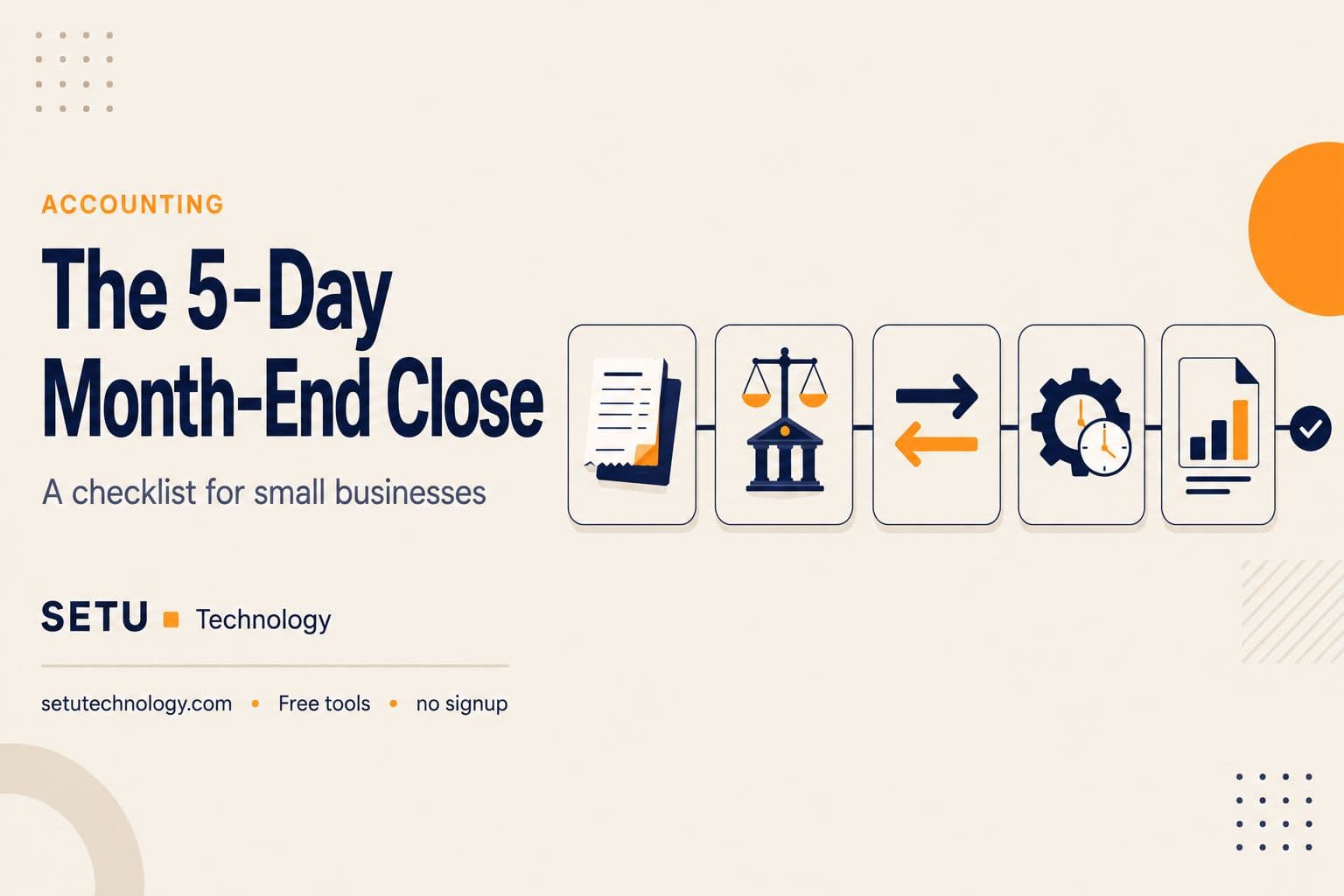
The 5-Day Month-End Close: A Checklist for Small Businesses in 2026
Most small businesses don't have a slow month-end close — they have no close at all, and the March numbers arrive in June. Here's a five-working-day version you can run with free tools, and the point at which handing it over makes more sense.
Read more →