The MSME 45-Day Payment Rule in 2026: New Section, Same Deadline, Same Cash-Flow Squeeze
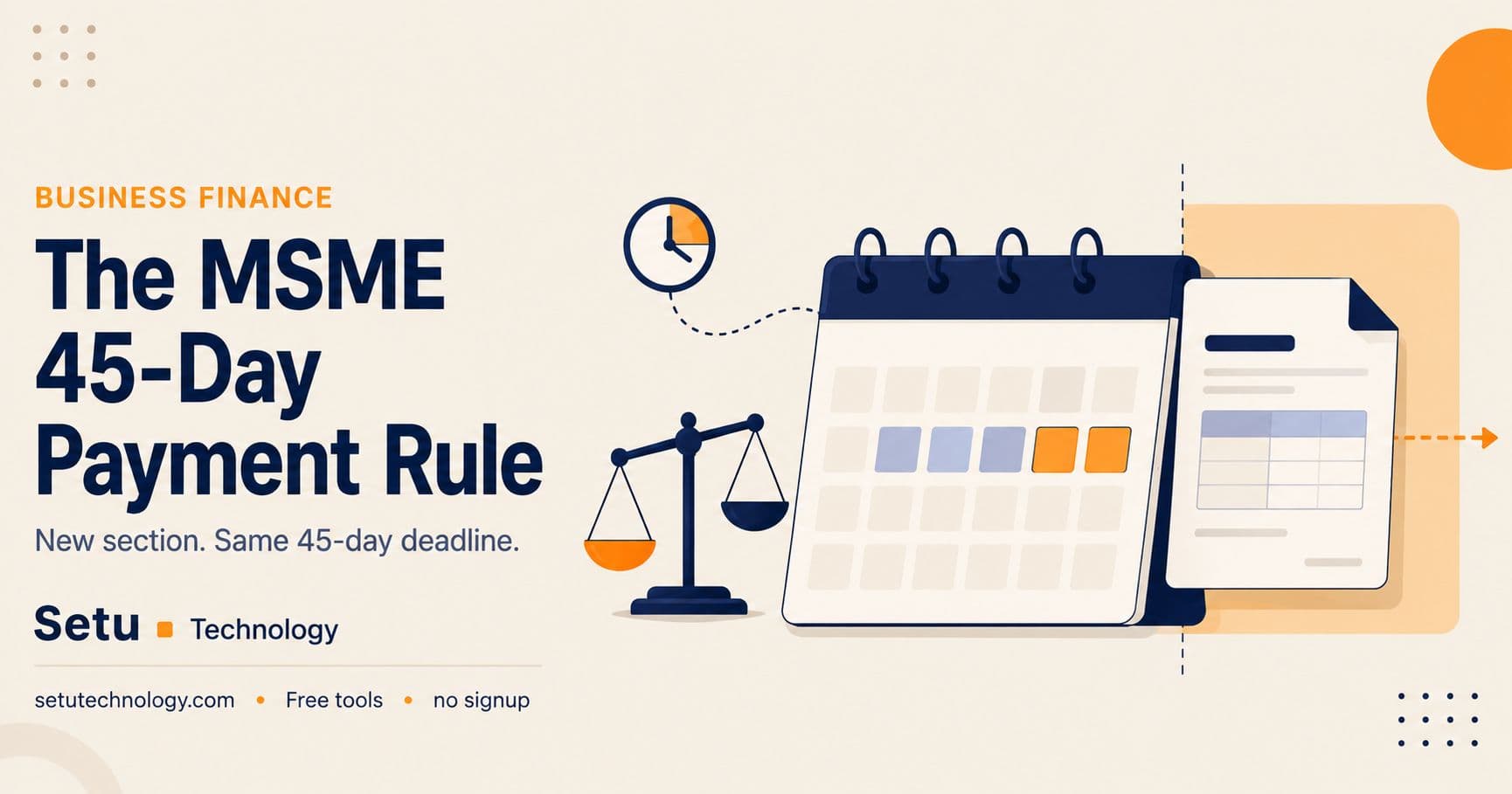
Two years after it landed, the MSME payment rule is still the tax provision small businesses most often discover too late — usually in a tax-audit conversation in September, about a payment they made in June.
It has now moved house. The provision most people know as Section 43B(h) of the Income-tax Act, 1961 carries forward into the Income-tax Act, 2025 as Section 37(2)(g), which takes effect from 1 April 2026. FY 2025–26 is still governed by the old Act — returns for AY 2026–27 are filed under it — with the new Act applying from AY 2027–28.
The section number changed. The deadline did not. And for a lot of businesses, the deadline is the real story: it is a tax rule doing the work of a working capital rule.
Not tax advice. This is a plain-English explainer, and the rule has genuine grey areas that are still being litigated. Confirm your specific position with your CA before you change a payment schedule or a tax provision.
What the rule actually says
If you buy from a registered micro or small enterprise, you must pay within:
- 15 days of acceptance (or deemed acceptance) of the goods or services, where there is no written agreement, or
- the period in your written agreement, capped at 45 days — an agreement cannot extend past 45 days, however it is worded
Miss that, and the expense is disallowed as a deduction in the year it was incurred. You get the deduction only in the year you actually pay.
Three details that catch people out:
The clock starts at acceptance, not at the invoice date. If you raise no objection within 15 days of delivery, the delivery date becomes the deemed acceptance date. A late invoice does not buy you time.
Paying before you file your return does not rescue it. This is the one that surprises everyone. The usual "pay before the ITR due date and it's fine" logic — the way TDS or provident fund work — does not apply here. Unpaid on 31 March means disallowed for that year, full stop. The deduction shifts to the year of actual payment.
Interest on the delay is separately non-deductible. Under Section 16 of the MSMED Act, delayed payments carry interest at three times the RBI Bank Rate, compounded monthly. At a 5.50% Bank Rate that's around 16.5% a year — and you cannot deduct it.
What changed on 1 April 2026
Practically speaking: the citation, and where your CA looks it up.
- The substance — the 15/45-day windows, the acceptance-date trigger, disallowance until actual payment — carries over
- Tax-audit reporting in Form 3CD was already tightened by Notification No. 23/2025 (28 March 2025) to break out total micro-and-small payables, the amount paid within the statutory deadline, and the amount overdue and inadmissible
- FY 2025–26 sits under the 1961 Act; the 2025 Act governs from FY 2026–27 (AY 2027–28)
If you keep a compliance calendar, the change to make is a citation update and a note about which financial year sits under which Act. If you don't keep one, this is the year to start — the reporting now makes the number visible on the face of the audit report.
Who counts as a micro or small enterprise now
The classification thresholds were revised with effect from 1 April 2025, and both conditions must be met:
| Category | Investment in plant & machinery | Annual turnover |
|---|---|---|
| Micro | up to ₹2.5 crore | up to ₹10 crore |
| Small | up to ₹25 crore | up to ₹100 crore |
Medium enterprises are outside the rule. So is anyone not registered on Udyam.
Two traps here:
Your vendor master is probably stale. Thresholds moved in April 2025, which means suppliers you classified as medium under the old limits may now be small — and in scope. A vendor list built before April 2025 and never revisited is a liability.
Pure traders are treated differently. Retail and wholesale traders have been able to register on Udyam since 2 July 2021, but the delayed-payment protection under this provision is generally understood not to extend to them. Where a supplier both trades and manufactures, the nature of the actual transaction matters more than the name on the letterhead. This is one of the grey areas — get it confirmed rather than assumed.
The disallowance most people don't see coming
Work an example. You're a buyer with a 31 March year end. In February you take ₹40 lakh of goods from a small supplier on 60-day terms — terms that are themselves unenforceable beyond 45 days. You pay in mid-April, comfortably before you file.
- The ₹40 lakh is disallowed for FY 2025–26
- At a 25% effective rate, that's ₹10 lakh of additional tax in a year you already budgeted
- You get the deduction back in FY 2026–27 — a timing difference, not a permanent loss, but a ₹10 lakh cash-flow event in a specific quarter
- Plus MSMED interest at ~16.5% on the delay, non-deductible
- Plus a disclosure in Form 3CD that your auditor now has to fill in
Nothing here is a penalty in the ordinary sense. It's a cash-timing hit — which is exactly the kind of hit that damages a small business more than a fine would.
What it does to your working capital
Zoom out and the rule is a compression of your cash conversion cycle from one side only.
Your days payable outstanding is capped at 45 for a chunk of your supplier base. Your days sales outstanding is capped at nothing — your customers, especially large ones, pay when they pay. Stretching payables was the informal working-capital line that a lot of Indian SMEs quietly ran on. For MSME suppliers, that line is closed.
Which means the pressure moves to the two levers you still control:
Collections. If payables are fixed at 45 days and receivables run at 75, the gap is real money and it has to come from somewhere. Run an Invoice Aging Report every month, send statements from the Customer Statement tool the day an account crosses 30 days, and treat 60+ as a problem rather than a fact of life. We went into the collections side in small business late payments in 2026.
Inventory. Stock you're holding is cash you've already handed to a supplier under a 45-day clock. Inventory turnover and dead stock stop being efficiency metrics and become funding questions. An ABC Analysis is a fast way to find where the money is sitting.
If the gap genuinely can't be closed operationally, that's a financing conversation — a working capital loan or an overdraft — and worth reading alongside SME business loan interest rates in 2026. Borrowing to fund a compliance deadline is a poor outcome, but it is a better outcome than a disallowance you didn't plan for.
Also worth separating clearly: this is a profitable-business problem as much as a struggling one. Profit and cash are different things, which is the whole argument of cash flow vs profit.
If you're the buyer: a checklist for this month
- Refresh your vendor master. Collect current Udyam numbers for every supplier and re-check classification against the April 2025 thresholds. Log it in the Supplier Book.
- Tag micro and small suppliers separately in your books so their payables can be reported and monitored on their own.
- Rewrite payment terms over 45 days. They aren't enforceable against an MSME supplier, and leaving them in your purchase orders creates a paper trail suggesting you intended to breach.
- Record the acceptance date, not just the invoice date, on your GRN. That date is what the clock runs from.
- Add an ageing gate to your month-end close. The Accounts Payable Aging report, filtered to MSME suppliers, belongs on Day 3 of your month-end close.
- Run a hard sweep in the second half of March and clear every MSME balance before 31 March, even if it means using an overdraft for a fortnight.
- Use the Payment Terms Calculator to check whether an early-payment discount beats the cost of the cash — often it does.
If you're the supplier: a checklist for this month
- Register on Udyam, and put your Udyam number on every invoice. The protection depends on it, and your buyer's finance team needs the number to classify you correctly.
- State your terms on the invoice — 45 days maximum, with a reference to the MSMED Act. The Invoice Generator has a payment terms block; use it.
- Get acceptance in writing. An email confirming delivery starts a clock you can prove.
- Chase on a schedule, not on a feeling. Statement at 30 days, call at 45, formal notice after. Keep it in the Customer Ledger.
- Tell your larger customers you're an MSME supplier. It is not an aggressive move — their tax team would rather know in January than in September.
- Know your position on interest. You are entitled to it under the MSMED Act. Whether you invoice for it is a commercial call; knowing you can is leverage either way.
The honest bottom line
For suppliers, this is one of the few pieces of Indian law written squarely in favour of the small business, and it is under-used because a lot of MSMEs still aren't registered on Udyam or don't say so on their invoices.
For buyers, it converts a soft habit — paying slowly because you can — into a dated tax exposure with an auditor's disclosure attached. Both sides need the same thing to handle it: an aged payables list, an aged receivables list, and a month-end close that actually finishes on time.
If that discipline isn't happening because nobody has the hours, Setu's accounting and bookkeeping service runs the ledgers, the AR and AP tracking and the reconciliation on a fixed cadence, inside your own accounting software. Talk to us →
Frequently asked questions
For FY 2025–26 (AY 2026–27), yes — that year is assessed under the Income-tax Act, 1961. From FY 2026–27 the equivalent provision sits in the Income-tax Act, 2025 at Section 37(2)(g), effective 1 April 2026. The 15/45-day requirement carries across.
More from Business Finance
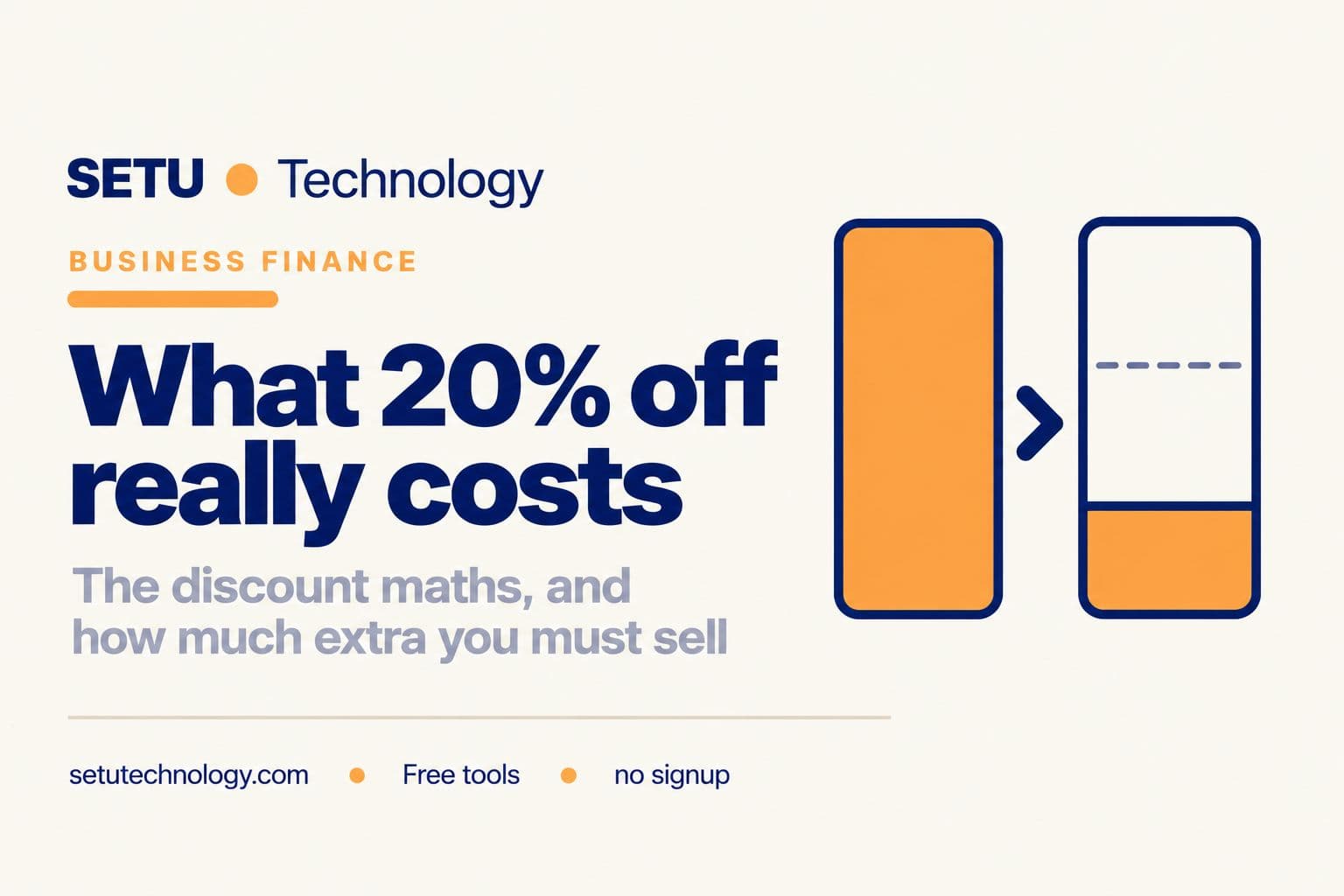
Discount Maths: What 20% Off Actually Costs You, and How Much Extra You Must Sell
A 20% discount on a 40% margin item does not cost you 20%. It halves your gross profit, and you need to sell twice as many units to stand still. Here is the arithmetic, the one formula worth memorising, and the three free calculators that do it for you.
Read more →
Small Business Loans Are Still Expensive in 2026 (Even as Rates Ease): What SMEs Can Actually Control
Policy rates are falling in 2026, but most small businesses aren't seeing cheaper loans — OECD data shows SME credit stock is still stagnant and borrowing costs remain high. Here's why the gap exists and what's actually in your control.
Read more →
94% of Small Business Owners Expect Growth in 2026. Half of Them Can't Predict Their Own Cash Flow.
Small business optimism just hit an all-time survey high — 94% expect growth in 2026. At the same time, close to half still can't reliably predict their own cash flow. Here's what's driving the gap, and the habits that close it.
Read more →
Small Business Late Payments Hit a Record High in 2026: What $17.7K in Unpaid Invoices Is Actually Costing Owners
Nearly 3 in 5 small businesses now have invoices overdue by 30 days or more, up from under half last year. Here's what's driving the record, what it costs downstream, and the fixes the data says actually work.
Read more →