The 5-Day Month-End Close: A Checklist for Small Businesses in 2026
Most small businesses don't have a slow close. They have no close at all.
The books get "done" whenever the owner has a free Sunday, which in practice means the March numbers arrive in June, the profit and loss statement is a formality for the CA, and nobody has looked at cash flow as a number since the last time a payment bounced.
That is expensive in a way that never shows up as a line item. You price badly because you're guessing at cost. You discover a supplier overcharge four months late. You find out an outlet is loss-making after a full quarter of subsidising it — the exact problem we wrote about in how to know which outlet is actually making money.
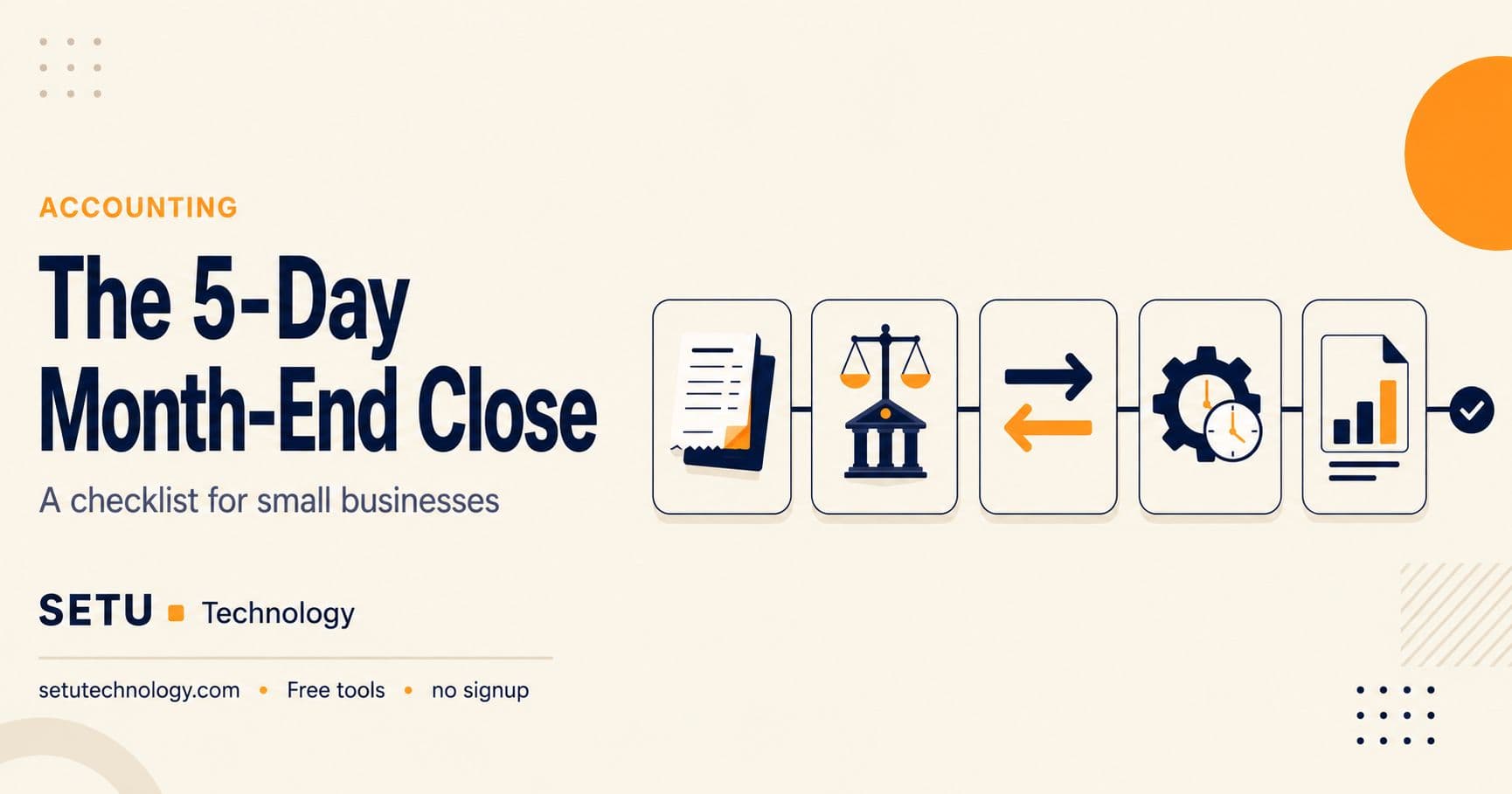
A close doesn't need to be sophisticated. It needs to be finished, and it needs to be finished on a date. Here's a five-working-day version, using tools that cost nothing.
Why the close slips — and what it costs
Three things stall a close, always:
- Missing paperwork. Purchase bills in a WhatsApp thread, a fuel receipt in someone's wallet, a supplier invoice that never arrived.
- An unreconciled bank. Once the bank and the books disagree, everything downstream is unreliable, so people stop.
- No owner. "The books" is nobody's task with nobody's deadline.
The fix for all three is the same: a fixed date, a fixed sequence, and a rule that the period gets frozen whether or not everything is perfect. An 85%-correct close on the 5th beats a perfect close on the 25th, because only one of them changes a decision.
Day 1 — Freeze the period and chase the paperwork
Declare the month closed for new entries. Then hunt down what's missing.
- Pull every purchase bill for the month into one folder and log it in the Purchase Register
- Match each bill to its purchase order and its GRN; flag quantity or rate mismatches now, not at year end
- Log petty cash and card spends in the Expense Tracker
- List every bill you expect but haven't received, so you can accrue for it on Day 4
- Check your invoice numbering has no gaps — a gap is either a missing sale or a cancelled invoice you forgot to write a credit note for
Deliverable: a complete purchase and expense list, plus a short "not yet received" list.
Day 2 — Reconcile the bank and the cash
This is the day that makes the rest of the close trustworthy.
- Run a full bank reconciliation for every account using the Bank Reconciliation tool
- Tick off deposits in transit and cheques issued but not presented; anything older than 90 days needs a decision, not another month of carry-forward
- Reconcile physical cash against the Cash Book — count it, don't assume it
- Reconcile payment gateway and UPI settlement reports against the sales you recorded, remembering that the gateway pays you net of MDR
- Reconcile aggregator payouts separately if you sell on Zomato or Swiggy — the payout is never the order value
If you're processing hundreds of lines by hand, the Bank Statement Analyzer will categorise a PDF statement far faster than you will. Our fuller walkthrough is in the bank reconciliation checklist for SMEs.
Deliverable: every bank and cash balance agreeing to the books, with a documented list of reconciling items.
Day 3 — Settle receivables and payables
- Run an Invoice Aging Report and bucket accounts receivable into 0–30, 31–60, 61–90 and 90+
- Send statements to anyone in the 60+ buckets using the Customer Statement tool
- Write off or provide for anything that is realistically a bad debt — carrying it at full value flatters your balance sheet and nothing else
- Run the Accounts Payable Aging report and check nothing has drifted past its payment terms
- Specifically flag anything owed to a micro or small supplier that is approaching 45 days — the tax consequences of missing that deadline are real, and we covered them in the MSME 45-day payment rule in 2026
- Compute days sales outstanding and days payable outstanding and write both down; the trend matters more than the number
Deliverable: two aging reports, a collections list, and a payables list ordered by consequence.
Day 4 — Adjustments: accruals, prepaids, depreciation
This is where a close stops being data entry and starts being accounting. If you run accrual accounting, the month has to carry its own costs.
- Accrue for the bills on Day 1's "not yet received" list, using last month's amount as an estimate
- Apportion prepaid expenses — insurance, rent paid in advance, annual software licences — so only this month's share hits this month
- Post the month's depreciation on fixed assets; straight-line depreciation monthly is fine for most SMEs
- Book the payroll provision, including provident fund, ESI and any gratuity accrual
- Post TDS deducted and payable
- Value closing stock against an actual stock take or cycle count — not against what the system thinks; the gap is your shrinkage
- Reconcile input tax credit claimed against GSTR-2B; an ITC mismatch found now is an argument with a supplier, found in December it's a cash loss
Use the Journal Entry tool for the adjustments and keep the narration honest enough that a stranger could follow it in a year.
Deliverable: all adjusting entries posted, with a one-line reason each.
Day 5 — Trial balance, statements, and the review call
- Run the Trial Balance and confirm it balances; if it doesn't, the error is in Day 4, not Day 5
- Produce the Profit & Loss Statement, Balance Sheet and Cash Flow Statement
- Compare against last month and against plan in Budget vs Actual; investigate any budget variance over 10%
- Sanity-check three ratios in the Financial Ratio Calculator: gross profit %, operating margin, and current ratio
- Confirm the chart of accounts hasn't sprouted three new "Miscellaneous" heads this month
- Hold a 30-minute review. Three questions only: what surprised us, what's the one number we want different next month, and who owns it
Deliverable: three statements, a variance note, and one owned action.
The free Setu tools that cover each day
| Day | What you're doing | Tool |
|---|---|---|
| 1 | Bills, expenses, purchase log | Purchase Register, Expense Tracker, Supplier Book |
| 2 | Bank, cash, gateway | Bank Reconciliation, Cash Book, Bank Statement Analyzer |
| 3 | Receivables and payables | Invoice Aging Report, Accounts Payable Aging, Customer Statement |
| 4 | Adjustments | Journal Entry, General Ledger, Stock Register |
| 5 | Statements and review | Trial Balance, Profit & Loss, Balance Sheet, Cash Flow Statement, Budget vs Actual |
None of these need a signup, and none of them are a trial.
When to stop doing this yourself
The five-day close is designed to be run by an owner or an office manager. There is a point where that stops being sensible, and it is usually one of these:
- The close is landing after the 15th, month after month
- You are doing it on Sundays
- You cannot answer "how much cash will I have in six weeks" without opening a spreadsheet
- Your CA is doing bookkeeping at CA rates because the books arrive raw
- You are running more than one entity, or more than one currency
- You've hit the point where a wrong number would cost more than a bookkeeper
At that point the question isn't whether to hand it over, it's whether you hire or outsource — and the cost maths there is less obvious than it looks. We ran the numbers in outsourced bookkeeping vs in-house, including the lock-in risk most comparisons skip.
Setu's accounting, bookkeeping and payroll service runs exactly this close for SMEs on a weekly, fortnightly, monthly or quarterly cadence — transaction recording, ledgers, AR and AP, bank reconciliation, and the three statements at the end of it. We work inside your accounting software, not ours: QuickBooks (Online and Desktop), Xero, Zoho Books, FreshBooks, Wave, Appfolio and Resman. Your file stays your file.
Talk to us about running your month-end close →
Frequently asked questions
Five working days is a reasonable target for an SME with one entity and a few bank accounts. Larger or multi-entity businesses often take 8–10. If you're consistently past 15 days, the bottleneck is usually unreconciled bank accounts or missing purchase bills, not effort.
More from Accounting

What to Send Your Bookkeeper Every Month, and Who Owns What
Most bookkeeping relationships stall over supply, not skill: one missing bank statement and the month cannot close. Here is the seven-part monthly pack, a task-by-task split of who owns what, and the dates worth writing into the engagement letter.
Read more →
Your Bookkeeper Sent Three Statements. Here Is How to Read Them.
Every month an outsourced bookkeeper sends a profit and loss statement, a balance sheet and a cash flow statement, and most owners glance at one number and file the rest. Here is what each statement actually answers, and in what order to read them.
Read more →
Comparing Bookkeeping Quotes: The Eight Questions That Matter
Two bookkeeping quotes use identical words and differ by three times in price, because price without scope is not a price. The eight questions that make quotes comparable, the four red flags, and an in-house cost comparison that carries its full weight.
Read more →
Are Your Books Audit-Ready? A Year-End Checklist for FY 2025-26
Tax-audit returns are due 31 October 2026 and GSTR-9 by 31 December 2026, but the work that makes those filings painless happens now. Here's a year-end checklist to get FY 2025-26 books audit-ready — and an honest note on when to outsource the cleanup.
Read more →