India's New Wage Code Just Rewired Your Payroll Math: What Every SME Needs to Fix in 2026
If your payroll spreadsheet still splits salary into a small "basic" and a large pile of allowances to keep provident fund contributions low, 2026 is the year that structure stops being a quiet cost-saver and starts being a compliance problem. India's four labour codes — the Code on Wages 2019, the Industrial Relations Code 2020, the Code on Social Security 2020, and the Occupational Safety, Health and Working Conditions Code 2020 — formally came into force on 21 November 2025, consolidating 29 older central labour laws. The Central Rules that actually operationalise them were notified on 8 May 2026. Most states have now finalised their own draft rules too, but "rules notified" is not the same as "rules commenced" — several states still have not issued a formal commencement date, which means the practical compliance position varies by which state your business operates in, and can change with little notice.
The 50% Basic Pay Rule, in Plain Numbers
The change that actually touches every payroll run is the new definition of "wages" under the Code on Wages. Exclusions from wages — house rent allowance, conveyance, special allowances and similar components — are now capped at 50% of an employee's total remuneration. In plain terms: basic pay can no longer be less than half of CTC. If your current structure looks like ₹40,000 CTC with ₹12,000 basic (30%) and ₹28,000 in allowances (70%), that structure no longer holds — the excess above the 50% exclusion cap gets reclassified as "wages" for the purpose of minimum wage checks, overtime, and statutory contributions. Since employer and employee provident fund contributions are calculated as a percentage of basic pay, a bigger basic pay figure means a bigger PF base, which means a real increase in employer cost even though the CTC number on the offer letter has not changed.
What This Breaks in a Typical SME Payroll Run
For a small or mid-sized business running payroll in-house on a spreadsheet or a basic tool, three things break at once. First, every employee's basic-to-CTC ratio needs to be re-checked and, where it falls under 50%, restructured — not just for new hires, but retroactively reviewed for existing staff. Second, PF, ESI, gratuity and bonus calculations that were built around the old basic figures need to be recalculated, and gratuity in particular compounds the error over an employee's tenure if it is missed. Third, overtime and minimum wage compliance checks now run against a wages definition that is broader than before, so a business that was technically compliant under the old definition can become non-compliant under the new one without changing a single salary number on paper.
Where State-by-State Rollout Adds a Second Layer of Risk
Because commencement is being notified state by state rather than nationally in one stroke, a business with employees across multiple states cannot apply one payroll policy uniformly and assume it is safe everywhere. A state that has notified its rules and commencement date requires immediate compliance; a state that has only published draft rules does not yet, but could within weeks. Multi-state employers are effectively running two payroll rulebooks in parallel until every state catches up, and getting the sequencing wrong — either moving too early in a state that has not commenced, or too late in one that has — carries real exposure on both sides.
It is also worth remembering that the wage definition is only one of four codes now in force. The Industrial Relations Code changes the process and notice period around layoffs and closures for larger establishments, and the Occupational Safety, Health and Working Conditions Code widens which categories of workers require formal appointment letters and standardised working-hour records. For most small and mid-sized employers, the wage and PF math is the change that bites first and hardest, but a compliance review this year should not stop at basic pay — appointment letter formats and working-hour documentation are also being checked more closely under the new framework, and gaps there are just as easy to miss as a payroll recalculation.
Why This Is a Good Moment to Outsource Payroll, Not Just Patch It
This is exactly the kind of shift that turns an internal payroll spreadsheet into a liability. It is not a one-time fix — it requires tracking state-by-state commencement notifications on an ongoing basis, re-running compensation structures against the 50% rule, and recalculating statutory contributions correctly from the effective date in each state, then keeping that current every time a new state notifies. A business with staff in three states could legitimately need three different effective dates for the same policy change, applied correctly to three different payroll runs, without missing any of them.
That is precisely the ongoing monitoring work an outsourced accounting and payroll partner is built to absorb, rather than something an internal HR generalist can track alongside everything else on their plate. A dedicated payroll partner is tracking state notifications for every client they serve, not just for one business, which means the cost of staying current gets spread across their whole book rather than sitting entirely on your internal team's shoulders. That is also the practical argument for outsourcing accounting and payroll broadly, not just during a regulatory transition: the compliance calendar does not pause once this rollout finishes, and the next update — GST, TDS, or the next state notification — will arrive on its own schedule regardless of how busy your internal team already is.
Before your next payroll cycle, run your team's current CTC structures through Setu's Take-Home Salary Calculator to spot basic-pay ratios that fall under the new 50% threshold, and check gratuity exposure on long-tenure staff with the Gratuity Calculator before assuming last year's numbers still hold. Neither calculator replaces a compliance review, but both will tell you within a few minutes whether your payroll structure needs a closer look before the next cycle runs.
Frequently asked questions
The four codes formally came into force on 21 November 2025 and their Central Rules were notified on 8 May 2026. However, commencement is being notified state by state, so whether they apply to your business today depends on whether your state has issued a formal commencement date, not just published draft rules.
More from Compliance
How to Use a GST Calculator in 2026: Inclusive, Exclusive and the New Slabs
Getting GST wrong on a bill is not a rounding error — it is money out of your margin or a mismatch your buyer's accountant bounces. This tutorial walks through the free GST Calculator: inclusive vs exclusive, the state split, and the 2026 slabs.
Read more →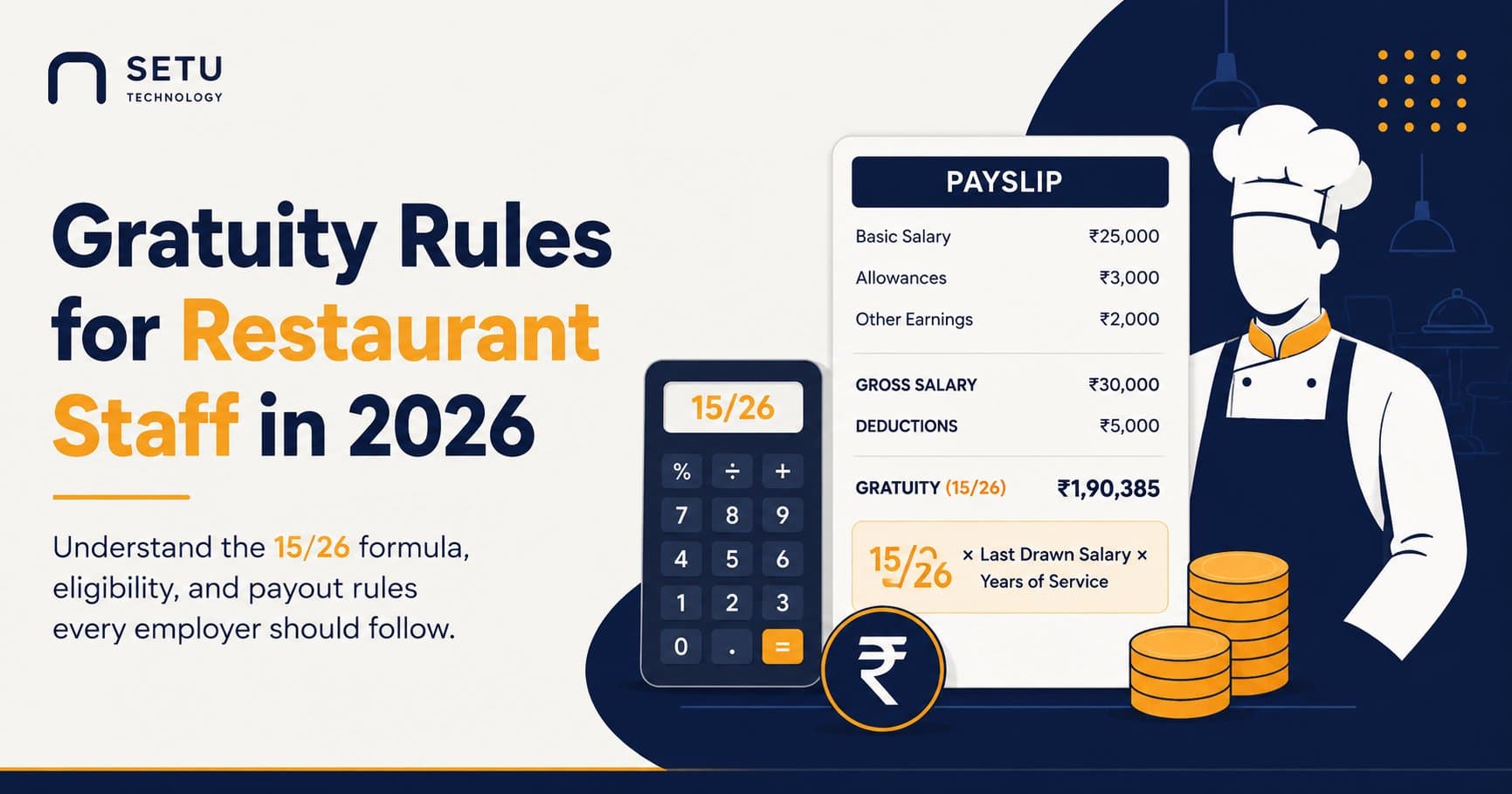
Gratuity Rules for Restaurant Staff in 2026: What Every Owner Must Pay (And How the 15/26 Formula Actually Works)
Restaurants churn staff faster than almost any industry — which is exactly why gratuity math trips owners up. Here's the real formula, the new fixed-term rule, and what a missed payment actually costs.
Read more →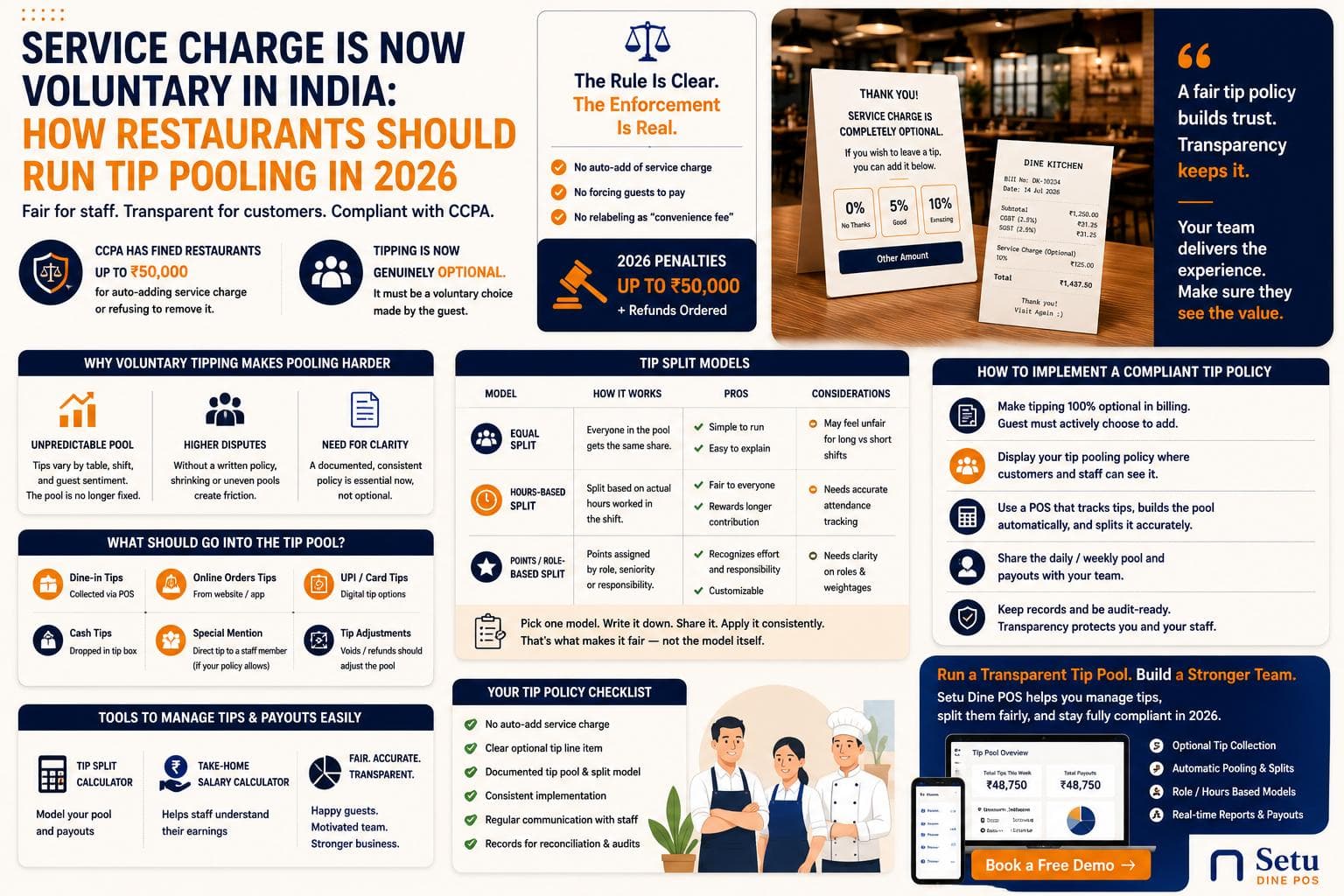
Service Charge Is Now Voluntary in India: How Restaurants Should Run Tip Pooling in 2026
Restaurants can no longer quietly add a 10% service charge and split it however they like. Here's how CCPA's 2026 crackdown changes tip pooling, and how to split a shrinking, unpredictable tip pool fairly across staff.
Read more →
GST Billing Checklist for Restaurants in India (2026)
The most common GST billing mistakes restaurants make, and a complete checklist to fix them before your next audit.
Read more →