Gratuity Rules for Restaurant Staff in 2026: What Every Owner Must Pay (And How the 15/26 Formula Actually Works)
Restaurants lose front-of-house and kitchen staff faster than almost any other industry — which is exactly why gratuity is the compliance item most owners get wrong. It isn't a bonus, and it isn't discretionary. Once an establishment has employed 10 or more people at any point, the Payment of Gratuity Act, 1972 applies to it permanently, even if headcount later drops back below 10. There's no opting out by shrinking the team.
Most owners find out how the math actually works the first time a five-year employee resigns — and by then, a wrong number isn't just an HR embarrassment. It's a legal entitlement the employee can contest.
What the Act Actually Requires
Gratuity becomes payable when an employee completes 5 years of continuous service (or 4 years and 240 days, under a separate provision) and then retires, resigns, or is terminated for reasons other than misconduct. It's also payable immediately on death or disablement, with the 5-year requirement waived entirely. Once it's due, the employer has 30 days to pay it — miss that window, and the unpaid amount accrues interest at 10% per year until it's settled.
The 15/26 Formula Most Restaurants Get Wrong
For establishments covered under the Act, the formula is:
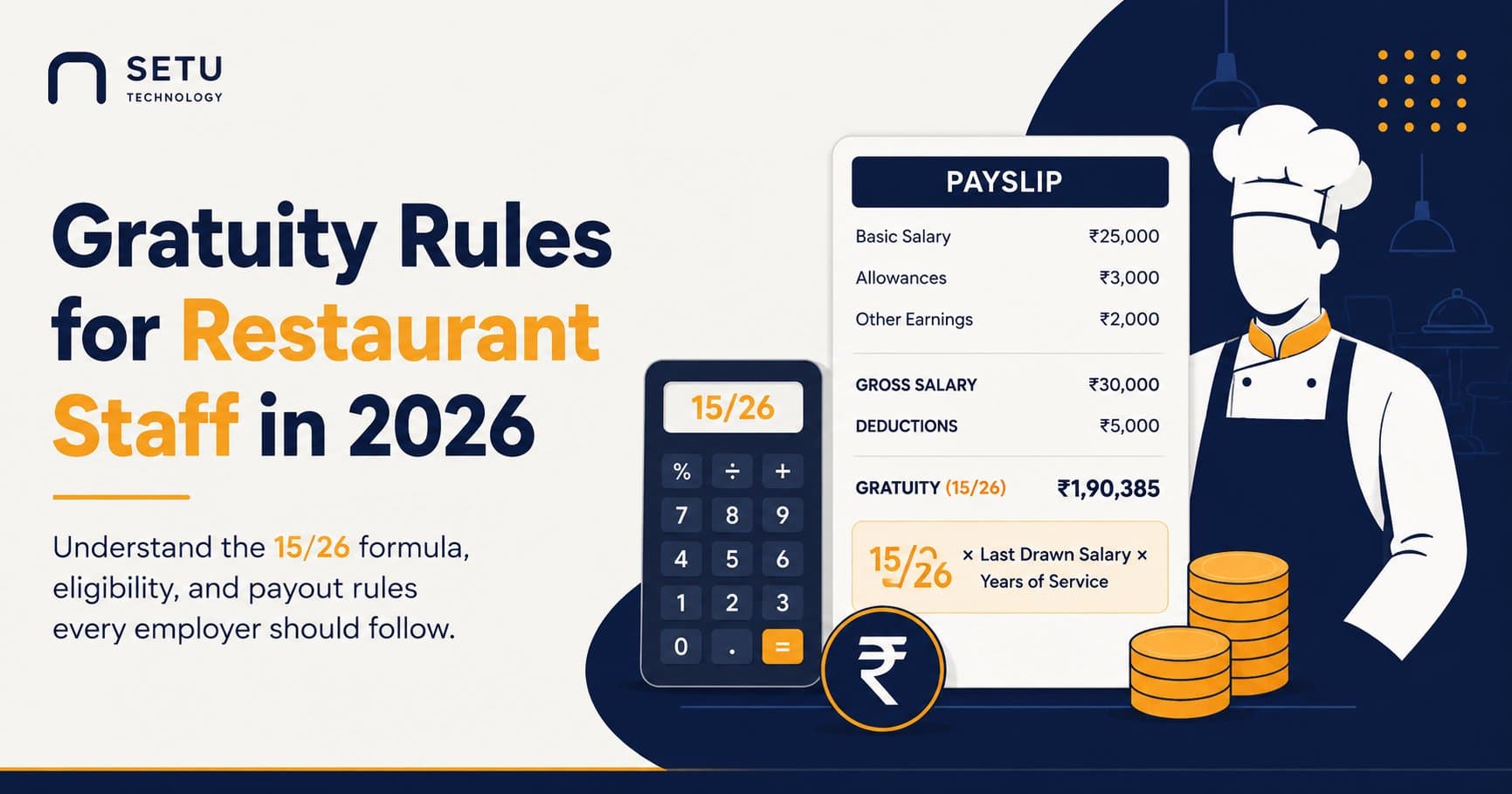
Gratuity = (Last Drawn Basic + DA) × 15 × Years of Service ÷ 26
The ‘26’ represents working days in a month (a four-week month minus weekly offs), and the ‘15’ represents 15 days of pay for every completed year served. Two details trip owners up every time: only Basic + DA counts — not the tips, service charge, or overtime that often make up a big share of a restaurant employee's real pay — and any service beyond 6 months in the final year rounds up to a full year.
Take a floor manager with a Basic + DA of ₹25,000/month who resigns after 7 years and 8 months. Rounded up to 8 years: ₹25,000 × 15 × 8 ÷ 26 = ₹1,15,385. Get the rounding wrong — count it as 7 years because “it's not quite 8” — and the payout is short by over ₹14,000, on a single employee.
The New Rule That Actually Changes Things for Restaurants
Restaurants and QSR chains lean on contract and seasonal staff more than most industries — festival-season hires, banquet staff, delivery-linked roles. Under the Code on Social Security, 2020, which took effect in November 2025, fixed-term contract employees are now eligible for pro-rata gratuity after just 1 year of service, instead of the 5 years required for permanent staff. Hire someone on a 1-year banquet season contract, and they're entitled to gratuity when that contract ends — something most restaurant payroll processes still aren't set up to catch.
What Getting It Wrong Actually Costs
Beyond the 10% annual interest on late payment, a wrong gratuity number is one of the more common triggers for a labour dispute in the restaurant industry, precisely because staff turnover is high and the calculation touches every departing employee. A single miscounted year of service, or a payout calculated on gross salary instead of Basic + DA, is the kind of error that looks small on one payslip and expensive across a whole staff roster.
Where This Fits Into Running the Floor
Gratuity is a downstream number — it depends on getting Basic + DA and exact tenure right for every employee, which is a payroll data problem before it's a gratuity problem. Setu Dine's staff and shift records exist for exactly this reason: they're the source of truth for tenure and pay structure, so the number isn't reconstructed from memory when someone hands in notice. Run the actual math on our free Gratuity Calculator, and check take-home pay implications with the Take-Home Salary Calculator.
Frequently asked questions
The Payment of Gratuity Act, 1972 applies to any establishment that has had 10 or more employees at any point — and once you cross that threshold, the Act keeps applying even if headcount later drops below 10. Below 10 employees and you've never crossed it, gratuity isn't a statutory requirement, though many owners pay it voluntarily using a slightly different formula (a 30-day divisor instead of 26).
More from Compliance
How to Use a GST Calculator in 2026: Inclusive, Exclusive and the New Slabs
Getting GST wrong on a bill is not a rounding error — it is money out of your margin or a mismatch your buyer's accountant bounces. This tutorial walks through the free GST Calculator: inclusive vs exclusive, the state split, and the 2026 slabs.
Read more →
India's New Wage Code Just Rewired Your Payroll Math: What Every SME Needs to Fix in 2026
India's four labour codes came into force on 21 November 2025 and Central Rules followed on 8 May 2026. The new rule that basic pay can't be less than 50% of CTC quietly changes PF, gratuity and overtime math for every SME. Here's what to check before your next payroll run.
Read more →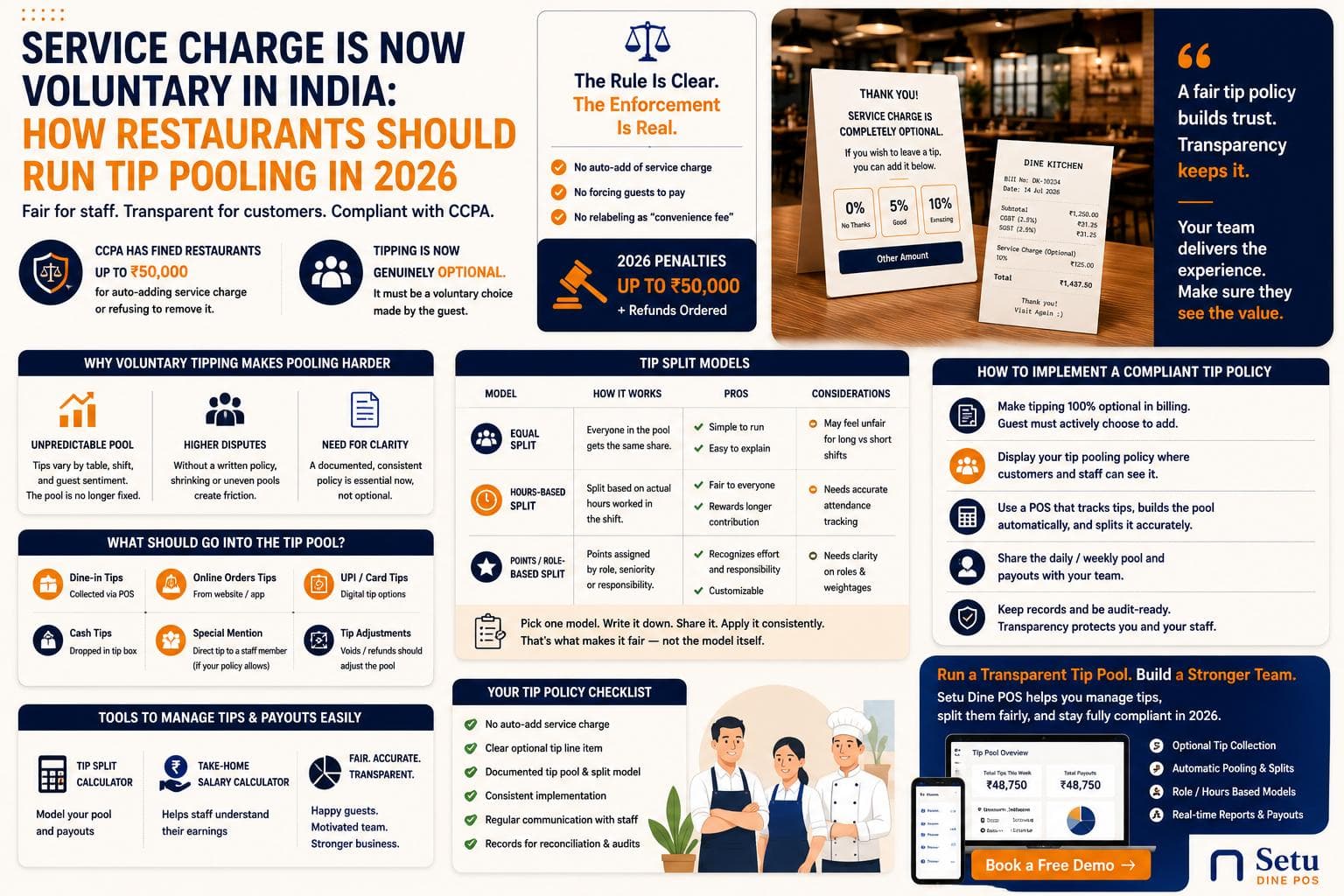
Service Charge Is Now Voluntary in India: How Restaurants Should Run Tip Pooling in 2026
Restaurants can no longer quietly add a 10% service charge and split it however they like. Here's how CCPA's 2026 crackdown changes tip pooling, and how to split a shrinking, unpredictable tip pool fairly across staff.
Read more →
GST Billing Checklist for Restaurants in India (2026)
The most common GST billing mistakes restaurants make, and a complete checklist to fix them before your next audit.
Read more →