The Real Cost of Making Diners Wait: Queue Management in 2026
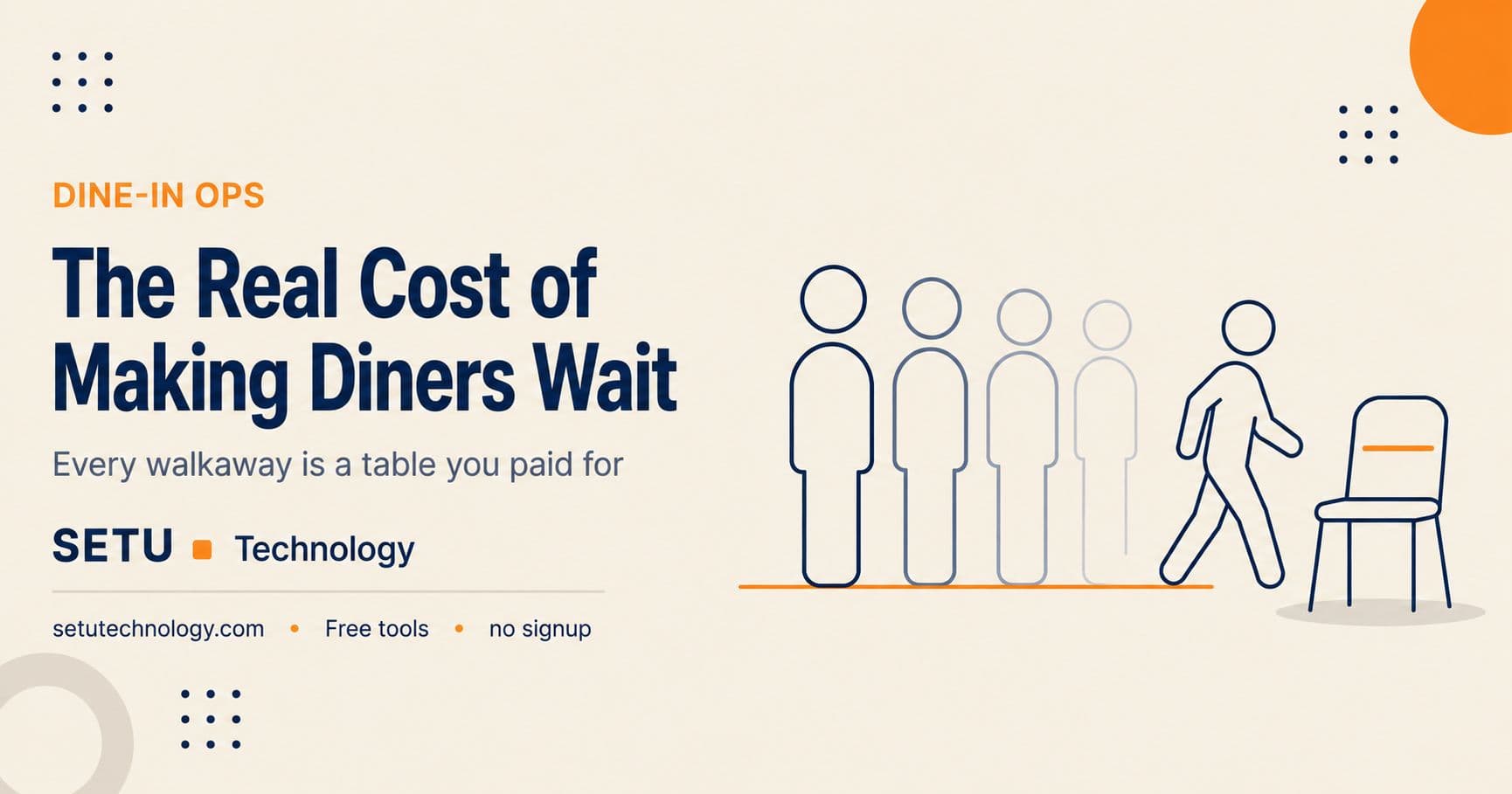
A line out the door reads like success. It photographs well, it signals demand, and for the first few minutes it genuinely helps — a short, visible wait can make a place feel worth trying. The trouble is what happens after those first few minutes, which is that people start doing arithmetic. How long is this really going to be. Is the place across the road emptier. And then some of them leave.
Those departures rarely show up anywhere you can see them. A walkout is not a refund or a complaint; it is simply a guest who was never billed. So the cost of making diners wait is real money that never appears as a loss on any report — which is exactly why it goes unmanaged. This post is about making it visible and then reducing it.
How little time you actually have
The tolerance for waiting is shorter than most owners believe, and it varies by format. Published 2025 industry figures put quick-service patience at roughly 8 minutes before a customer abandons a queue, while sit-down, walk-in tolerance runs closer to 15–30 minutes, with satisfaction falling off sharply once the wait passes about 20 minutes. (Treat these as directional benchmarks from operator surveys, not laws — your own guests will tell you your real number if you count.)
Two things matter more than the exact figure. First, the clock is shorter than it feels from behind the counter, where you are busy and time moves differently than it does for someone standing with nothing to do. Second, an unmanaged wait feels far longer than a managed one of the same length. A guest who has been given an honest estimate and can sit down or step away waits more patiently than one left standing at a podium with no idea whether it is five minutes or thirty.
What one walkout is really worth
Put a number on it, because "we lose a few" hides the size of the problem.
Take a casual-dining table that turns an average bill — your average order value — of ₹900. On a Friday rush that table might turn three or four times. A guest who walks at 7pm does not cost you one ₹900 cover; they cost you that seat's share of the rush, because you cannot always backfill an empty table instantly when the whole floor is full. Layer on the fact that you already spent to get that guest to your door — the customer-acquisition cost of the ad, the listing, the discount that pulled them in — and a walkout is a table you paid for twice and billed zero times.
Run the pattern across a month. A restaurant losing a handful of covers each weekend evening to walkaways is quietly writing off a meaningful slice of its best revenue — the peak-hour, full-price revenue that carries the slow middle of the week. That is what a queue abandonment problem costs when you actually total it.
Make it concrete. Six walkaway groups on a Friday and six more on a Saturday, at an average of two covers each and a ₹900 bill, is roughly ₹21,600 of billed revenue gone in a weekend — before you count the tables those groups would have turned, and before the acquisition spend that brought them in. Multiply by the weekends in a month and the number stops looking like "a few walkouts" and starts looking like a line item you would fight to protect if it appeared on a report. It does not appear on a report, which is exactly the problem.
Why guests really leave — and it is usually not capacity
The instinct is to blame a shortage of tables. Occasionally that is right. Far more often the wait is a flow problem wearing a capacity costume:
- Slow table turnover. Tables that sit uncleared, bills that take fifteen minutes to arrive, and a reset cycle that lags the door. The seats exist; they are just not becoming available fast enough. This is a table turnover rate problem, and it is measurable.
- A kitchen bottleneck at peak. If the pass jams at 8pm, seating more people just moves the wait from the door to the table — and a guest waiting 40 minutes for food is worse than one waiting 15 for a seat.
- Bad information at the door. "Maybe twenty minutes" said three times to three groups, with no list and no updates, converts a manageable wait into a stream of quiet exits.
The reason this matters: more tables is the most expensive possible fix, and usually the wrong one. Faster turnover and better information are cheaper and often solve the same walkouts.
Measure it before you fix it
You cannot manage a cost you do not count. Three numbers turn the guesswork into something you can act on:
- Quoted wait versus actual wait. If your actual seating time routinely beats your quote, you are scaring people off with pessimism. If actual routinely blows past the quote, you are breaking a promise and training guests not to trust the next one. You want quoted slightly conservative and actual reliably inside it.
- Walkaways per service. A simple tally of groups who ask, hear the wait, and leave. Track it by daypart. A spike at a predictable time tells you where the turnover or kitchen fix belongs.
- Turnover by daypart. Use the Table Turnover Rate Calculator to see how many times each table actually turns during the rush. If the number is low exactly when the queue is long, your problem is on the floor, not at the door.
None of this needs new hardware. It needs someone counting for two weekends. Our fuller treatment of the turnover side is in table turnover time for restaurants in 2026.
The cheap fixes, in order
Give an honest quote and a way to leave. The single highest-return change is telling guests a realistic wait and letting them step away without losing their place — a name on a list and a message when the table is ready. It does not create seats, but it converts the uncertain leavers, who are most of them, into stayers. Setu's queue and token system is built for exactly this: a managed waitlist instead of a crowd at the podium.
Attack the reset cycle. Clear, clean and re-seat faster and every table gains a fraction of a turn. Across a rush, fractions of a turn on every table is a whole extra seating.
Unblock the kitchen before you seat more. If the pass is the constraint, seating faster makes the experience worse, not better. Fix the bottleneck first, then open the door wider. A browser-based POS that fires orders straight to the kitchen removes one common source of the jam — the lag between order taken and order cooking.
Only then, consider capacity. If turnover is genuinely healthy and the kitchen is keeping up and you are still turning people away every night, that is the good problem — the one where more seats actually pays back. Reach it last, not first.
What "good" looks like
A well-run wait is not a zero wait — a short, visible queue still helps you. It is a wait that is honest and managed: a realistic quote at the door, a name on a list rather than a crowd at the podium, a message when the table is ready, and an actual seating time that reliably lands inside the quote. Get there and two things happen at once. The guests who used to leave from uncertainty now stay, and the ones who do wait arrive at the table in a better mood, which shows up in what they order and whether they come back. The queue stops being a leak and goes back to being what it looked like from the start: a sign that people want in.
The honest bottom line
A queue is not proof of success; it is a test of how well you manage the minutes after a guest decides to try you. Past a short, format-specific threshold, every extra minute of an unmanaged wait is converting demand you already earned into revenue for the restaurant next door. The fix is rarely more tables. It is honest information at the door, faster turns on the floor, and an unblocked kitchen — and the first step is simply counting the walkaways you have been trained not to see.
Frequently asked questions
It varies by format, but published 2025 figures put quick-service tolerance around 8 minutes and sit-down walk-in tolerance closer to 15–30 minutes, with satisfaction dropping sharply past 20. The practical rule: the number is lower than owners assume, and it collapses when the wait feels unmanaged rather than long.
More from Dine-In Ops
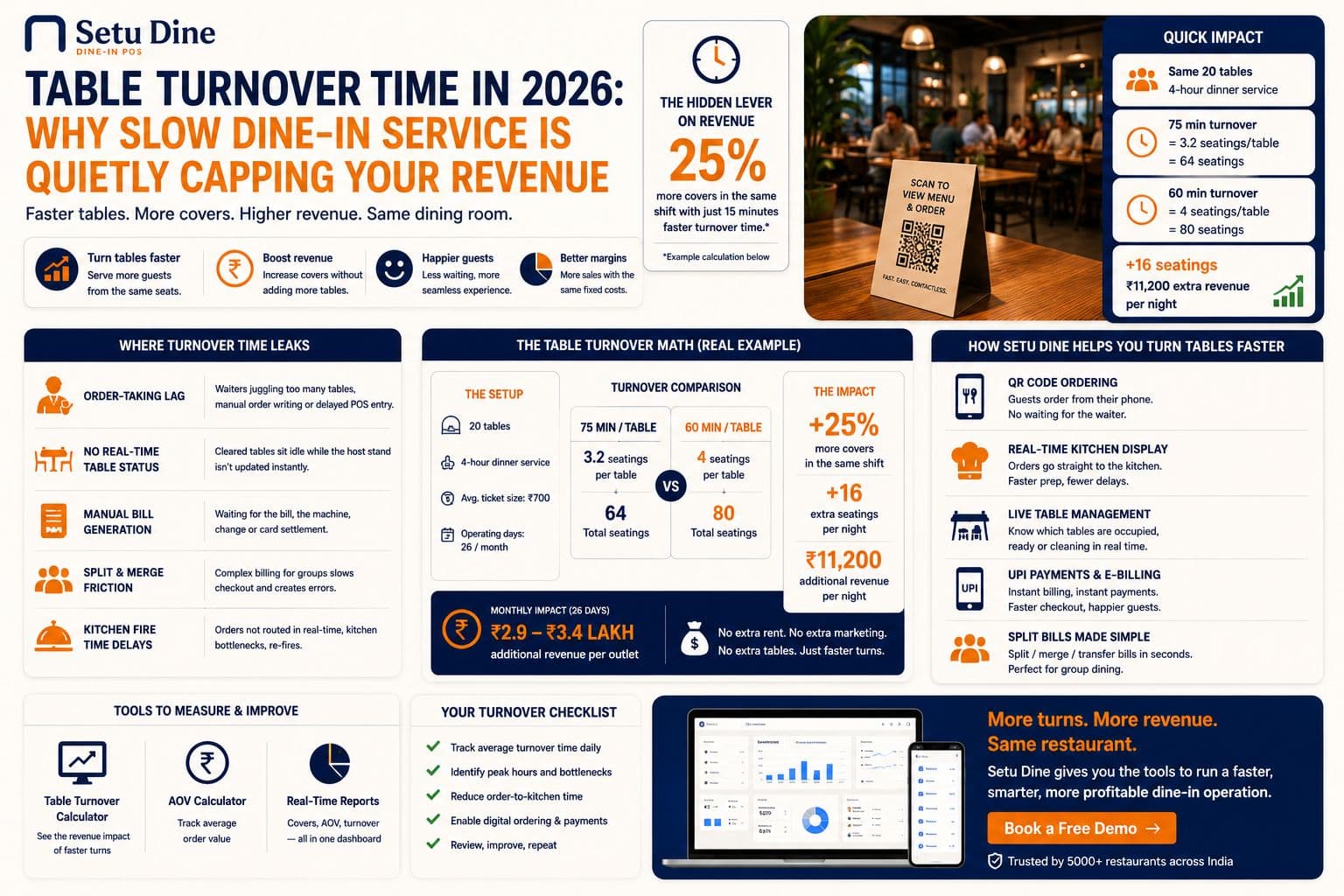
Table Turnover Time in 2026: Why Slow Dine-In Service Is Quietly Capping Your Restaurant's Revenue
You can't add more tables to a full dining room. But you can turn the ones you have faster. Here's what's actually slowing down table turnover in 2026, and the fixes that don't require a bigger floor plan.
Read more →