Outsourced Bookkeeping vs. In-House: The Real 2026 Cost Math (and the Lock-In Risk Nobody Talks About)
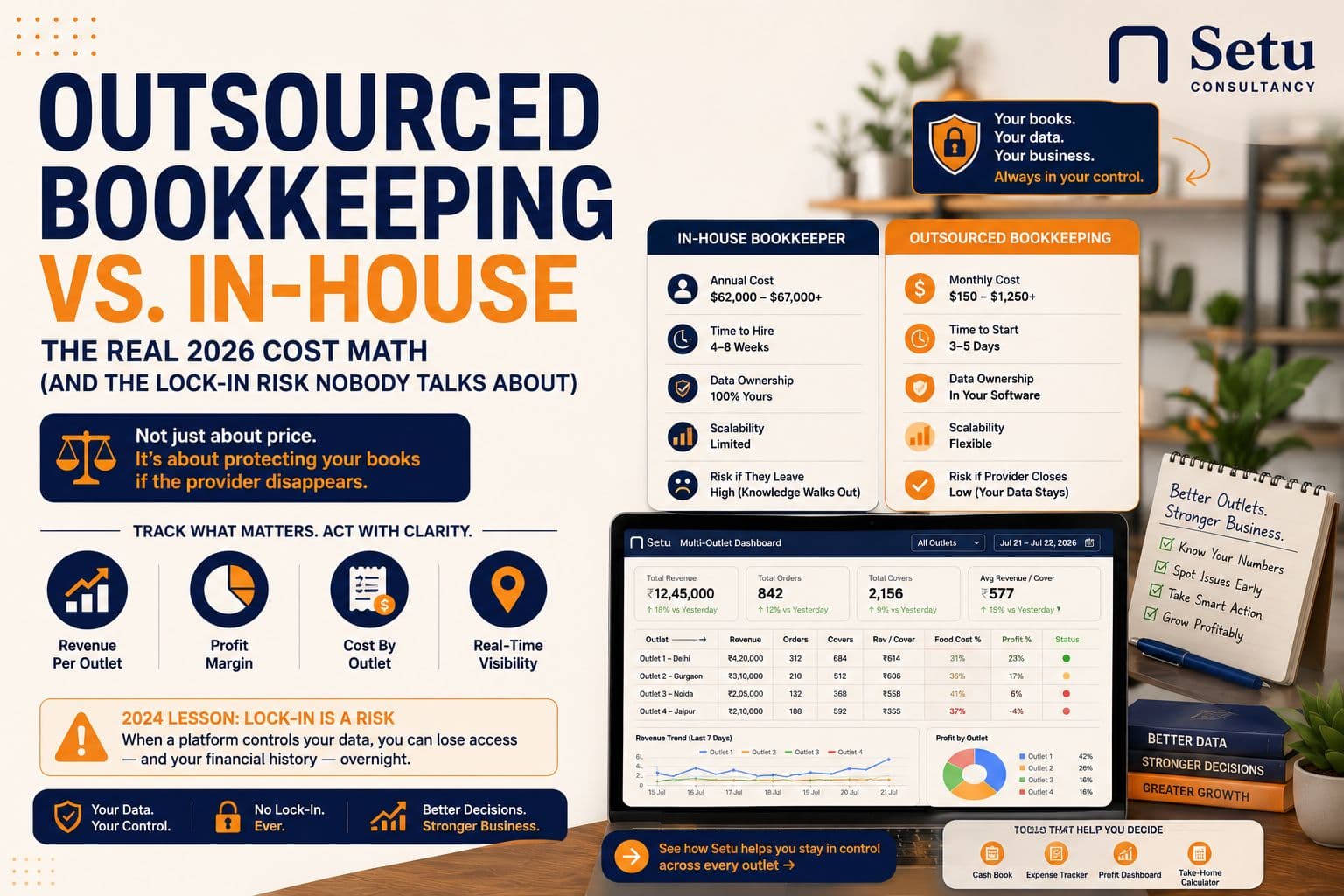
Every small business owner ends up asking the same question eventually: hire someone to keep the books, or send them out to a firm. Almost everyone decides that question on price — a monthly retainer versus a full-time salary — and stops there. 2024 handed the bookkeeping industry a hard lesson in why that comparison is incomplete: a bookkeeping platform with over a decade of history, more than a hundred million dollars in venture funding, and tens of thousands of small-business clients shut down its systems with almost no warning, leaving those businesses locked out of their own financial records. The real comparison isn't just what each option costs each month. It's what happens to your books if the provider disappears.
Worth noting first: a 2021 QuickBooks Live survey found that roughly a third of small business owners were still doing their own bookkeeping at midnight and on weekends rather than choosing either option. If that's you, the cost math below is exactly what you're trying to decide between.
What an in-house bookkeeper actually costs
In the United States, the U.S. Bureau of Labor Statistics puts the median annual wage for bookkeeping, accounting and auditing clerks at just over $49,000 as of May 2024, with the bottom 10% under $35,000 and the top 10% above $72,000. That's salary only. Add a standard employer burden of 15–30% for payroll taxes, benefits and the software seat they'll need, and a single fully loaded in-house bookkeeper typically runs somewhere between $62,000 and $67,000 a year — before you've accounted for the time you spend reviewing their work, or covering the gap when they're out sick or leave for a better offer. (Outside the US, swap in your local median wage; the loading math works the same way.)
What outsourced bookkeeping actually costs
Outsourced monthly bookkeeping generally runs anywhere from around $150 a month for a very simple, low-volume business up to $1,250 or more for a business with heavier transaction volume and more complex reporting needs. As of 2026, named providers' starting prices give a useful sense of range — QuickBooks Live around $300/month, a relaunched Bench around $299/month, Merritt in the $190–$250/month range, Bookkeeper360 around $399/month with a lighter $49 software-only tier, and Pilot in the $599–$699/month range. Treat every one of these as a snapshot: pricing in this market moves often, and — as the next section shows — providers themselves sometimes don't survive.
The collapse that changed how this decision should be made
In late December 2024, Bench Accounting told its clients the platform would no longer be accessible, effective December 27. At the time it had roughly 12,000 active clients, who were given only until March 7, 2025 to export their financial data before losing access for good. Bench went on to file for bankruptcy in Canada in January 2025, with debts reported above $65 million, despite having raised $113 million in total funding — including a $60 million round in 2021 — and running an operation of around 650 people out of Vancouver. It was eventually acquired by Employer.com, but by then the disruption had already landed on thousands of small business owners.
The root cause matters more than the headline. Bench ran its own proprietary software. A client's entire financial history — every transaction, every reconciliation, every prior year's statements — lived inside a platform the client didn't own and couldn't cleanly export once it went dark. Businesses that outsourced their books specifically to save time suddenly had to reconstruct a year or more of financial history from raw bank statements, on a hard deadline, while still running day-to-day operations.
The question most cost comparisons skip entirely
Before comparing monthly fees, there's a more important question: does this provider do the work inside accounting software you own, or inside a platform only they control?
If it's the former — QuickBooks Online or Desktop, Xero, Zoho Books, FreshBooks, Wave, or an industry tool like Appfolio or Resman for real estate — your ledger already lives in an account with your name on it. If that provider closed tomorrow, you'd still have your books. You'd just need to find someone new to keep entering transactions.
If it's the latter, you're effectively renting access to your own financial history, and the provider's business risk quietly becomes your risk. This is the exact distinction Bench's clients learned the hard way. It's also the reason Setu's bookkeeping team works directly inside a client's own QuickBooks Online or Desktop, Xero, Zoho Books, Appfolio, Resman, FreshBooks or Wave account — never a closed platform of our own.
When it actually makes sense to outsource — not just on price
The trigger points that actually signal it's time, regardless of what a retainer costs:
- Bank and credit card reconciliations are consistently a few weeks (or months) behind
- Month-end close routinely slips past the first week of the following month
- You, the owner, are the one doing the books — at night or on weekends — instead of running the business
- You can't answer "what's my current cash position" without digging through statements
- Accounts receivable aging isn't tracked, so overdue invoices go unnoticed
- Transaction volume has outgrown what one person can track accurately by hand
A short checklist before you sign with any provider
- Which accounting software does the work actually live in — and do you have your own owner-level login to it?
- What's the data-export process, and how fast can you get a complete export if you switch or cancel?
- Is pricing tied to transaction volume and complexity, and does it scale predictably as you grow?
- Does the provider have real experience in your specific industry — a real estate trust account looks nothing like an e-commerce ledger?
- Can the billing cadence flex — weekly, bi-weekly, monthly, quarterly, yearly — as your business needs change, rather than locking you into one rhythm?
A quick note on the software itself
Zoho Books offers a genuinely free tier for businesses under $50,000 in annual revenue. Xero includes unlimited users on every plan, useful if more than one person on your team needs visibility. QuickBooks Online has the deepest bookkeeper and accountant familiarity, particularly in the US. But the platform you pick matters less than whether you actually control the account it runs in — that's the lesson worth carrying out of 2024, regardless of which software you choose.
Setu's accounting, bookkeeping and payroll team works inside your own QuickBooks, Xero, Zoho Books, Appfolio, Resman, FreshBooks or Wave account, on a weekly, bi-weekly, monthly, quarterly or yearly cadence — never inside a closed platform of our own. If you're also weighing where AI genuinely speeds up the close versus where it still needs a human checking the work, we broke that down separately too.
See what's included in Setu's bookkeeping and payroll services →
Frequently asked questions
Usually, yes. A fully loaded in-house bookkeeper commonly runs $62,000–$67,000 a year, while outsourced monthly bookkeeping ranges from about $150 to $1,250+ depending on transaction volume and complexity.
More from Accounting
What to Send Your Bookkeeper Every Month, and Who Owns What
Most bookkeeping relationships stall over supply, not skill: one missing bank statement and the month cannot close. Here is the seven-part monthly pack, a task-by-task split of who owns what, and the dates worth writing into the engagement letter.
Read more →
Your Bookkeeper Sent Three Statements. Here Is How to Read Them.
Every month an outsourced bookkeeper sends a profit and loss statement, a balance sheet and a cash flow statement, and most owners glance at one number and file the rest. Here is what each statement actually answers, and in what order to read them.
Read more →
Comparing Bookkeeping Quotes: The Eight Questions That Matter
Two bookkeeping quotes use identical words and differ by three times in price, because price without scope is not a price. The eight questions that make quotes comparable, the four red flags, and an in-house cost comparison that carries its full weight.
Read more →
Are Your Books Audit-Ready? A Year-End Checklist for FY 2025-26
Tax-audit returns are due 31 October 2026 and GSTR-9 by 31 December 2026, but the work that makes those filings painless happens now. Here's a year-end checklist to get FY 2025-26 books audit-ready — and an honest note on when to outsource the cleanup.
Read more →