Your Bookkeeper Sent Three Statements. Here Is How to Read Them.
An outsourced bookkeeper does the work, and once a month an email arrives with three attachments. Most owners open the first one, find the bottom line, feel either relieved or worried about it, and never open the other two. That is a shame, because the statement everyone reads is the one most likely to be misread on its own, and the two nobody opens are the ones that explain it.
This is not an accounting lesson. It is a reading order, a short list of what each statement can and cannot tell you, and the handful of questions worth sending back. Ten minutes a month, properly spent.
What you should be receiving
A monthly bookkeeping engagement normally produces the same bundle: the books written up for the period, a trial balance behind them, and then three reports built on top — a profit and loss statement, a balance sheet and a cash flow statement. Alongside those, most engagements include bank and card reconciliation, income and expense categorisation, journal entries and adjustments, and some form of receivables and payables tracking. That is roughly the scope Setu's accounting and bookkeeping service runs on, and it is a fair benchmark to hold any provider to.
If what lands in your inbox is a spreadsheet of transactions and nothing else, you are being sent raw material rather than accounts. Ask for the three statements by name.
Read the cash flow statement first
This is the reversal most owners find useful. Profit is an opinion built on timing rules; cash is a fact. So start with the statement that explains where the money actually went, then use the other two to understand why.
A cash flow statement splits the month's movement into three buckets. Operating is the business doing its job: customers paying, suppliers and staff being paid. Investing is money that left to buy something durable, an oven, a fit-out, a vehicle. Financing is loans in and loan repayments out, plus anything you put in or took out yourself.
The single most useful habit is to compare operating cash with the profit figure on the other statement. If operating cash is consistently below profit, the business is turning sales into something other than money — usually receivables that are stretching, or stock that is building. If operating cash is comfortably above profit, you may be running on customer money collected in advance, which is pleasant until the delivery falls due. Either direction, three months of the same gap is a pattern and worth a conversation.
Then the profit and loss, by shape rather than bottom line
A profit and loss statement answers one question: did the period's trading make money on the timing rules of accounting. The bottom line is the least interesting part of it. The shape is where the information lives.
Read it in three moves. Revenue first, against the same month last year rather than against last month, so that a seasonal dip does not read as a decline. Then direct costs as a percentage of revenue, not as a rupee figure, because the percentage is the number that tells you whether your pricing is still holding while supplier rates move. Then the overhead block, which should be boring; any line that has moved more than a fifth without a reason you can name is worth asking about.
Two things this statement will not tell you, and both catch people out. It does not show the principal portion of a loan repayment, because repaying principal is not an expense — so a month of heavy EMIs can show healthy profit and a shrinking bank balance. And it does not show stock you bought and have not sold, which sits on the balance sheet instead. A month of aggressive purchasing looks identical to a good month here.
Then the balance sheet, as a trend and not a snapshot
A balance sheet is a position at one instant, which makes a single month's copy almost useless and a run of twelve genuinely valuable. Keep them and read the direction of travel.
Four lines carry most of the signal. Receivables, which should move roughly in step with revenue — if revenue is flat and receivables are climbing, your collection has slipped rather than your sales. Stock, where the same logic applies in reverse. Payables, where a rising balance can mean either useful supplier credit or bills you cannot yet pay, and only you know which. And cash, which you already understand from the first statement you read.
Underneath all three reports sits the trial balance, which is simply every account and its closing figure, debits equalling credits. It is not a report to read for insight, but it is the document to ask for when a number looks strange, because every line in the three statements is built from it.
Five questions worth sending back
The point of reading the accounts is to ask better questions than whether the profit is right. These five earn their keep every month.
- Which transactions make up this line? Always the first question about anything odd. The answer takes a competent bookkeeper two minutes and resolves most surprises as a miscategorisation.
- What is still sitting in suspense or unreconciled? Every set of books has a few items nobody could classify. You want to know the size of that pile, not to be protected from it.
- Which customers make up the receivables figure, and how old is each? One number hides everything that matters here. An age-wise breakdown turns it into a collections list.
- What did you have to assume? Bookkeeping involves judgement calls on unlabelled payments and part-personal expenses. The assumptions should be visible to you, not buried.
- What changed in how something is treated? If a recurring cost moved from one category to another, this month's comparison against last month is broken until you know.
When the pack itself is the problem
Sometimes the reading is fine and the material is not. Three symptoms are worth naming, because each has a different fix and none of them is you trying harder.
The pack arrives but the dates keep moving. A report that lands anywhere between the fifth and the twenty-second stops being part of your routine, because you can never plan to read it. Fix the day in the engagement scope rather than chasing it each month.
The figures change after you have read them. Restatements are normal once or twice a year when a prior-period error surfaces. If last month quietly looks different every time you open it, the books are being adjusted continuously rather than closed, and the pack is a draft being passed off as a report. Ask when the period is locked.
You get the statements but never the detail behind them. This is the serious one. Accounts you cannot drill into are accounts you have to take on faith, and the whole point of receiving them monthly is that you can test them. Any provider should be able to produce the ledger behind a line within a day, and reluctance to do so tells you more than the numbers do.
None of the three is unusual, and all three are easier to raise early, in a scope conversation, than nine months in when the relationship already has history.
Make it a ten-minute monthly routine
Open the cash flow statement and look at operating cash against profit. Open the profit and loss and check revenue against the same month last year, then direct costs as a percentage. Open the balance sheet and look at receivables, stock, payables and cash against the previous two months. Write down anything that surprised you, send the list back, and stop.
Doing that twelve times is how an owner stops being dependent on a single number someone else produced. You do not need to learn double-entry to run a business well, but you do need to be able to tell the difference between a good month and a month that merely looked like one — and that difference is almost always sitting in the attachments nobody opens.
If your current arrangement cannot answer the five questions above within a day, the problem is the arrangement rather than your reading. Accounts you cannot interrogate are not much better than no accounts at all.
Frequently asked questions
Because the two statements are measuring different things on purpose. Profit counts a sale when you raise the invoice; the bank counts it when the money lands. Add in stock you paid for but have not sold, an EMI whose principal portion never appears as an expense, and tax set aside, and a profitable month with a falling balance is ordinary rather than alarming. The cash flow statement is the one that reconciles the gap.
More from Accounting

What to Send Your Bookkeeper Every Month, and Who Owns What
Most bookkeeping relationships stall over supply, not skill: one missing bank statement and the month cannot close. Here is the seven-part monthly pack, a task-by-task split of who owns what, and the dates worth writing into the engagement letter.
Read more →
Comparing Bookkeeping Quotes: The Eight Questions That Matter
Two bookkeeping quotes use identical words and differ by three times in price, because price without scope is not a price. The eight questions that make quotes comparable, the four red flags, and an in-house cost comparison that carries its full weight.
Read more →
Are Your Books Audit-Ready? A Year-End Checklist for FY 2025-26
Tax-audit returns are due 31 October 2026 and GSTR-9 by 31 December 2026, but the work that makes those filings painless happens now. Here's a year-end checklist to get FY 2025-26 books audit-ready — and an honest note on when to outsource the cleanup.
Read more →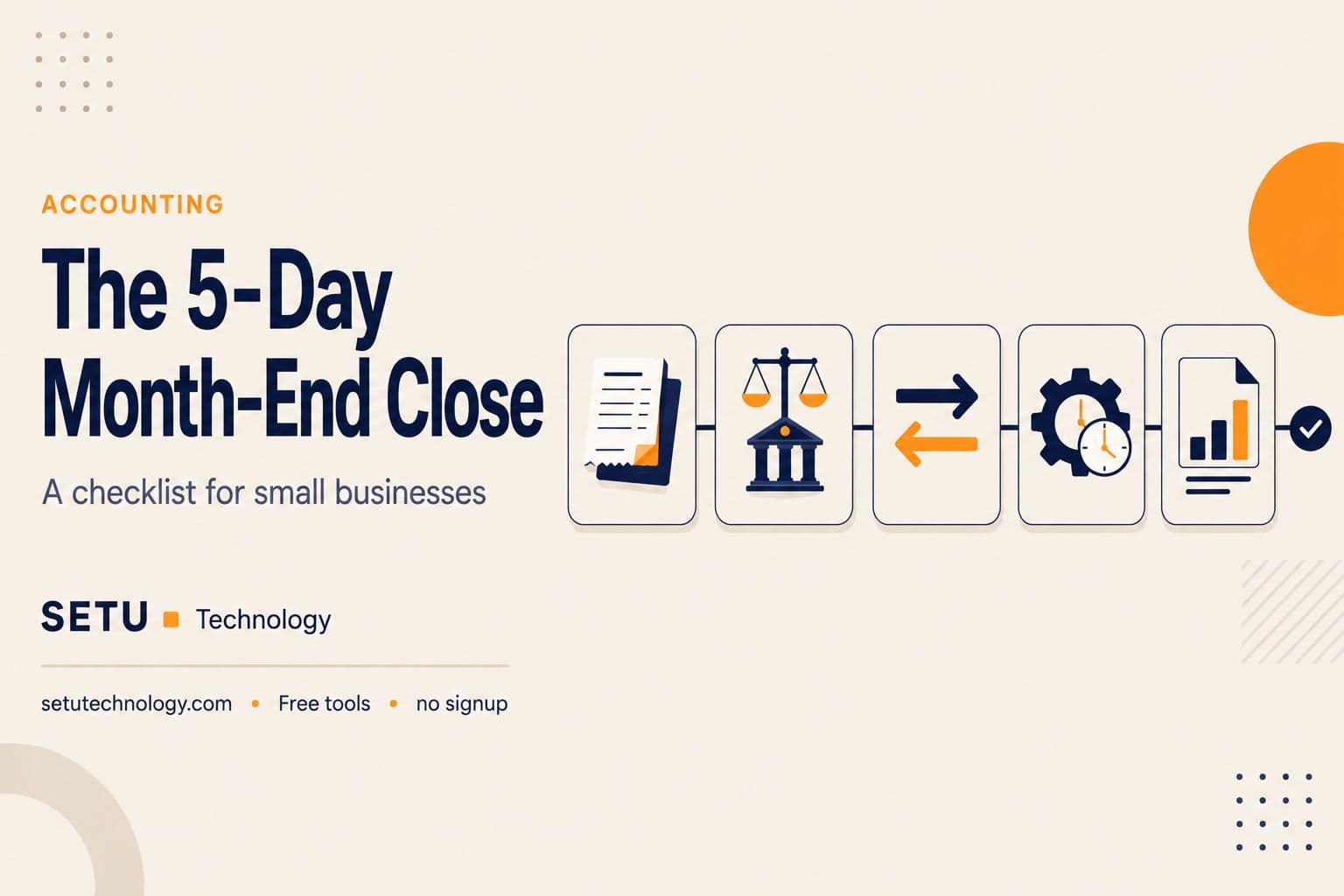
The 5-Day Month-End Close: A Checklist for Small Businesses in 2026
Most small businesses don't have a slow month-end close — they have no close at all, and the March numbers arrive in June. Here's a five-working-day version you can run with free tools, and the point at which handing it over makes more sense.
Read more →