Discount Maths: What 20% Off Actually Costs You, and How Much Extra You Must Sell
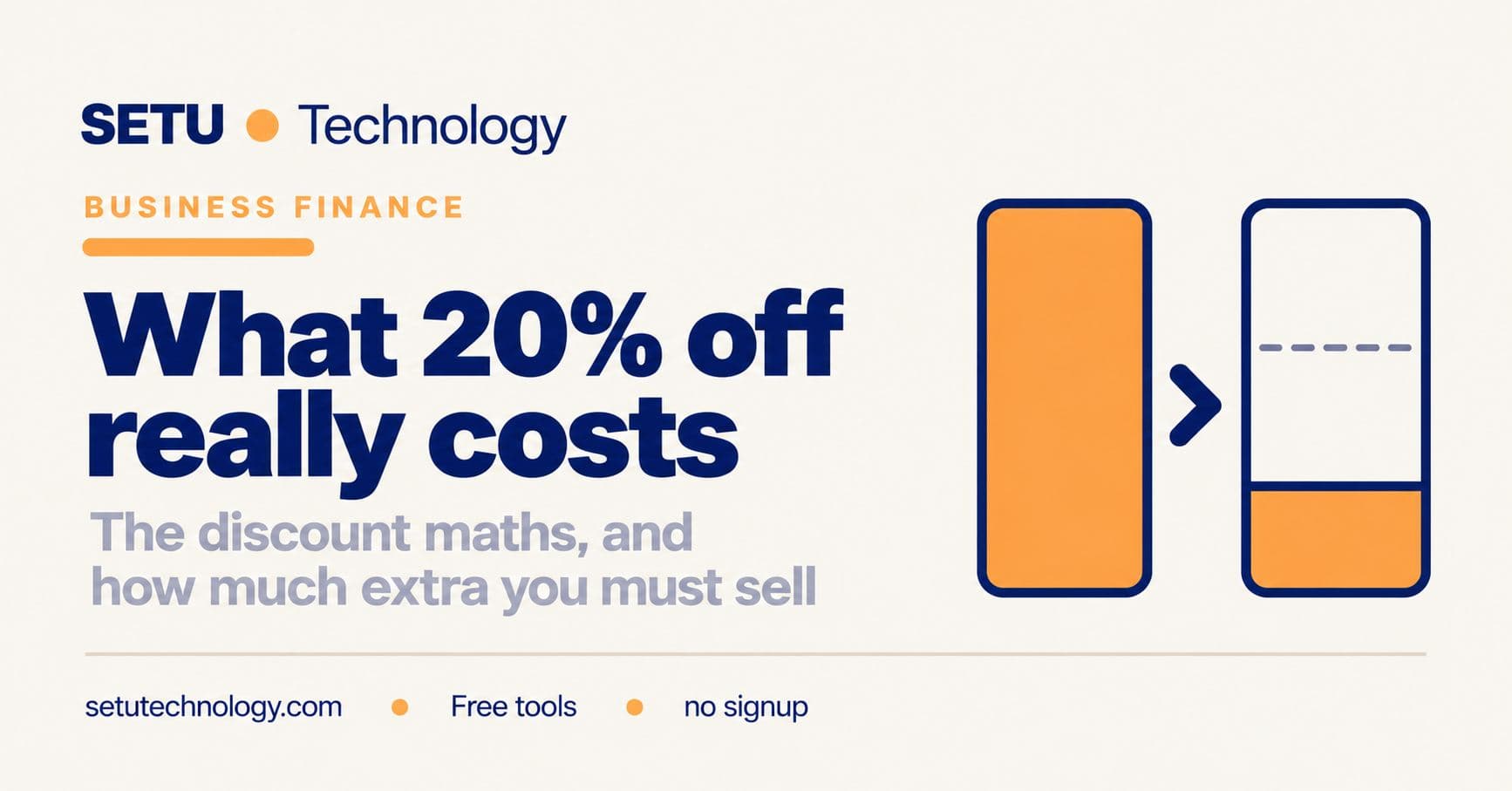
Every discount conversation runs on the same unexamined assumption: that taking 20% off a price costs you 20%. It does not, and the gap between what people assume and what actually happens is the reason festive offers so often end with more boxes sold, more hours worked and less money in the bank.
Here is the arithmetic, done slowly once, with the three free calculators that will do it for you afterwards in about forty seconds.
Start with the one example that explains everything
An item costs you ₹600 and sells for ₹1,000. Your gross profit is ₹400 and your margin is 40% of the selling price. Those are the only numbers you need.
Now take 20% off. The price becomes ₹800. Your cost has not moved, so your gross profit is ₹200. The discount was 20% of the price — and it was 50% of your profit.
That is the whole idea. A discount comes out of the margin, not out of the revenue, because the cost is fixed. The percentage the customer sees and the percentage you lose are measured against completely different bases, and the smaller your margin, the more violent the difference.
| Discount | Selling price | Gross profit | Share of profit lost |
|---|---|---|---|
| 0% | ₹1,000 | ₹400 | — |
| 10% | ₹900 | ₹300 | 25% |
| 20% | ₹800 | ₹200 | 50% |
| 30% | ₹700 | ₹100 | 75% |
| 40% | ₹600 | ₹0 | 100% |
Read the last row again. A discount equal to your margin wipes out the gross profit entirely. You are not making a thin margin at that point; you are working for nothing and paying for the packaging. For a business running on a 20% margin, that line arrives at 20% off — which is roughly the discount everybody advertises without thinking.
The formula worth memorising
To earn the same gross profit after a discount, divide your margin by what the discount leaves of it.
Volume multiplier = margin % / (margin % - discount %)
At 40% margin and 20% off: 40 / 20 = 2. You need to sell twice as many units to stand exactly where you started. At 10% off: 40 / 30 = 1.33, so a third more units. At 30% off: 40 / 10 = 4, four times the volume. The curve is not gentle, and it steepens exactly where the offers get attractive.
Run the same formula on a 20% margin and the picture becomes severe. A 5% discount needs a third more units. A 10% discount needs double. A 15% discount needs four times the volume. If you sell on thin margins, you do not have a discounting lever at all — you have a bundling lever, a timing lever and a cost lever, and pretending otherwise is how low-margin retailers trade themselves into trouble during a sale.
Before you accept any of this for your own numbers, get the margin right. Put cost and selling price into the Profit Margin Calculator and use the figure it gives you. The Discount Calculator then handles the price side — the discounted amount, the rupees given away, and the effective rate when two offers stack, which is the case people get wrong by hand.
The markup trap
This is the error that turns a planned offer into a loss, and it is purely a vocabulary problem. Markup is calculated on cost. Margin is calculated on selling price. They are different numbers for the same transaction, and most small businesses set prices in markup and then discuss discounts in margin.
An item costing ₹600 with a 20% markup sells at ₹720. That looks like a 20% cushion. It is not: ₹120 of profit on a ₹720 price is a margin of 16.7%. Offer 20% off and the price lands at ₹576, which is ₹24 below what you paid for it. You have advertised a sale that loses money on every unit, and the busier the day, the worse it gets.
The Markup Calculator converts between the two in one step. The habit worth building is simple: never approve a discount percentage until you have seen the margin percentage next to it.
Pricing so a discount does not hurt
If you know you will be running offers — because your category does, or because your platform demands it — build the room in at the start rather than carving it out later.
Divide cost by the discounted share of the price, times the share of revenue you intend to keep. For a 20% offer that must still leave a 40% margin: 0.8 × 0.6 = 0.48, and ₹600 / 0.48 = ₹1,250. List at ₹1,250, discount 20% to ₹1,000, keep your 40%. The arithmetic always works.
Whether it works commercially is a different question, and it deserves an honest answer. If ₹1,250 is not a price a customer would ever pay, you have not created headroom, you have created a fictitious list price that trains people to wait for the sale and to distrust the full price when it returns. Permanent discounting is just a lower price with extra admin. The technique is sound for genuine seasonal offers and unconvincing as a year-round posture.
When a discount genuinely pays
The volume formula assumes the discount is the only thing that changes. It usually is not, and the cases where discounting works are the ones where something else moves with it.
The basket gets bigger. Suppose your average order is ₹1,000 at a 40% margin, which is ₹400 of gross profit. Offer 10% off orders above ₹1,500 and a customer who would have spent ₹1,000 spends ₹1,600 instead. Cost of goods is 60% of ₹1,600, so ₹960; you collect ₹1,440; gross profit is ₹480. That is ₹80 more than before, on the same single transaction. Threshold offers work when the uplift is real, and the AOV Calculator is how you find out whether it was, by comparing the average order before and during the offer rather than trusting the feeling that it was busy.
The stock was going to die anyway. Ageing inventory has no margin to protect, only cash to recover. A 40% discount on something that will otherwise be written off is not a 40% loss, it is a recovery of 60%. Discount the slow lines hard and leave the fast ones alone; blanket store-wide percentages do the opposite and give away the margin on exactly the items that did not need help.
The customer comes back. A first-order discount can be rational if the second order arrives at full price, but only if you actually measure whether it does. If you have never checked the repeat rate on discounted first orders against undiscounted ones, you are not running an acquisition offer, you are running a permanent price cut for new customers.
One more thing to keep straight: where the discount sits on the paperwork. A reduction shown on the invoice itself generally reduces the taxable value, while a discount granted after the sale carries conditions around prior agreement and linkage to specific invoices. Your offer design has a tax consequence, not just a margin one — this is not tax advice, so confirm the treatment of your particular scheme with your CA before you print the posters.
The forty-second version
Before the next offer goes out: get the real margin from the margin calculator, divide it by what the discount leaves, and look at the volume multiplier. If it is above about 1.5 and you cannot name a concrete reason volume will rise that much, the offer is a transfer from you to your customers with a busy day attached. Narrow it to slow stock, attach it to a basket threshold, or make it a free add-on costed at cost price instead.
None of this argues against discounting. It argues against discounting by instinct, which is the only expensive way to do it.
Frequently asked questions
Divide your margin percentage by what is left of it after the discount. At a 40% margin, a 20% discount leaves 20 points, and 40 divided by 20 is 2 — so you need twice the units to earn the same gross profit. That one division answers nearly every offer you will ever consider, and it is why a discount equal to your margin is the point where an item earns nothing at all.
More from Business Finance
The MSME 45-Day Payment Rule in 2026: New Section, Same Deadline, Same Cash-Flow Squeeze
Section 43B(h) has moved into the Income-tax Act, 2025 as Section 37(2)(g) from 1 April 2026. The section number changed, the 15/45-day deadline did not — and for most SMEs this is a working capital rule wearing a tax rule's clothing.
Read more →
Small Business Loans Are Still Expensive in 2026 (Even as Rates Ease): What SMEs Can Actually Control
Policy rates are falling in 2026, but most small businesses aren't seeing cheaper loans — OECD data shows SME credit stock is still stagnant and borrowing costs remain high. Here's why the gap exists and what's actually in your control.
Read more →
94% of Small Business Owners Expect Growth in 2026. Half of Them Can't Predict Their Own Cash Flow.
Small business optimism just hit an all-time survey high — 94% expect growth in 2026. At the same time, close to half still can't reliably predict their own cash flow. Here's what's driving the gap, and the habits that close it.
Read more →
Small Business Late Payments Hit a Record High in 2026: What $17.7K in Unpaid Invoices Is Actually Costing Owners
Nearly 3 in 5 small businesses now have invoices overdue by 30 days or more, up from under half last year. Here's what's driving the record, what it costs downstream, and the fixes the data says actually work.
Read more →