Diwali Bonus and Gifts: Three Thresholds That Do Not Line Up

Lakshmi Puja falls on Sunday 8 November, and most owners will hand out an envelope and a sweet box without thinking of either as a tax event. Both are. A Diwali payment to staff touches the Code on Wages, the income-tax perquisite rules and, for a hamper, GST as well — three rulebooks with thresholds that do not line up.
Two of those numbers changed in 2026, so last year's practice is not a safe guide. Here is what each rulebook asks this season, and the deadline three weeks after Diwali that catches people out.
The Diwali bonus and the statutory bonus are not the same payment
Most festival envelopes are ex-gratia: goodwill, at whatever amount feels right. Statutory bonus is a separate, legally owed amount with its own formula and deadline. The two can be the same cheque, but only if you say so in writing.
An owner who pays a generous ex-gratia in November, then gets asked in March for statutory bonus, has no record that the November money was meant to discharge it — and may pay twice. If the festival payment is meant to cover statutory bonus, the payslip has to say so and name the accounting year. One line settles it.
Statutory bonus under the Code on Wages: who, how much, by when
The four labour codes came into force on 21 November 2025 and the Central Rules were notified on 8 May 2026, so the Payment of Bonus Act, 1965 is no longer the governing law. Bonus now sits in Chapter IV of the Code on Wages, 2019. Much of the shape is familiar; not all.
| Question | Position under the Code |
|---|---|
| Which establishments | Twenty or more persons employed on any day in the accounting year |
| Which employees | Those who worked at least thirty days in that year |
| Minimum bonus | 8.33% of wages earned, or ₹100, whichever is higher — due even in a loss-making year |
| Maximum bonus | 20% of wages earned in the accounting year |
| Deadline | Within eight months of the close of the accounting year |
| How it must be paid | Credited to the employee's bank account |
Three rows deserve a second look. The twenty-person test is a change: the 1965 Act covered every factory regardless of headcount, so a small factory once inside the net may now sit outside it. The bank-credit requirement is new — cash in an envelope no longer discharges the obligation. And the eight-month deadline has a date attached: for a year that closed on 31 March 2026, statutory bonus is due by 30 November 2026. Three weeks after Diwali, not three months.
It can be extended only on application to the appropriate Government, never beyond two years.
New businesses get a real concession. For the first five accounting years from the first sale or service rendered, bonus is payable only in a year the employer actually derives profit, with set-on and set-off switched off. Years six and seven phase it in; from the eighth, the full mechanism applies.
The wage ceiling nobody has notified yet
Here is the genuinely unsettled part, worth being plain about rather than filling with last year's figure. Under the Code, bonus applies to employees drawing wages up to a limit set by notification — and commentary through mid-2026 reported that no limit had been prescribed. The old ₹21,000 and ₹7,000 figures come from the 1965 Act and are not in the Code.
What the Code does say: where wages exceed the notified amount, bonus is still payable, calculated as if wages were that amount or the applicable minimum wage, whichever is higher. The ceiling caps the computation, not eligibility. State rules are also still landing and they differ, so ask your CA what applies in your state before computing anything. We covered the wider payroll effects in what the new labour codes change for payroll.
Gifts in kind to staff: the ₹15,000 line that moved this year
A sweet box, a dry-fruit hamper, a kettle, a gift voucher — all perquisites, tax-free only up to a threshold. That threshold went up this year.
Under the Income-tax Rules, 2026, which apply from tax year 2026-27 alongside the Income-tax Act, 2025, the perquisite value of gifts, vouchers or tokens given to an employee or their household is nil where the aggregate is below ₹15,000 in the tax year. The old limit was ₹5,000 — three times the headroom, which for most small employers puts an ordinary hamper comfortably clear.
Two details are easy to get wrong. The relief reads "below" the figure, so an aggregate landing exactly on ₹15,000 is outside it. And it is all-or-nothing on the year's total, not a deduction: on the cautious reading, once the aggregate reaches the threshold the whole value becomes the perquisite, not the slice above. Gifts to household members count towards the same total, as does anything given at Holi or a work anniversary. Add up the year, not the hamper.
Cash is different, and the difference is total
None of that headroom applies to money. A cash Diwali bonus, a bank transfer, or anything cash-equivalent is salary from the first rupee — it enters the salary estimate for the year and TDS is recomputed under section 392 of the Income-tax Act, 2025, which was section 192 under the old Act.
The consequence lands on the employee, in a month they are not expecting it. Someone below the taxable line all year can be pushed over it by one November payment, and the deduction appears in their next payslip with no explanation. Run it through a take-home salary calculator before you pay and tell them what to expect.
The GST threshold is a different number doing a different job
This is where owners most often conflate two rules. GST has its own line for employee gifts and it is ₹50,000, not ₹15,000. Employer and employee are related persons under GST, so a transfer without consideration would ordinarily be a deemed supply under Schedule I — except that gifts not exceeding ₹50,000 in a financial year are not a supply at all.
| Threshold | Which law | What it decides |
|---|---|---|
| ₹15,000 | Income-tax Rules, 2026 | Whether the gift is a taxable perquisite for the employee |
| ₹50,000 | GST, Schedule I | Whether the gift is a deemed supply you must charge GST on |
| ₹20,000 | Section 194R, income tax | Whether you must deduct TDS on a gift to a dealer or client |
So a ₹20,000 hamper to one employee is a taxable perquisite for them and no GST supply for you. The numbers are not alternatives — each is checked separately. Above ₹50,000 it gets contentious: whether GST applies to the whole value or only the excess is disputed, with the revenue taking the wider view. At that level, do not resolve it yourself.
One useful carve-out: a festive benefit forming part of the contractual terms of employment is treated as outside GST. Written into the appointment letter, an annual hamper stands on firmer ground than one handed out at discretion.
The input credit you have to let go
Whatever GST you paid buying the hampers, you almost certainly cannot claim. The law blocks input tax credit on goods disposed of by way of gift or free samples, so the tax becomes part of the cost.
Budget for it before you order. On dry-fruit boxes and most packaged gift lines at 5%, a ₹60,000 purchase carries roughly ₹3,000 of GST you will not recover; on an 18% item, about ₹9,150. Record the full invoice value in the expense tracker under a festival or staff-welfare category so the season's real cost stays visible. If you have already claimed the credit, it needs an ITC reversal — better made deliberately than found later.
The October 2026 GST Council meeting recommended easing the restriction for free samples. It did not extend that to gifts or hampers, and it has not been notified, so nothing changes this year.
Hampers to dealers and clients: Section 194R at ₹20,000
Gifts outside the payroll are the part small businesses most often miss. Where you give a benefit to a dealer, distributor, channel partner or client in the course of business, section 194R requires TDS at 10% of its value — 20% with no PAN on record. The threshold is ₹20,000 aggregate per recipient per financial year, and once crossed the deduction applies to the whole value.
Smaller businesses are carved out: an individual or HUF with previous-year turnover up to ₹1 crore in business, or gross receipts up to ₹50 lakh in a profession, is outside it. So are your own employees, and ordinary trade and cash discounts on a sale — it is benefits beyond the sale price that are caught.
The oddity is that a hamper cannot have tax withheld from it. The tax must be settled before the benefit is released, so you either recover the 10% from the recipient or bear it and gross the value up. Most firms bear it, putting the real cost of a ₹25,000 client gift closer to ₹27,800. And where 194R applied and nothing was deducted, 30% of the expenditure can be disallowed.
The gifts are generally deductible as business promotion or staff welfare where incurred wholly and exclusively for the business. Gifts to government officials are disallowed outright.
What to do this week
- Decide whether the festival payment is ex-gratia or statutory bonus and write it on the payslip. If statutory, name the accounting year.
- Put 30 November 2026 in the diary if your year closed on 31 March and you have twenty or more people. Accrue it now with a provision in the journal entry page.
- Total each employee's gifts for the whole tax year, not just the hamper, and check it against the ₹15,000 line.
- Recompute TDS before paying any cash bonus, and tell the employee what to expect.
- Value every dealer and client gift and check each recipient against ₹20,000. Decide who bears the 194R tax.
- Do not claim input credit on gift purchases — use a GST calculator to size the irrecoverable tax before approving the order.
- Check what your state has notified — the wage ceiling and several procedural rules are set at state level.
None of this is tax advice
Thresholds and the state rules under the labour codes are all moving, and two figures here changed inside the last twelve months. The ₹15,000 perquisite limit is new enough that practice is still settling, and the bonus wage ceiling is unresolved pending notification. Treat this as a map of what to ask, not a position to file on — confirm your own case with your CA before you pay. If you would rather someone looked at your payroll and gift list, that is what our consultancy team is for.
Frequently asked questions
A festival gift is not, but statutory bonus can be. Under the Code on Wages an establishment with twenty or more people must pay eligible employees at least 8.33 percent of wages earned, or Rs 100 if higher, even in a loss-making year. A goodwill Diwali payment only counts towards that if you record it as such.
More from Compliance
GSTR-9 for FY 2025-26: The Reconciliation to Run Before 31 December
The GST annual return for FY 2025-26 is due on 31 December 2026, and the rate restructure of September 2025 falls inside the year. Here are the five reconciliations to run in November, what the ₹5 crore threshold adds, and the credit deadline behind it.
Read more →
How to Use a GST Calculator in 2026: Inclusive, Exclusive and the New Slabs
Getting GST wrong on a bill is not a rounding error — it is money out of your margin or a mismatch your buyer's accountant bounces. This tutorial walks through the free GST Calculator: inclusive vs exclusive, the state split, and the 2026 slabs.
Read more →
India's New Wage Code Just Rewired Your Payroll Math: What Every SME Needs to Fix in 2026
India's four labour codes came into force on 21 November 2025 and Central Rules followed on 8 May 2026. The new rule that basic pay can't be less than 50% of CTC quietly changes PF, gratuity and overtime math for every SME. Here's what to check before your next payroll run.
Read more →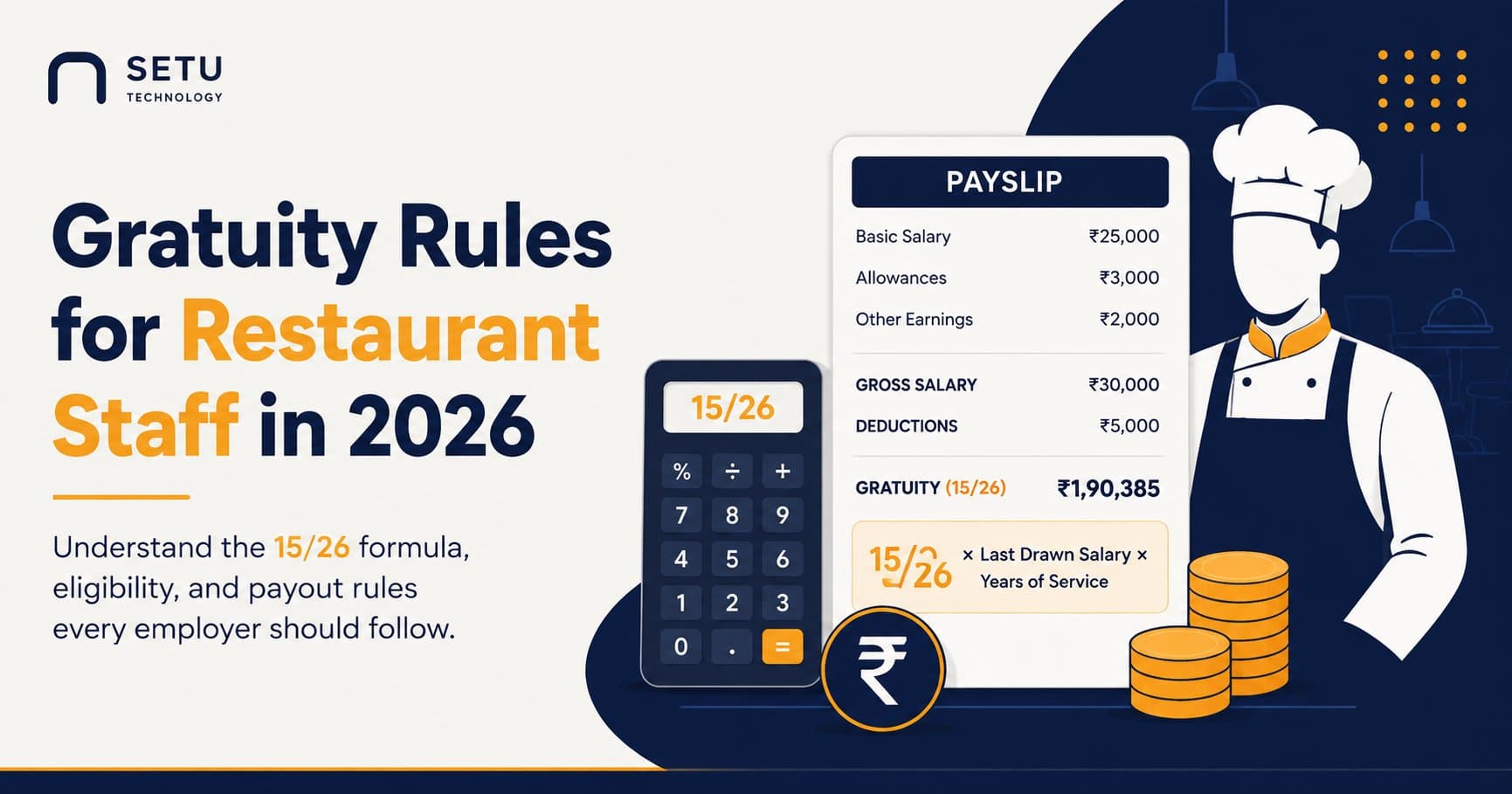
Gratuity Rules for Restaurant Staff in 2026: What Every Owner Must Pay (And How the 15/26 Formula Actually Works)
Restaurants churn staff faster than almost any industry — which is exactly why gratuity math trips owners up. Here's the real formula, the new fixed-term rule, and what a missed payment actually costs.
Read more →