GSTR-9 for FY 2025-26: The Reconciliation to Run Before 31 December
The GST annual return is the one filing small businesses treat as paperwork and accountants treat as a confession. Everything you reported month by month gets laid side by side with everything your books say, and the gaps have nowhere left to hide. For the financial year 2025–26 the form is due on 31 December 2026, which means the reconciliation work belongs in November, not in the last week of December.
This post is the reconciliation list we work through for clients, in the order we work through it. None of it is hard. It is just tedious, and it is far cheaper to do in November than to explain in a notice two years later.
This is general information, not tax advice. Thresholds and fee structures are notified and amended year to year, and some of the figures below are reported inconsistently even in professional commentary. Confirm your own position with your CA before you file.
The date, and what it covers
The annual return for FY 2025–26 covers 1 April 2025 to 31 March 2026 and is due on 31 December 2026. It is not a fresh assessment and it is not a chance to redo the year. It is a consolidation: outward supplies, input tax credit claimed and reversed, tax paid, and amendments — summarised for the year, per GSTIN, and reconciled against your own ledgers.
Who has to file, and who may skip it
Filing is mandatory once your aggregate turnover for the year crosses ₹2 crore. Below that, the government has for several years notified an exemption making the annual return optional for small taxpayers, and the common practice is that the exemption is renewed each year rather than being permanent in the statute. Two consequences follow. If you are near the line, compute your turnover across all GSTINs on the same PAN before you decide you are exempt. And if you are below it, check whether the exemption was actually notified for this year before you skip the filing — do not take last year's position on faith.
Being exempt is not the same as being safe. If your monthly returns and your books disagree, that disagreement exists whether or not you file an annual return summarising it.
Five reconciliations to run before you open the form
1. Books turnover against returns turnover. Pull the revenue figure from your profit and loss statement for the year and set it against the total outward supply you reported across twelve monthly or four quarterly returns. The differences that are legitimate — credit notes, exempt supplies, schedule entries that are not supplies at all — need to be listed and explainable, one line each. The differences you cannot name are the ones to chase now.
2. Input tax credit claimed against credit actually available. Your purchase register is the starting point: every supplier bill you booked, with the tax on it. Against that sits the auto-drafted statement the portal generated each month. Credit you claimed that never appeared, and credit that appeared but you never claimed, both need a decision before the year closes.
3. Credit reversals you promised and never made. Payments to suppliers not made within the prescribed period, exempt-supply proportions, personal use of business assets — reversals are the single most commonly skipped line in a small business's returns, and the annual return is where the arithmetic has to add up.
4. Tax paid against tax payable. The cash and credit ledgers on the portal tell you what went out. Your general ledger tells you what you recorded. If the GST payable accounts do not close to something you can explain, fix the books before the filing rather than after.
5. Amendments and credit notes landing in the right year. An invoice from February amended in May sits in two different periods. List them, and make sure each one is reflected once rather than twice or not at all.
Why this year's reconciliation is not like last year's
FY 2025–26 straddles the rate restructure that took effect on 22 September 2025. For a great many businesses that means the same item or service was billed at one rate in the first half of the year and a different rate in the second. Rate-wise summaries in the annual return are where that shows up, and three errors are worth looking for specifically: invoices dated around the changeover charged at the old rate, credit notes issued after the change against invoices raised before it, and advances received before the change against supplies made after it. If any of those apply to you, this is the year to have your accountant look rather than to self-file quickly. A GST calculator settles the arithmetic on individual invoices quickly — we walked through that workflow in our guide to using it — but the classification question underneath is a judgement call, not a calculation.
What the reconciliation statement adds above ₹5 crore
Cross ₹5 crore in aggregate turnover and a second document joins the annual return: a reconciliation statement that formally ties your audited financial statements to what you declared under GST, with every difference explained line by line. It is filed along with the annual return rather than separately. Since FY 2020–21 the position has been that this statement is self-certified by the taxpayer rather than certified by a chartered accountant or cost accountant, following the removal of the GST audit requirement — though you will still find guides online stating the older position, which is one more reason to confirm with your own CA. Self-certified does not mean lightly prepared: you are signing the reconciliation yourself, which puts the exposure on you rather than on a professional's certificate.
The credit deadline hiding behind the filing date
Here is the trap that catches people who file early to get it over with. Input tax credit for a financial year can generally be claimed up to 30 November following the end of that year — or until you furnish the annual return for that year, whichever comes first. File the annual return in October and you may have closed your own window for claiming credit you had not yet taken. So the sequence matters: finish the credit reconciliation, take what is rightfully yours in a monthly return, and file the annual return after that. Confirm the dates for your own case, because this is exactly the kind of provision that gets amended.
What late filing costs
Late fees on the annual return are graded by turnover. The structure in circulation for recent years runs along these lines, and the older flat figures are still widely quoted, so treat this as the shape of the exposure rather than a quotation:
| Aggregate turnover for the year | Late fee per day | Capped at |
|---|---|---|
| Up to ₹5 crore | ₹50 (₹25 central plus ₹25 state) | 0.04% of turnover |
| ₹5 crore to ₹20 crore | ₹100 (₹50 plus ₹50) | 0.04% of turnover |
| Above ₹20 crore | ₹200 (₹100 plus ₹100) | 0.5% of turnover |
Separately, tax found short and paid late carries interest at 18% a year from the original due date, and that is usually the bigger number. The non-financial consequences bite harder still: a pending annual return can hold up subsequent compliance, and a long-unfiled return is an invitation for a departmental query built from data the department already has.
A four-week plan that fits around running a business
- Week one. Close the books for FY 2025–26 properly if you have not. Bank reconciled, suppliers and customers agreed, stock figure settled. There is no useful GST reconciliation on top of books that are still moving.
- Week two. Turnover reconciliation and the rate-change review. One sheet, one line per difference, each line named.
- Week three. The credit side: register against auto-drafted statement, reversals computed, anything still claimable taken in the current monthly return.
- Week four. Draft the return, read the rate-wise summaries against your own figures, and file. Keep the working sheet — it is the first thing anyone will ask for later.
If your books are not in a state where week one is realistic, the honest move is to start there instead. Our audit-ready books checklist is the shorter version of that job.
Where we come in
Most of our clients do not want to learn this. They want somebody to run the reconciliation, bring back a list of the handful of items that need a business decision, and file. That is what our accounting, bookkeeping and payroll service does — monthly bookkeeping so the annual reconciliation is a review rather than an excavation, and the annual return prepared from books we already keep. If you are reading this in November with a year of unreconciled returns behind you, that is a normal place to start from. Send us your turnover and how many GSTINs you hold and we will tell you what the clean-up looks like before you commit to anything.
Frequently asked questions
31 December 2026 is the date to work back from. Because the reconciliation depends on closed books, November is when the work actually has to happen — a December scramble tends to produce a filed return that nobody can defend later. Due dates have been extended in past years, but planning around an extension that has not been announced is not a plan.
More from Compliance
How to Use a GST Calculator in 2026: Inclusive, Exclusive and the New Slabs
Getting GST wrong on a bill is not a rounding error — it is money out of your margin or a mismatch your buyer's accountant bounces. This tutorial walks through the free GST Calculator: inclusive vs exclusive, the state split, and the 2026 slabs.
Read more →
India's New Wage Code Just Rewired Your Payroll Math: What Every SME Needs to Fix in 2026
India's four labour codes came into force on 21 November 2025 and Central Rules followed on 8 May 2026. The new rule that basic pay can't be less than 50% of CTC quietly changes PF, gratuity and overtime math for every SME. Here's what to check before your next payroll run.
Read more →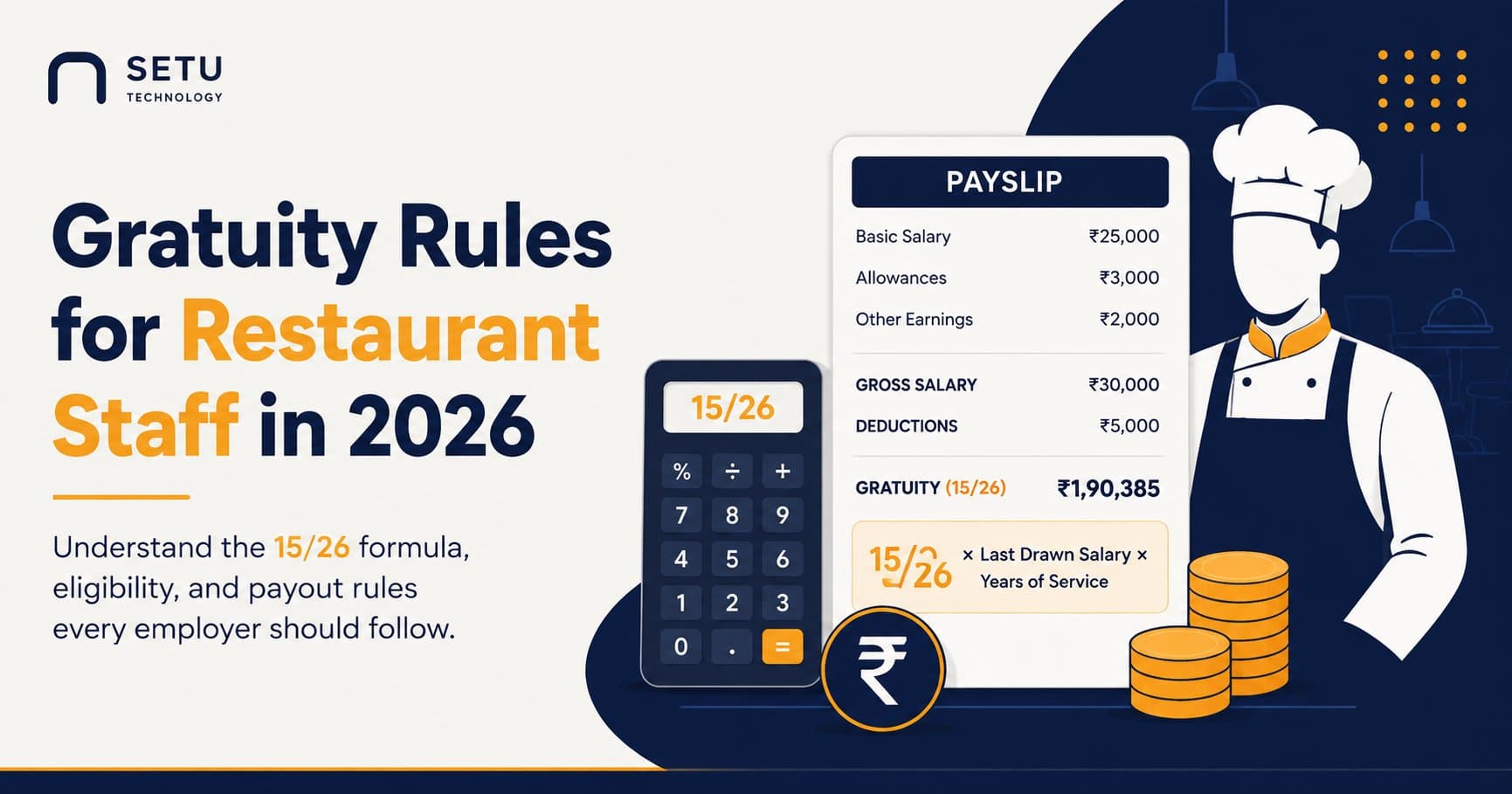
Gratuity Rules for Restaurant Staff in 2026: What Every Owner Must Pay (And How the 15/26 Formula Actually Works)
Restaurants churn staff faster than almost any industry — which is exactly why gratuity math trips owners up. Here's the real formula, the new fixed-term rule, and what a missed payment actually costs.
Read more →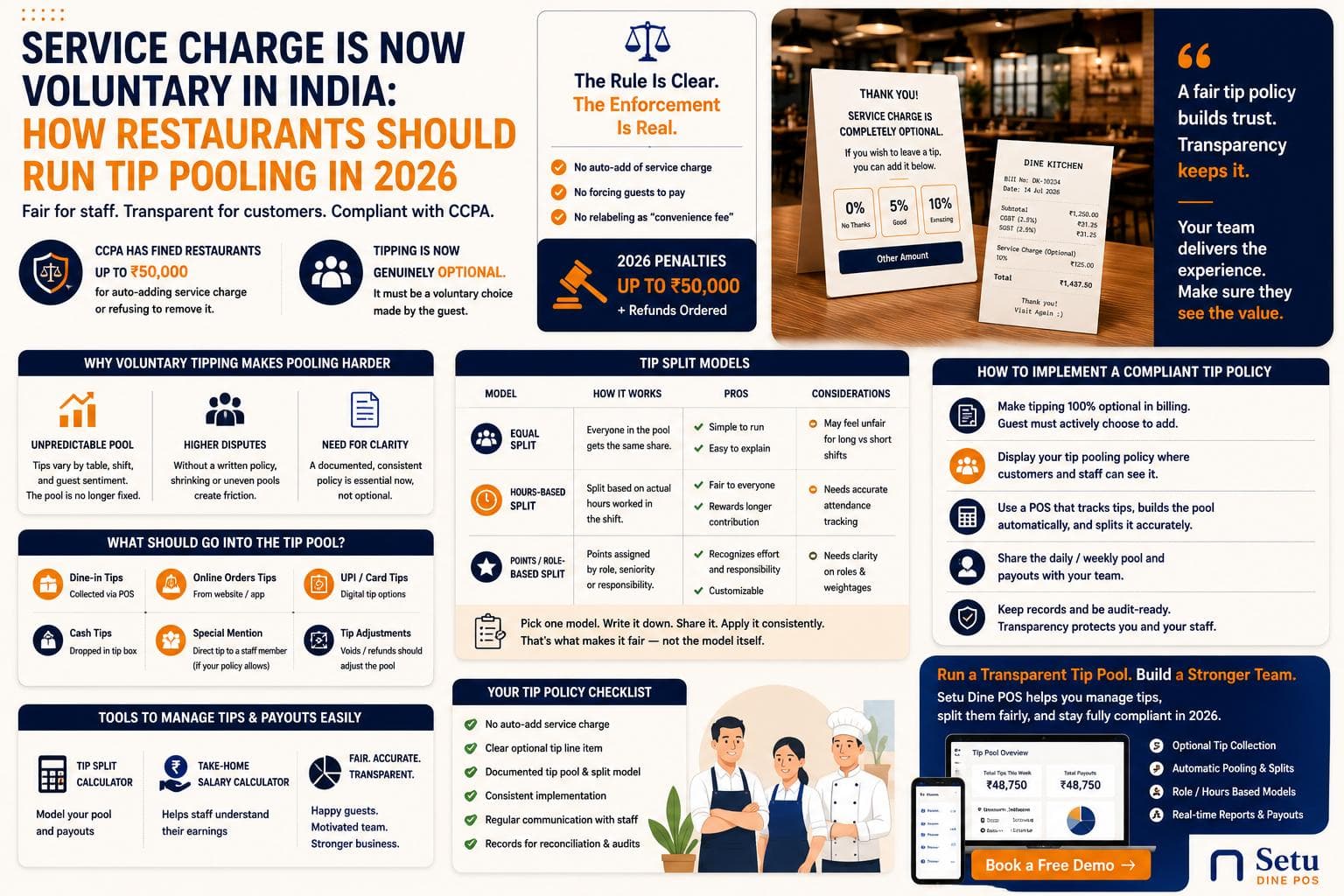
Service Charge Is Now Voluntary in India: How Restaurants Should Run Tip Pooling in 2026
Restaurants can no longer quietly add a 10% service charge and split it however they like. Here's how CCPA's 2026 crackdown changes tip pooling, and how to split a shrinking, unpredictable tip pool fairly across staff.
Read more →