Setu vs UrbanPiper: Do You Need Aggregator Middleware in 2026?
Two restaurants ask the same question in the same week and mean completely different things by it. The first does ninety delivery orders a day across Swiggy and Zomato, keeps three tablets propped against the pass, and has a staff member whose actual job is retyping those orders into the billing screen. The second does fourteen delivery orders a day, mostly repeat, and wants to know whether those fourteen are making money at all.
UrbanPiper is built for the first restaurant. Setu's tools are built for the second. They are not really competitors, and the honest version of this comparison starts by saying so — but they get shortlisted against each other often enough that it is worth laying out exactly where the line falls, and what it costs to be on the wrong side of it.
What UrbanPiper is actually built to do
UrbanPiper is channel middleware. It sits between the delivery platforms and whatever you already use to run the restaurant, and its job is to stop you from touching the platforms directly. Its current line-up, as the company describes it, runs roughly like this: Hub manages every ordering channel from your existing till; Meraki builds your own branded ordering site and app so some share of demand arrives without commission; Orderline AI answers phone orders and reservations; and Prime is UrbanPiper's own point of sale for outlets that want the whole stack from one vendor. The named integrations include Swiggy, Zomato, UberEats and Talabat.
The value is concentrated in three unglamorous things. Orders land in one place instead of on three tablets, so nobody retypes them and nobody mishears a modifier. Menu changes push out once rather than being edited separately on each platform, which matters enormously the day a supplier fails and eleven items need switching off. And when the kitchen is drowning, you can pause a channel from one screen instead of hunting for three partner apps.
None of that is a nice-to-have at volume. A single mistyped order costs a remake, a refund and a rating. Multiply the retyping by ninety orders a day and the tablet farm is not an inconvenience, it is a salary.
What it costs, and what the pricing page does not say
UrbanPiper does not publish a price list for the platform. There is no pricing page on the site, and the third-party software directories that normally scrape one say plainly that no plans are listed and that you should contact the vendor. The route in is a demo, and the number you get is quoted against your outlet count, your channel count and whichever modules you take. That is normal for middleware sold to chains, and it does mean you cannot budget for it from a web page.
Prime, the point of sale, is the one piece with a figure attached in public. As listed on an Indian software marketplace in October 2026, Prime runs about ₹8,475 for a one-year plan and about ₹6,356 a year on a two-year commitment, both quoted exclusive of taxes, with billing, KOT, inventory, recipe and menu management, reporting and delivery integrations in the bundle. Treat that as a signpost rather than a quote: marketplace listings go stale, they rarely include onboarding or hardware, and they almost never include the channel modules. Check urbanpiper.com and ask for the quote in writing before you budget anything.
The two questions worth asking on that call are what the per-outlet charge becomes at outlet number four, and what happens to your menu and order history if you leave. Middleware earns its keep by becoming the thing everything else plugs into, which is also what makes leaving expensive.
What Setu is, and the one thing it does not do
Setu's side of this is a set of free browser tools with no account and no subscription. The browser-based POS bills walk-ins and takeaway from any laptop or tablet. The QR Menu Generator publishes a dine-in menu you can edit without reprinting anything. Two calculators do the delivery arithmetic: the Online Order Commission Calculator works out what you actually keep on an aggregator order, and the Online Menu Price Calculator works backwards from the margin you want to the price you need to list.
Here is the part that decides this comparison for a lot of people, so it goes in plain words: Setu has no aggregator integration. No Swiggy connection, no Zomato connection, no menu push, no order injection. If your problem is that orders arrive on three tablets and somebody has to retype them, Setu does not solve that problem and no amount of free tools will. UrbanPiper, Petpooja, Posist and the rest of that category exist precisely because that problem is real and worth paying to remove.
What Setu does instead is the counter and the maths. Records live in your own browser rather than on a server, which is why the tools are free and also why a weekly CSV export is not optional advice.
Where the two actually overlap
| The job | UrbanPiper | Setu tools |
|---|---|---|
| Pull Swiggy and Zomato orders into one screen | Yes, this is the product | No |
| Push one menu change to every channel | Yes | No |
| Pause a channel when the kitchen is under water | Yes, from one place | No, use the partner apps |
| Bill a walk-in or a takeaway at the counter | Yes, with Prime | Yes, free |
| Dine-in QR menu | Yes, within the stack | Yes, free |
| Work out what you keep on an aggregator order | Reporting, after the fact | Yes, before you list the price |
| Own-branded ordering site | Yes, Meraki | No |
| Price to see it | Quote only; Prime listed separately | Free, no signup |
Read that table as two different purchases rather than two columns of the same purchase. One removes operational friction at volume. The other removes cost and tells you whether the volume is worth having.
The number that decides this for most kitchens
Before you compare software, work out what an aggregator order is actually worth to you. Commission on Indian delivery platforms is commonly reported in the region of eighteen to twenty-five per cent of order value, but that figure on its own is close to useless, because the deductions that follow it are where the margin goes: payment handling, packaging, your share of any discount the platform ran, advertising spend, and taxes on the commission itself. Your own contract and your own monthly statement are the only authority here — the published ranges are a starting point for a conversation, not a number to plan with.
Put a real order through the commission calculator, deductions and all, and you get the figure that matters: rupees retained per order. Then put that next to the dine-in equivalent. Restaurants that do this often discover one of two things. Either delivery is thin but high volume, in which case operational friction is the whole game and middleware pays for itself in avoided errors and avoided retyping. Or delivery is genuinely unprofitable at current list prices, in which case the fix is repricing the online menu and trimming the items that never made sense, not buying software to process more of them faster. Our earlier piece on pricing a menu for Zomato and Swiggy walks through that repricing in detail.
Who should pay for middleware
Four signals, and one is usually enough.
- Two or more channels live and somebody retyping orders. The moment a human sits between the platform and the kitchen, you are paying a salary to do what an integration does.
- Menus that change weekly. Editing three platforms by hand is where wrong prices and sold-out items come from, and both are rated publicly.
- More than one outlet. Per-outlet consistency by hand does not survive the third location.
- A tablet-error rate you can name. If you know roughly how many remakes a week come from misread orders, you can price the fix.
Who should not, yet
If you run a single outlet, your delivery volume is in the low teens per day, and one person handles orders on the partner apps without strain, middleware is solving a problem you do not have. Buy it later, when the volume arrives. Until then the partner apps handle the orders at no extra cost, the free POS handles the counter bill, and the two calculators tell you whether the delivery channel is earning its place on the menu board.
The middle path is legitimate and underrated: run the aggregators natively, run the counter and the arithmetic on free tools, and keep a written note of what the tablets are costing you in remakes and retyped orders. When that note crosses the quoted price of middleware, the decision makes itself and you will have the evidence to negotiate with.
Where each one wins
UrbanPiper wins when delivery is a serious share of revenue across several channels, when menu consistency across platforms is a daily chore, when you are multi-outlet, or when you want one vendor accountable for the whole order path from platform to kitchen. At that point you are not buying features, you are buying the removal of a failure mode.
Setu's tools win when delivery is a side channel rather than the business, when you would rather not hold another subscription, or when the actual question is whether the delivery orders are profitable before you invest in handling more of them. They are also a reasonable second opinion to keep running alongside a paid stack, since there is no cost to holding an independent copy of the arithmetic.
And if the thing nagging at you is not the order flow but the books behind it — aggregator payouts that never match the statement, commission sitting uncategorised, purchases that do not tally — that is a bookkeeping problem and new software will not touch it. Our accounting and bookkeeping service is built for exactly that.
Frequently asked questions
It cannot, and that is the clearest dividing line in this comparison. Setu's tools have no connection to any delivery platform. If consolidating channel orders is your problem, you need middleware such as UrbanPiper or a POS that ships integrations, and free browser tools will not substitute for it.
More from Aggregator Ops
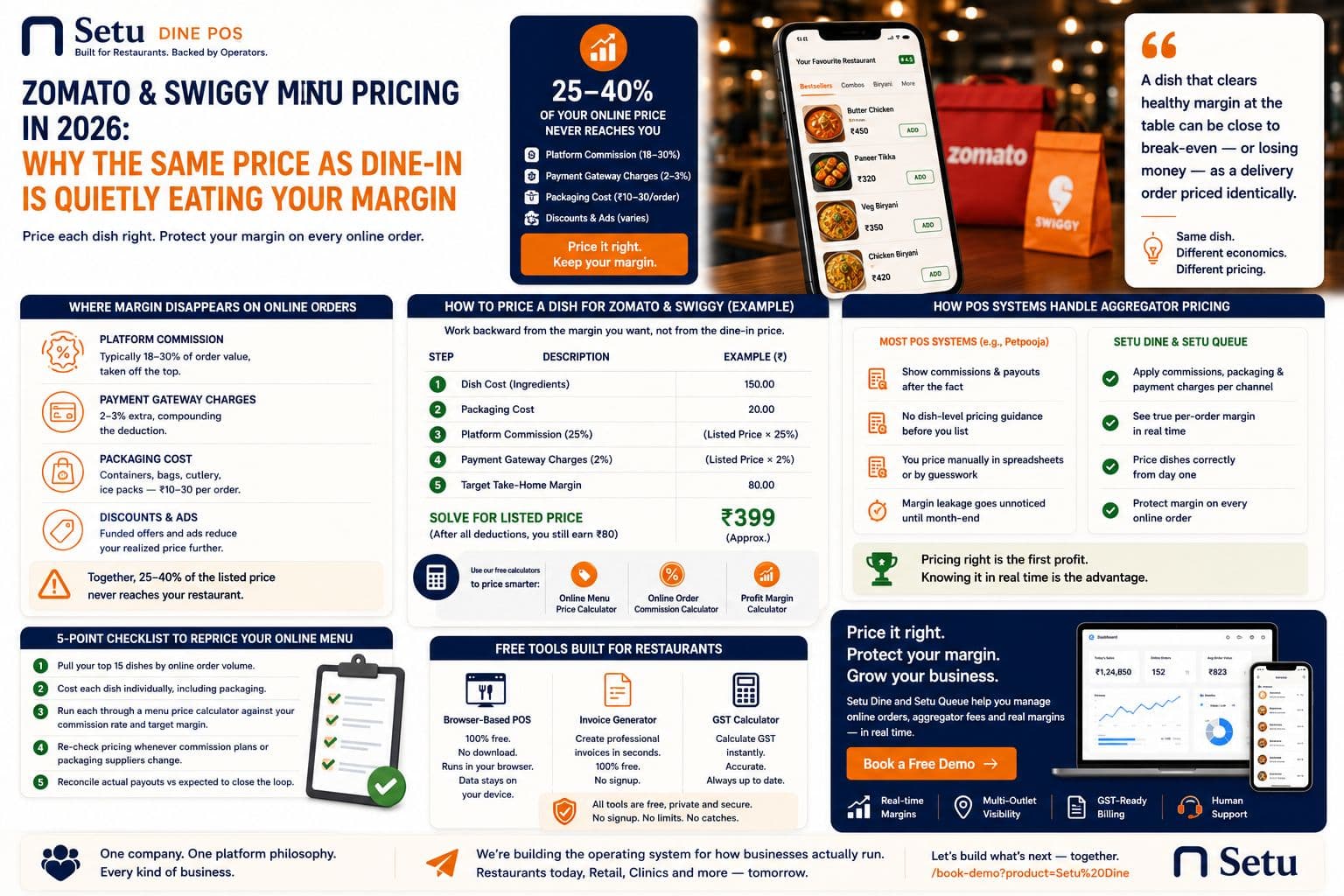
Zomato & Swiggy Menu Pricing in 2026: Why the Same Price as Dine-In Is Quietly Eating Your Margin
Most restaurants copy their dine-in price straight onto Zomato and Swiggy. Here's why that quietly loses margin on every online order, and how to price each dish correctly in 2026.
Read more →