Break-Even Analysis for a New Restaurant Outlet in 2026: The Real Numbers Before You Sign a Lease
Most restaurant owners can tell you exactly what they want their new outlet to look like — the seating count, the open kitchen, the corner unit with the good frontage. Almost none can tell you the number of covers a day that outlet needs to serve before it stops losing money. The lease gets signed on gut feel and a rough sense of "the last outlet did fine." Break-even analysis is the boring spreadsheet exercise that sits between those two decisions, and skipping it is how a promising second or third outlet quietly turns into a cash drain that takes eighteen months to notice.
None of this is complicated math. It's just math nobody runs before the deposit cheque is written.
What break-even actually means for a restaurant outlet
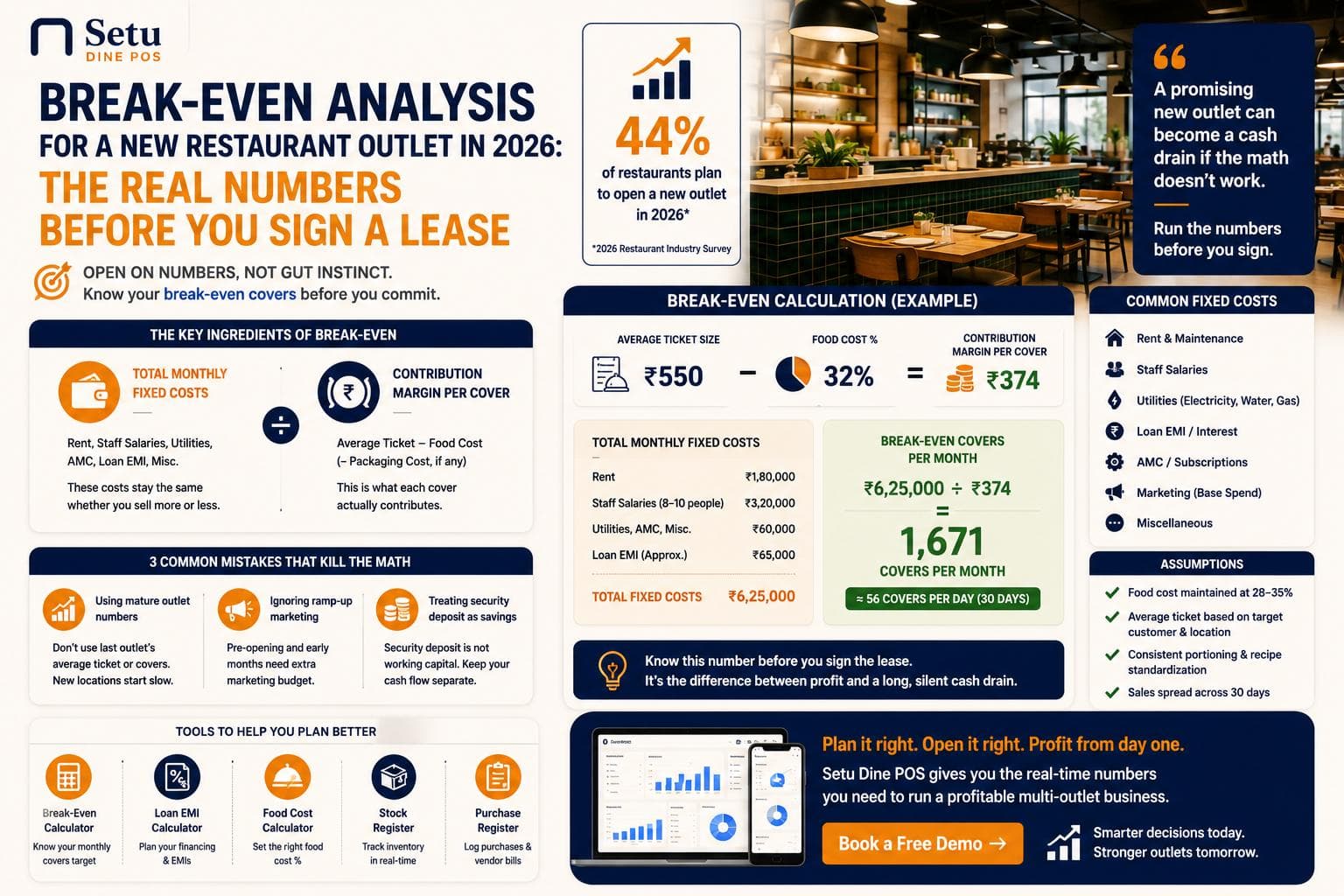
Break-even is the point where your contribution margin from covers served exactly covers your fixed costs for the month. Two numbers drive it:
- Fixed costs — rent, staff salaries, utilities, AMC contracts, loan EMI if you've financed the build-out. These don't move whether you serve 20 covers a day or 120.
- Contribution margin per cover — your average ticket size minus your food cost (and packaging cost, if relevant) on that ticket.
A worked example
Take a mid-size casual dining outlet with a monthly rent of ₹1,80,000, staff costs of ₹3,20,000 for a team of eight to ten, and another ₹60,000 in utilities, AMC and miscellaneous fixed spend. Add a loan EMI of roughly ₹65,000 (more on that below) and total fixed cost lands around ₹6,25,000 a month.
If the average ticket size is ₹550 and food cost runs at a healthy 32%, that's ₹176 in food cost per cover, leaving a contribution margin of ₹374 per cover. Divide ₹6,25,000 by ₹374 and you get roughly 1,671 covers a month to break even — about 56 covers a day across a 30-day month. That's the number that should sit next to the lease agreement before it's signed, not the one that gets calculated three months after opening when the P&L doesn't add up. The break-even calculator runs this same math with your own numbers in under a minute.
The financing piece most owners underplan
Capex for a new outlet typically runs well beyond the rent deposit. Interiors, kitchen equipment, POS and tech setup, and a contingency buffer commonly add up to ₹35–50 lakh for a mid-size dine-in outlet, depending on city and format. Very few owners fund all of it from savings — a business loan covering part of the capex is the norm, and the EMI on that loan becomes a fixed cost that belongs in the break-even calculation from day one, not something added later once the lease is signed and the number quietly gets worse.
Business loan interest rates for restaurant capex commonly fall in an 11–14% range depending on the lender, tenure and the owner's existing credit profile, though the exact rate you're quoted will vary. Before signing anything, it's worth running the actual figures — loan amount, rate, tenure — through the business loan EMI calculator to see what the monthly outflow really looks like, rather than estimating it and finding out the real number once the first EMI is due.
Three mistakes that quietly wreck the break-even number
- Using a mature outlet's average ticket size. A new outlet ramps up slowly. Early footfall skews toward smaller tickets and cautious first-time visits, so plugging in the average ticket from an established location overstates contribution margin in month one.
- Ignoring the ramp-up marketing spend. Getting to 56 covers a day on opening week almost never happens. The marketing spend to build initial footfall is a real, if temporary, cost that needs its own line — not something absorbed silently into a worse month-one loss than planned.
- Treating the security deposit as recoverable cash. A large deposit is real capital tied up for the life of the lease. Owners who count it as available working capital during a slow ramp-up period often find themselves short exactly when they need cash most.
A checklist before you sign the lease
- Run the break-even covers-per-day number against realistic footfall for that specific location, not the city average.
- Check whether the lease has a minimum guaranteed rent or a revenue-share clause, and model break-even under both.
- Build a phased staffing plan — a leaner team for the first six to eight weeks costs less and matches lower early volume.
- Budget at least three months of cash runway past your projected break-even month, not up to it.
- Make sure your GST registration, tax engine and billing setup are ready for day one — a delayed or manual billing setup in the first weeks creates compliance risk exactly when you're trying to build first impressions with new customers.
That last point connects to a broader shift covered in why Indian restaurants are switching POS systems in 2026 — a lot of switches happen precisely when an owner is opening outlet two or three and realizes their existing setup wasn't built to be replicated quickly.
Once outlet two opens, break-even isn't a single number anymore
The moment a second location opens, break-even stops being one spreadsheet and becomes one per outlet, since rent, staff cost and local footfall rarely match across locations. An owner who was comfortable eyeballing performance across a single outlet usually finds that instinct stops working by outlet two — which is exactly the blind spot covered in how to know which restaurant outlet is actually making money. The same discipline that goes into a pre-launch break-even model needs to keep running monthly once the outlet is live, outlet by outlet.
This is also where POS choice starts to matter for reasons beyond billing speed. Petpooja is a reasonable fit for owners opening a single new outlet who want fast setup without heavy customization. Restroworks (POSist) is built for larger chains adding outlets five, six and beyond, with centralized reporting that a two- or three-outlet owner often doesn't need yet and may find expensive at that stage. Gofrugal leans retail-first, with restaurant-specific multi-outlet reporting as a secondary layer rather than the core design. None of this makes any of them the wrong choice — it just means the setup speed and per-outlet visibility you need when opening outlet two is worth checking against your actual growth plan, not just your outlet-one requirements.
Setu Dine and multi-outlet expansion
Setu Dine's dashboard was built around exactly this problem — sales, cost and performance visible per outlet from day one, on the same system whether you're running one location or twenty, so a new outlet's break-even progress is something you can actually watch rather than estimate at month-end. The tax engine and billing setup are ready before the first cover is served, which removes one more variable from an already uncertain opening month.
Before the next lease gets signed, it's worth running your own numbers through the break-even and loan EMI calculators rather than carrying last outlet's numbers forward. A new location rarely behaves like the one before it, and the gap between "should work" and "actually breaks even by month four" is almost always sitting in a spreadsheet nobody opened.
Frequently asked questions
Divide total monthly fixed costs (rent, staff, utilities, loan EMI) by your contribution margin per cover (average ticket minus food cost). The result is the number of covers a month you need to break even.
More from Operations
Setu vs Marg ERP: Free Tools or a Licensed Retail ERP in 2026?
Marg ERP editions are publicly listed from about ₹5,550 to ₹26,000 exclusive of tax in October 2026, and the listings disagree on whether that is yearly or one-time. Setu's retail tools are free browser pages. Here is exactly where the line falls.
Read more →
Setu vs Swipe: Free Invoicing Tools or a Billing Account in 2026?
Swipe's paid plans start near ₹2,542 a year excluding GST as publicly listed in October 2026, and it keeps a free app tier. Setu's invoicing tools are free browser tools with no account and no sync. Here is exactly where the line between them falls.
Read more →
Setu vs myBillBook: Counter Billing and Stock for a Small Shop in 2026
myBillBook puts billing, stock and khata in one paid account, listed from ₹3,490 a year with a trial but no permanently free tier. Setu's billing, stock register and ledger tools are free with no cap. Here is how to tell which trade fits your shop.
Read more →
Setu vs Refrens: Quoting and Invoicing for a Service Business in 2026
Refrens is a real quote-to-payment platform for Indian service businesses, free to 15 documents and priced from ₹7,080 a year after that. Setu's quotation and invoice tools are free with no cap. Here is how to tell which trade fits your business.
Read more →